Enterprise Requirements Series—Article 13
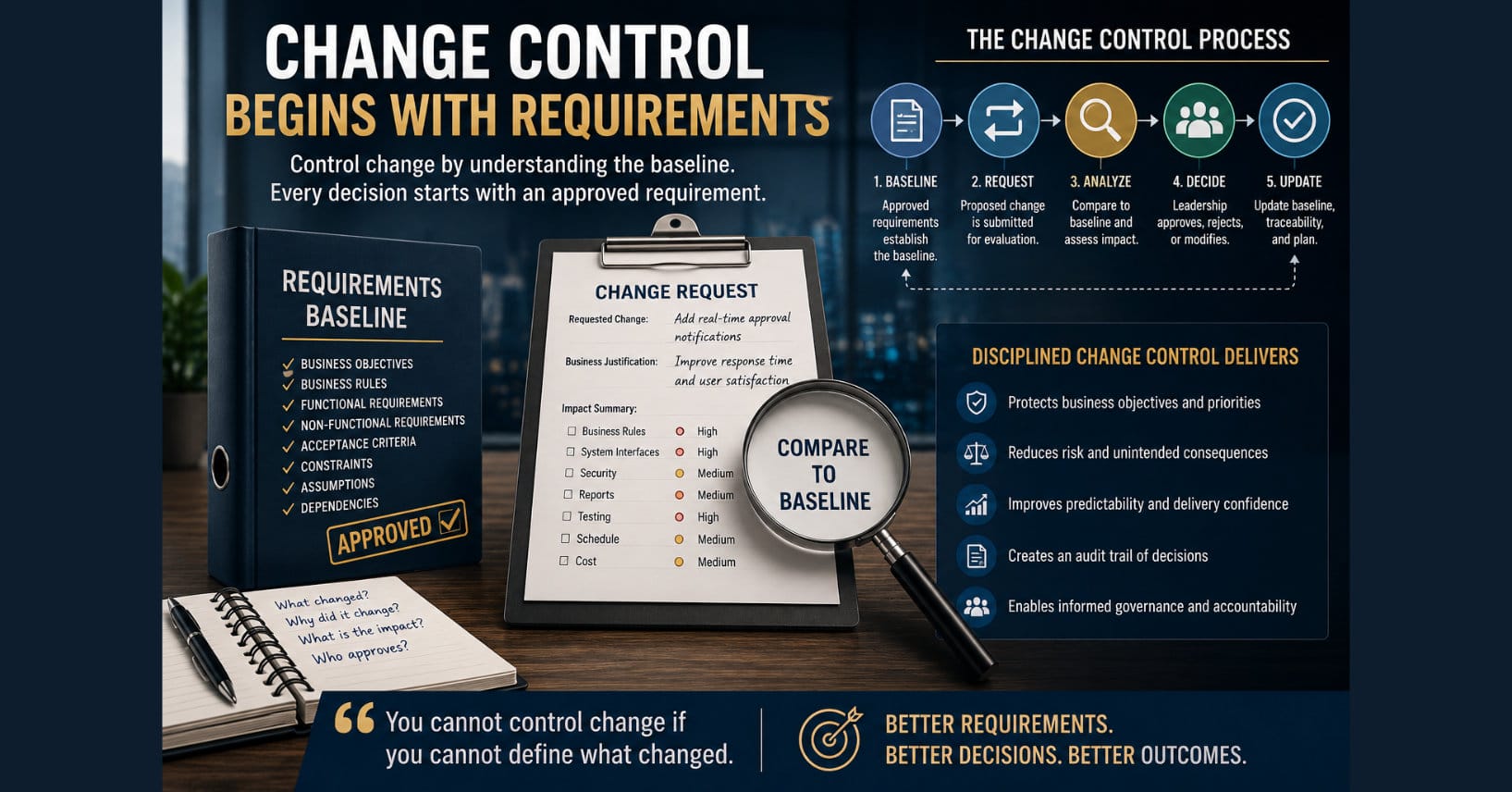
This article explains why effective change control begins when requirements are approved, not when a change request is submitted. It shows how requirements baselines, traceability, version history, and impact analysis help organizations compare proposed changes against previously approved decisions. The article positions change control as decision control for software, emphasizing that disciplined requirements management makes change predictable, governable, and defensible.
Building Better Software by Engineering Better Decisions
Ask most project teams when change control begins, and they’ll point to a change request form.
A steering committee.
A project management office.
A governance board.
A ticketing system.
They’re all wrong.
Change control does not begin when someone submits a change request.
It begins the moment the original requirement is approved.
If you don’t know what was originally agreed upon, you cannot manage change.
You can only react to it.
Every Change Requires a Baseline
Imagine trying to measure how far you’ve traveled without knowing where you started.
Project teams face the same challenge when requirements lack a defined baseline.
A requirements baseline establishes the organization’s approved understanding of:
- Business objectives
- Business rules
- Functional requirements
- Non-functional requirements
- Acceptance criteria
- Constraints
- Assumptions
- Dependencies
Without that baseline, every conversation about change becomes subjective.
With it, every proposed modification can be evaluated against an agreed starting point.
Change Is a Comparison
Every change request asks the same fundamental question:
What is different today than what we previously approved?
That question cannot be answered unless the original requirement is:
- Documented.
- Approved.
- Traceable.
- Version controlled.
Good change control is not about processing paperwork.
It is about comparing today’s proposal against yesterday’s decision.
Requirements Define the Impact
When a new requirement is proposed, leadership should immediately understand its implications.
Will it affect:
- Business rules?
- System interfaces?
- Security controls?
- Data structures?
- Reports?
- Compliance obligations?
- User training?
- Testing?
- Project cost?
- Delivery schedule?
Requirements provide the context necessary to answer those questions.
Without that context, impact analysis becomes educated guesswork.
Every Change Has a Ripple Effect
Software systems are connected.
Changing one requirement rarely changes only one thing.
A modified approval workflow may require:
- New business rules.
- Updated security roles.
- Additional audit logging.
- Revised reports.
- New integration logic.
- Additional testing.
- Updated documentation.
- New user training.
Organizations that evaluate only the visible feature often underestimate the true cost of change.
Requirements engineering makes those downstream effects visible before implementation begins.
Good Change Control Protects Innovation
Some organizations fear disciplined change control because they believe it slows innovation.
The opposite is usually true.
Poor change control creates uncertainty.
Uncertainty slows decision-making.
Disciplined requirements make change predictable.
Predictable change enables faster decisions because leadership understands both the benefits and the consequences.
Control is not the enemy of innovation.
Uncertainty is.
Governance Begins with Understanding
Governance boards should never evaluate change requests in isolation.
Every proposed change should answer questions such as:
- Which requirement changes?
- Why is the change necessary?
- Which business objective benefits?
- Which risks are reduced?
- Which risks are introduced?
- What work must be reprioritized?
- Who approves the decision?
Requirements provide the evidence necessary to answer each question objectively.
Without requirements, governance becomes opinion.
With requirements, governance becomes informed leadership.
Version History Matters
One of the greatest advantages of disciplined requirements engineering is preserving decision history.
Organizations should know:
- What the original requirement said.
- When it changed.
- Why it changed.
- Who approved the change.
- Which project release implemented it.
That history becomes invaluable during audits, future enhancements, post-project reviews, and organizational learning.
Without version history, every future discussion begins by reconstructing the past.
Change Control Is Really Decision Control
Organizations often think they are managing software changes.
They are actually managing business decisions.
Technology simply reflects those decisions.
Requirements engineering captures them.
Architecture organizes them.
Development implements them.
Testing verifies them.
Governance oversees them.
The requirement is where the decision first becomes visible.
That is why change control begins there.
Looking Ahead
Every organization experiences change.
The difference between successful organizations and struggling ones is rarely the amount of change they encounter.
It is how well they manage it.
Requirements provide the baseline.
Traceability provides the evidence.
Governance provides the discipline.
Together, they transform change from disruption into deliberate decision-making.
That process begins long before a change request is ever submitted.
It begins with a well-engineered requirement.
Requirements Reality
You cannot control change if you cannot define what changed.
Coming Next
Article 14—Requirements Debt Is More Dangerous Than Technical Debt
Technical debt receives most of the attention, but poorly defined, incomplete, and unmanaged requirements often create even greater long-term risk. Next, we’ll examine why requirements debt may be the most expensive debt an organization never measures.