Enterprise Architecture Series—Article 3
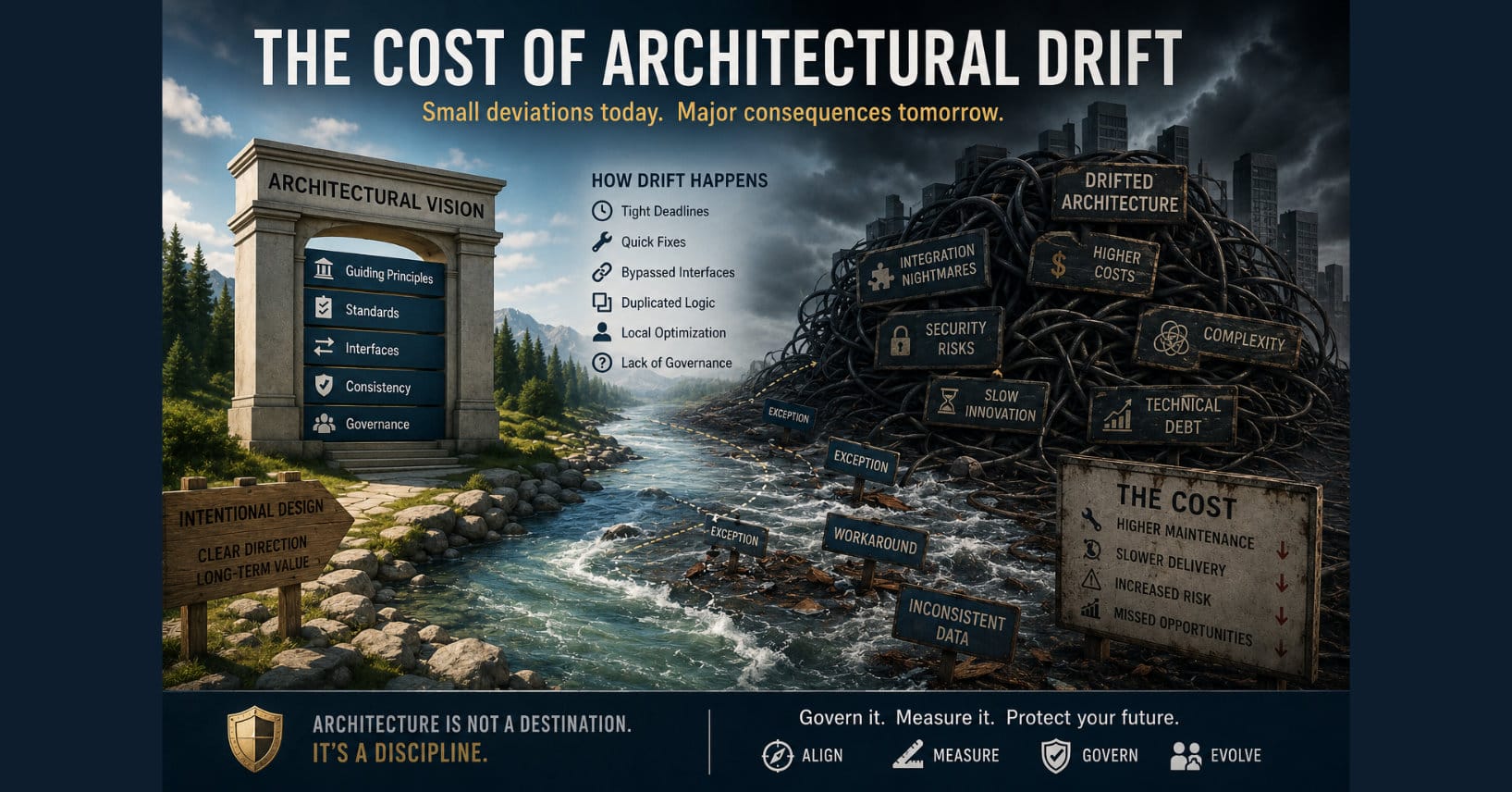
Most enterprise architectures do not fail because of a single bad decision—they fail through gradual architectural drift. This article explores how seemingly harmless shortcuts, undocumented exceptions, and inconsistent implementation slowly undermine architectural integrity. Learn why governing architectural evolution is essential to maintaining scalability, security, and long-term business value.
Executive Brief
Very few enterprise systems fail because someone intentionally designed a poor architecture.
Most fail because the architecture slowly changes without anyone noticing.
A feature is added to satisfy a customer.
A deadline justifies bypassing an interface.
A new application integrates directly with the database because “it’s only temporary.”
Another service duplicates business logic because reusing the existing implementation would take too long.
Individually, each decision appears reasonable.
Collectively, they transform a well-designed architecture into a collection of exceptions.
This gradual departure from the original architectural vision is known as architectural drift, and it is one of the most expensive problems an organization can experience.
Unlike catastrophic failures, architectural drift happens quietly. By the time it becomes visible, the organization is already paying for years of accumulated compromises.
The Business Problem
Every enterprise architecture begins with a set of guiding principles.
Data should flow through approved interfaces.
Business rules should exist in one location.
Applications should remain loosely coupled.
Security should be consistently enforced.
Documentation should reflect implementation.
Those principles provide consistency as systems evolve.
The challenge is that businesses never stop evolving.
Deadlines become aggressive.
Projects compete for limited resources.
New vendors introduce proprietary integrations.
Emergency fixes bypass established patterns.
Every exception is justified because it solves an immediate problem.
Over time, however, exceptions become the new architecture.
The documented design no longer reflects reality.
Engineers begin making decisions based on assumptions instead of standards.
Eventually, nobody can confidently explain how the system actually works.
The organization has not experienced a single architectural failure.
It has experienced thousands of small deviations.
The Architectural Principle
Architecture is not a one-time deliverable.
It is an operational discipline.
Creating an architecture is relatively easy.
Maintaining architectural integrity throughout years of continuous change is considerably more difficult.
Successful organizations recognize that architecture requires governance.
Every significant technical decision should be evaluated against established architectural principles.
Not because innovation should be discouraged.
Because inconsistency compounds.
Architectural drift rarely occurs through poor engineering.
It occurs because nobody is responsible for preserving the architectural vision after implementation begins.
Enterprise Example
A financial services company designs a modern service-oriented platform.
Customer records are accessed through a dedicated customer service.
Payments are isolated.
Reporting consumes published APIs.
Security policies are centrally enforced.
The architecture performs well for several years.
Then a reporting deadline approaches.
Rather than extending an existing service, a development team connects directly to the customer database.
Months later, another project copies the same approach.
A third application adds its own customer validation logic because modifying the original service requires coordination with another team.
Soon multiple applications define “customer” differently.
Security updates must be implemented in several locations.
Database changes unexpectedly break downstream systems.
Reporting results become inconsistent.
No individual decision caused the problem.
The architecture simply drifted away from its original design.
Common Mistakes
Organizations often assume architecture is self-enforcing.
It is not.
Another common mistake is allowing every project to optimize for local success without considering enterprise consequences.
Project teams naturally focus on delivering their own objectives.
Architecture exists to ensure those objectives continue supporting the organization as a whole.
Some organizations document architectural standards but never measure compliance.
Others enforce standards so rigidly that teams begin bypassing governance altogether.
Neither approach succeeds.
Architecture must be both governed and practical.
Perhaps the greatest mistake is believing that temporary exceptions remain temporary.
Experience suggests otherwise.
The most permanent components of many enterprise systems began life as temporary workarounds.
Architecture Insight
Architectural drift is rarely the result of one poor decision.
It is the cumulative effect of hundreds of reasonable decisions made without a shared architectural discipline.
Organizations rarely notice the drift.
They notice the consequences.
Questions Architects Should Ask
Before approving an exception, consider:
- Does this align with our architectural principles?
- Is there a less disruptive alternative?
- If this becomes permanent, what future problems will it create?
- Will another team interpret this exception as a new standard?
- Have we documented why this exception exists?
- Who is responsible for removing it later?
Architect’s Checklist
Healthy architectures demonstrate these characteristics:
- Architectural principles are actively governed.
- Exceptions are documented and periodically reviewed.
- Interfaces remain the preferred integration mechanism.
- Business logic has a single authoritative implementation.
- Architecture documentation reflects operational reality.
- Temporary solutions have defined retirement plans.
- Teams understand why architectural standards exist.
Conclusion
Architectural drift does not occur overnight.
It develops through small compromises that individually appear harmless but collectively redefine the system.
The greatest danger is not that architecture changes.
Architecture should evolve as organizations evolve.
The danger is allowing change to occur without intention.
Successful enterprise architecture balances flexibility with discipline.
It welcomes innovation while preserving consistency.
Organizations that actively govern architectural evolution continue building systems that remain understandable, maintainable, and adaptable.
Those that ignore architectural drift eventually discover that the cost of restoring architectural integrity is almost always greater than the cost of preserving it in the first place.