Enterprise Architecture Series—Article 4
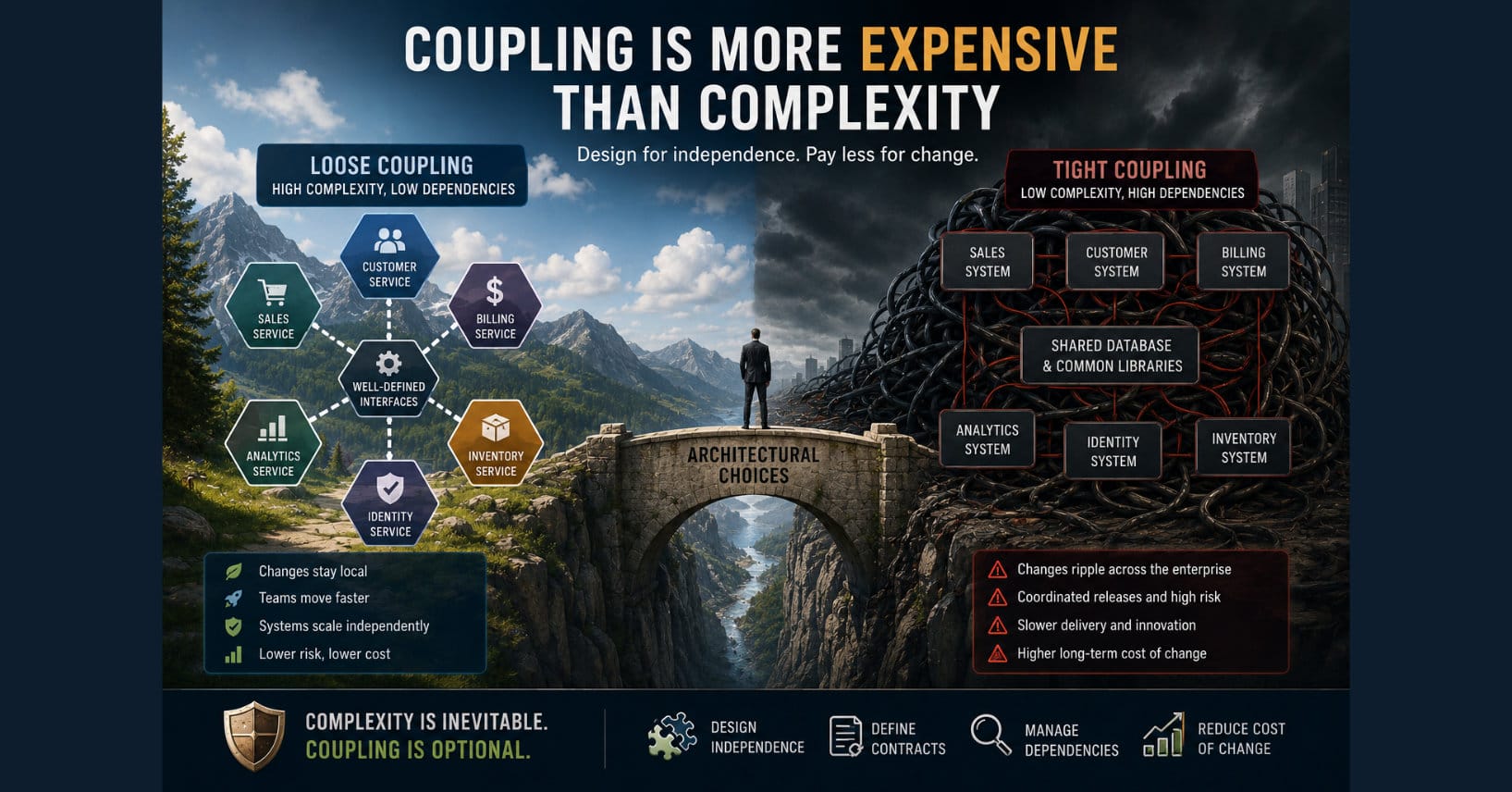
Complexity is an unavoidable characteristic of enterprise systems, but excessive coupling is a design choice. This article explains why tightly coupled applications increase maintenance costs, slow innovation, and reduce organizational agility. Discover how architects can localize complexity while minimizing dependencies to build resilient, adaptable enterprise platforms.
Executive Brief
Architects often spend significant time trying to reduce complexity. Simpler systems are easier to understand, easier to maintain, and generally less expensive to operate.
But complexity is not always the greatest threat to an enterprise system.
Coupling is.
A complex system composed of independent components can evolve, scale, and adapt over time.
A simple system whose components are tightly coupled often cannot.
Organizations frequently invest enormous effort simplifying code while overlooking the relationships between systems, services, databases, and teams. Those relationships—not the individual components—ultimately determine how expensive a system becomes to change.
The true cost of enterprise architecture is measured less by complexity than by dependency.
The Business Problem
No enterprise remains static.
Applications grow.
Teams expand.
Products diversify.
Business capabilities evolve.
Every significant change introduces new relationships between systems.
Some of those relationships are intentional.
Others emerge accidentally.
An application begins reading another application’s database directly.
A reporting solution depends upon undocumented data structures.
Multiple systems share the same authentication tables.
Several services duplicate the same business rules.
Individual shortcuts appear harmless because they reduce immediate development effort.
Collectively, however, they create invisible dependencies.
Eventually, changing one application requires coordinating changes across five others.
A simple enhancement becomes a multi-team project.
Testing expands dramatically.
Deployment windows become increasingly difficult to schedule.
Innovation slows because every modification carries enterprise-wide consequences.
The software itself may remain relatively simple.
The relationships between its components become extraordinarily expensive.
The Architectural Principle
Complexity describes how difficult a component is to understand.
Coupling describes how difficult it is to change.
Those are very different problems.
A highly sophisticated rules engine may contain significant internal complexity.
If it exposes stable interfaces and can evolve independently, its complexity remains largely isolated.
Conversely, a simple utility shared directly across dozens of systems creates extensive coupling.
Even minor changes now require enterprise-wide coordination.
Enterprise architecture seeks to localize complexity while minimizing coupling.
This often means accepting slightly more sophisticated internal implementations in exchange for dramatically greater organizational flexibility.
Independent systems can evolve.
Dependent systems negotiate every change.
Enterprise Example
Consider two organizations building customer management capabilities.
The first stores customer information in a centralized database.
Rather than consuming services, dozens of applications query the database directly.
Each application develops its own understanding of customer status, validation rules, and relationships.
Initially, development proceeds quickly because everyone has direct access to the data.
Years later, the organization needs to introduce new privacy requirements.
Changing the customer schema requires modifying dozens of applications.
Several integrations fail unexpectedly.
Reporting systems generate inconsistent results.
Deployment is delayed for months.
The second organization exposes customer information exclusively through well-defined services.
Individual applications never depend upon database structures.
Business rules exist within the customer capability.
When privacy regulations change, only one implementation requires modification.
Other systems continue operating through stable interfaces.
The second architecture may contain more internal complexity.
It has substantially less coupling.
Common Mistakes
Many organizations confuse code reuse with architectural quality.
Sharing implementation details often increases coupling rather than reducing duplication.
Another common mistake is allowing applications to integrate through shared databases instead of published interfaces.
This creates dependencies that are difficult to discover and even more difficult to remove.
Some organizations optimize exclusively for development speed, encouraging shortcuts that tightly connect otherwise independent systems.
Others attempt to eliminate all duplication regardless of organizational impact.
Sometimes a small amount of intentional duplication reduces far more expensive coupling.
Architecture should optimize for organizational agility, not theoretical elegance.
Architecture Insight
The most expensive dependency in enterprise architecture is the one nobody realizes exists until a production deployment fails.
Invisible coupling creates visible consequences.
Questions Architects Should Ask
Before introducing a new dependency, consider:
- Does this component truly need direct knowledge of another?
- Can the relationship be expressed through a stable interface?
- If one component changes, what else must change?
- Are business rules duplicated across multiple systems?
- Is this dependency intentional and documented?
- Would removing this dependency become increasingly difficult over time?
Architect’s Checklist
Healthy enterprise architectures demonstrate these characteristics:
- Components communicate through stable contracts.
- Business capabilities remain independently deployable whenever practical.
- Shared databases are minimized.
- Business rules have clear ownership.
- Dependencies are visible and documented.
- Teams can deliver changes without enterprise-wide coordination.
- Complexity remains localized instead of spreading throughout the organization.
Conclusion
Complexity is often unavoidable.
Enterprise systems solve complex business problems.
Coupling, however, is largely a design choice.
Architects cannot eliminate every dependency, nor should they attempt to.
The objective is to create relationships that support collaboration without preventing independent evolution.
Organizations that minimize unnecessary coupling discover that new technologies, regulatory changes, business initiatives, and organizational growth become significantly easier to accommodate.
Those that ignore coupling eventually find themselves managing not a collection of systems, but a collection of constraints.
The most resilient enterprise architectures are not necessarily the simplest.
They are the ones whose complexity is carefully contained while their dependencies remain intentionally controlled.