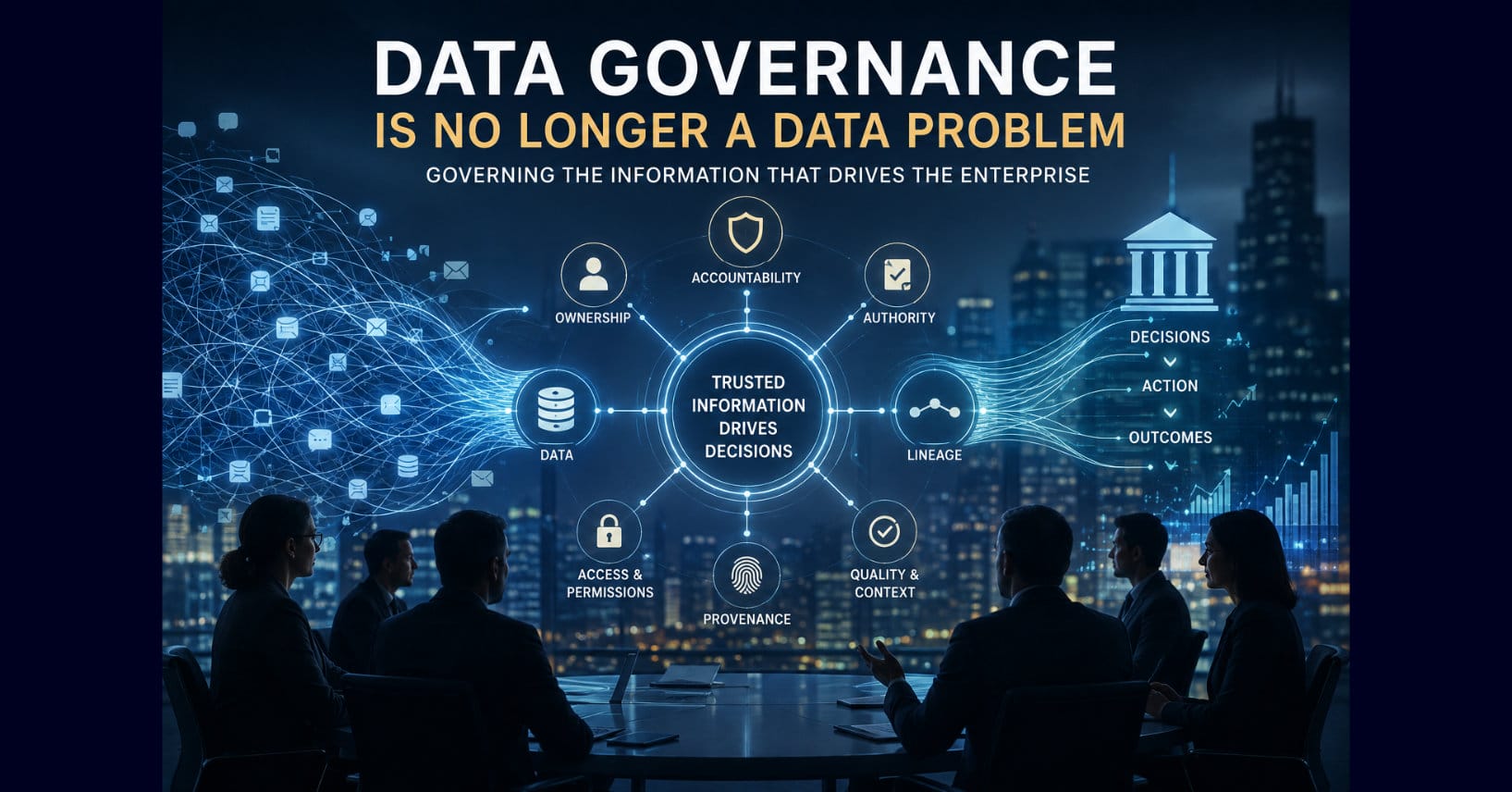
Data Governance Series | Article 1 of 20
Governing the Information That Drives the Enterprise
Summary
Data governance is no longer simply a technical or data-management discipline. Enterprise data now drives financial reporting, operational decisions, regulatory compliance, automation, analytics, and artificial intelligence.
This article explains why modern data governance must focus on accountability, decision rights, authoritative information, lineage, provenance, access, context, and evidence. It examines how AI has exposed weaknesses that organizations could previously tolerate and argues for a decision-centric approach in which governance requirements are proportional to business consequence.
The central premise is straightforward: when data determines what executives see, what AI systems communicate, and what decisions organizations make, governing data becomes part of governing the enterprise.
For years, organizations treated data governance as something that belonged somewhere between the database administrators, compliance team, and data office.
Define the fields. Establish naming conventions. Assign data stewards. Document retention requirements. Improve data quality. Build a catalog.
Those activities still matter.
But they no longer describe the problem enterprises are actually trying to solve.
Data now influences nearly every consequential business process. It drives financial reporting, customer decisions, operational planning, cybersecurity, regulatory compliance, automated workflows, analytics, and increasingly artificial intelligence.
That changes the governance question.
The question is no longer simply:
How do we manage our data?
It is:
How do we govern an enterprise whose decisions increasingly depend on data?
That is a very different problem.
Data Has Escaped the Database
Traditional data governance emerged in an environment where enterprise information was comparatively centralized.
Organizations had transactional systems, data warehouses, reporting platforms, document repositories, and databases with relatively clear administrative boundaries.
Those boundaries have largely disappeared.
Today, enterprise data moves through SaaS platforms, APIs, cloud services, collaboration systems, analytics environments, data lakes, integration platforms, mobile applications, vendor ecosystems, automation tools, and AI systems.
A single customer record might originate in one system, be enriched in another, synchronized through an integration platform, copied into a warehouse, exposed through a dashboard, retrieved by an AI assistant, and ultimately influence an executive decision.
At that point, governing the database is not enough.
The organization must govern the information lifecycle.
That means understanding where data originated, who owns it, who may modify it, how its meaning changes, which systems consume it, whether it remains authoritative, and what decisions depend upon it.
This is why data governance can no longer be reduced to data administration.
The Real Problem Is Accountability
Most organizations have enormous quantities of data.
What they often lack is clear accountability for that data.
Consider a seemingly simple executive question:
Which number is correct?
Anyone who has worked inside a sufficiently complex enterprise knows how quickly that question can become uncomfortable.
Finance has one number.
Operations has another.
The CRM produces a third.
The executive dashboard shows something slightly different.
Someone has a spreadsheet that supposedly reconciles everything.
And somewhere in the meeting, somebody says:
“It depends on how you define it.”
That sentence is often a governance warning.
The problem may not be that any particular dataset is technically incorrect. The problem may be that the organization has never established authoritative definitions, decision rights, ownership, transformation rules, or accountability.
The enterprise has data.
It does not necessarily have governed meaning.
Data Quality Is Not Enough
Data governance programs frequently concentrate on data quality.
Accuracy.
Completeness.
Consistency.
Timeliness.
Validity.
Uniqueness.
These are important characteristics, but high-quality data can still be poorly governed.
A dataset can be perfectly accurate and still be used by someone who should not have access to it.
It can be complete and still lack provenance.
It can be timely and still originate from an unauthorized source.
It can be internally consistent while using a definition that conflicts with the organization’s official definition.
It can even be technically pristine while being inappropriate for the decision being made.
This distinction becomes particularly important as organizations deploy AI.
AI systems do not merely require clean data.
They require data whose authority, context, lineage, permissions, meaning, and intended use are understood.
Improving data quality without addressing those questions creates cleaner uncertainty.
AI Has Made the Governance Problem Impossible to Ignore
Artificial intelligence has exposed weaknesses in enterprise data governance that organizations could previously tolerate.
A human analyst encountering conflicting information might recognize the discrepancy and investigate it.
An AI system may retrieve both sources and confidently synthesize them.
A knowledgeable employee may understand that a policy stored on SharePoint was superseded two years ago.
An enterprise AI assistant may simply discover that document, retrieve it, and use it as context.
A manager may know that a particular spreadsheet is unofficial.
A retrieval system sees a file.
That difference is profound.
Generative AI and retrieval-augmented generation introduce a new requirement: machines must increasingly be able to distinguish not merely between available and unavailable information, but between authoritative and non-authoritative information.
That requires governance.
If an organization cannot determine which information should be trusted, an AI system cannot reliably make that determination on its behalf.
Access Is Not Authority
Enterprise technology has historically placed enormous emphasis on access control.
Who can read the file?
Who can query the database?
Who can access the application?
Those questions remain essential, but AI introduces another dimension.
Just because a system is permitted to access information does not mean that information should be authoritative for every purpose.
Imagine an AI assistant that has legitimate access to:
- the current corporate policy;
- three superseded versions of that policy;
- meeting notes discussing proposed revisions;
- an employee’s interpretation of the policy;
- a training presentation summarizing it; and
- an old FAQ containing outdated guidance.
From an access-control perspective, everything may be working correctly.
From a governance perspective, the situation is dangerous.
The AI system needs more than permission.
It needs context.
Which document is authoritative?
Which version is current?
Who approved it?
When did it become effective?
What superseded the previous version?
For which jurisdiction does it apply?
Those are metadata, provenance, and governance questions.
They are rapidly becoming operational requirements.
Ownership Must Mean Something
Organizations often respond to governance problems by assigning data owners.
That is useful only if ownership carries actual authority and accountability.
A name in a data catalog does not constitute governance.
A genuine data owner should have clearly defined decision rights concerning matters such as classification, permissible use, quality thresholds, authoritative sources, access requirements, retention, remediation, and escalation.
Otherwise, “data owner” becomes another organizational label without operational consequence.
This distinction matters because governance ultimately concerns decisions.
Someone must be able to answer:
Who determines what this data means?
Who determines which source is authoritative?
Who accepts the risk when quality falls below an acceptable threshold?
Who approves new uses?
Who determines whether AI may consume it?
Who is accountable when governed data is misused?
If the organization cannot answer those questions, it does not have data ownership.
It has data custodianship with better stationery.
The Boardroom Connection
Data governance is also moving closer to executive and board oversight.
Not because boards should approve schemas, metadata standards, or database designs.
They should not.
Boards should care because data increasingly underpins the representations organizations make to regulators, investors, customers, insurers, employees, and business partners.
It also underpins automated and AI-assisted decisions.
When leadership receives a dashboard, there is an implicit assumption that the information behind it is sufficiently reliable to support the decision being made.
That assumption deserves governance.
Executives therefore need visibility into questions such as:
- Which critical business decisions depend on governed data?
- Who is accountable for that data?
- Where are significant quality or lineage weaknesses?
- Which AI systems consume sensitive or authoritative enterprise information?
- Can the organization demonstrate how consequential information was created, transformed, approved, and used?
These are not database questions.
They are enterprise risk questions.
Governance Must Follow the Decision
One of the most useful ways to rethink data governance is to stop beginning with the dataset.
Begin with the decision.
Ask:
What important decisions does this organization make, and what information must be trusted for those decisions to be defensible?
That changes the architecture of the governance program.
Instead of attempting to govern every piece of information equally, the organization can prioritize data according to business consequence.
Financial reporting data may require stronger controls than cafeteria inventory.
Patient information may require stronger governance than publicly available marketing content.
Data used by an AI system to determine customer eligibility may deserve substantially greater scrutiny than data used to suggest the next paragraph in an internal memo.
Governance becomes proportional to consequence.
That is a far more scalable model than attempting to impose identical controls across every dataset in the enterprise.
Evidence Changes the Conversation
There is another transition underway.
Organizations are moving from policy-based governance toward evidence-based governance.
A policy may state that critical datasets must have owners.
Evidence demonstrates that owners were assigned, responsibilities were accepted, reviews occurred, exceptions were identified, and remediation was tracked.
A policy may require data quality monitoring.
Evidence demonstrates what was measured, when thresholds were exceeded, who was notified, what decision was made, and whether corrective action occurred.
A policy may restrict AI from using certain sensitive information.
Evidence demonstrates which systems were evaluated, which data sources were accessible, what controls were implemented, and whether those controls continue to operate.
This is where data governance begins to intersect with evidentiary architecture.
The enterprise must increasingly be capable of answering not merely:
What are our rules?
But:
Can we prove that those rules governed actual behavior?
That is the difference between documented governance and defensible governance.
Data Governance Is Becoming Enterprise Governance
The future of data governance will not be defined primarily by better catalogs, larger data offices, or more sophisticated quality dashboards.
Those capabilities will remain important.
But the strategic value of data governance will come from something larger.
It will establish the accountability structure connecting:
Data → Information → Decisions → Actions → Outcomes
And increasingly:
Data → AI → Decisions → Actions → Outcomes
That chain is becoming part of the operating architecture of the enterprise.
Every link introduces questions of authority, accountability, provenance, risk, and evidence.
The organizations that recognize this transition will stop treating data governance as an administrative discipline sitting somewhere inside IT.
They will begin treating it as part of the organization’s decision infrastructure.
Because once data determines what the enterprise believes, what AI systems tell employees, what executives see, and what decisions organizations make, governing data is no longer merely about governing data.
It is about governing the enterprise.
Boardroom Takeaway
Data governance has outgrown the data office.
Executives and boards do not need to manage databases, metadata standards, or data catalogs. They do need assurance that the information driving consequential decisions is authoritative, accountable, traceable, appropriately used, and governed according to its business impact.
The critical question is no longer:
“Do we have a data governance program?”
It is:
“Can we demonstrate that the data driving our most important decisions is trustworthy, governed, and defensible?”
That is the standard enterprises should begin preparing to meet.
Coming Next
Article 2: The Data Accountability Gap
Most enterprises can tell you where their data resides. Far fewer can tell you who is ultimately accountable for what it means, whether it can be trusted, and what happens when it is wrong. The next article examines the accountability gap hiding underneath many modern data governance programs.