Data Governance Series | Article 16 of 20
Governing the Information That Drives the Enterprise
Summary
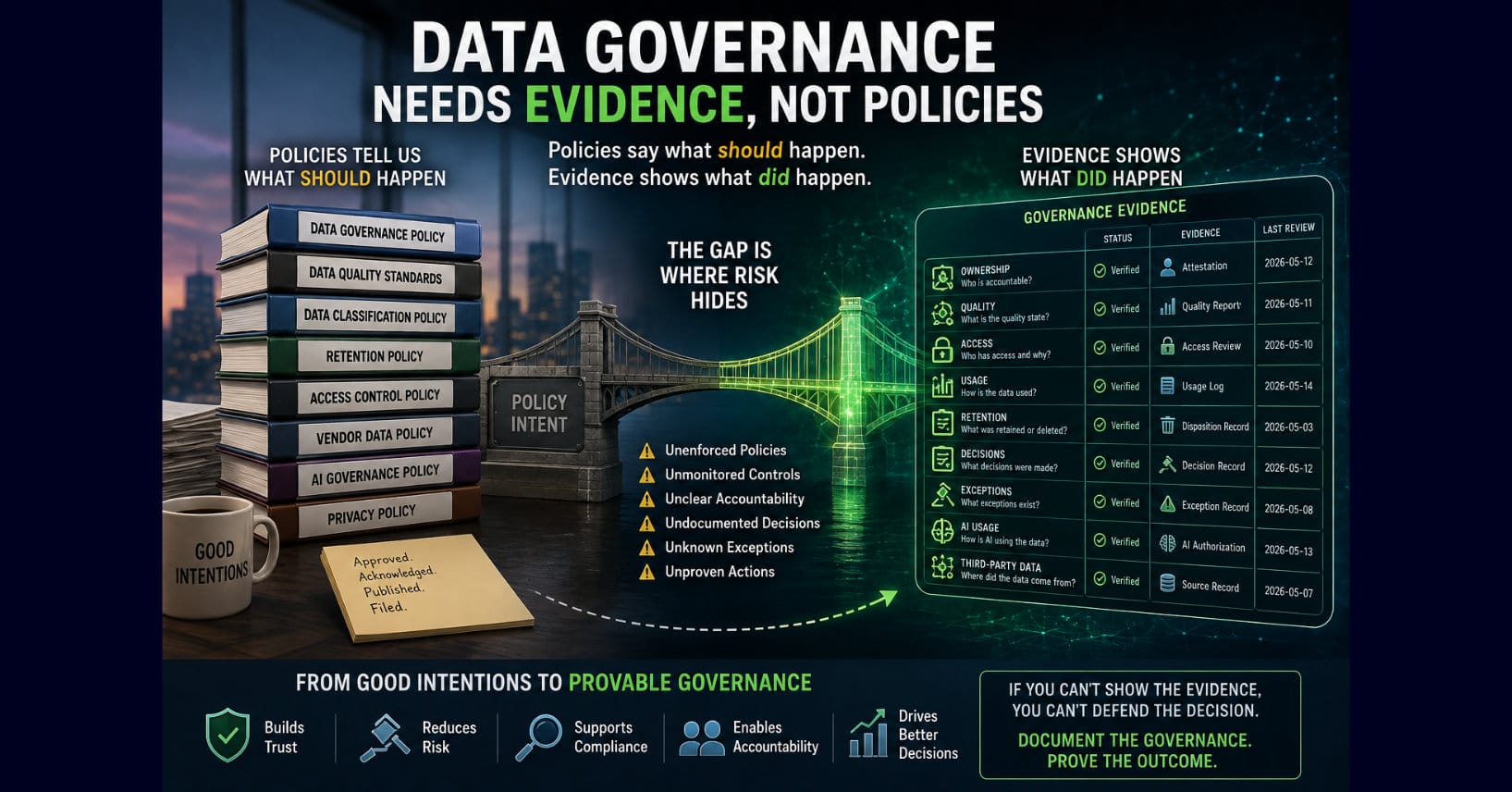
Most enterprises can produce data governance policies, standards, ownership models, committees, and control frameworks. Their existence does not prove that governance is actually operating.
“Data Governance Needs Evidence, Not Policies” examines the gap between documented governance and evidenced governance. Policies establish expectations, while evidence demonstrates whether ownership was exercised, quality thresholds were measured, classifications were reviewed, retention rules executed, access was appropriate, exceptions were authorized, and consequential decisions followed established governance requirements.
The article explores contemporaneous evidence, reconstructability, evidence quality and provenance, exception management, decision sufficiency, governance committee records, continuous evidence, and machine-readable governance. It also examines how AI increases the need for deliberately designed evidence as automated systems compress the distance between data, interpretation, decision, and action.
The central principle is that mature data governance requires policies, controls, and evidence. Organizations should be able to demonstrate not only what decision was made, but what evidence existed, who had authority, why that evidence was considered sufficient, and what happened afterward.
Most organizations with mature data programs can produce policies.
Data governance policies.
Data quality standards.
Data classification standards.
Retention schedules.
Access control policies.
Privacy requirements.
Metadata standards.
Data ownership models.
AI governance policies.
Acceptable-use requirements.
The documents may be excellent.
The organization may have invested months developing them.
The board may have approved them.
Employees may have acknowledged them.
Auditors may have reviewed them.
And none of that proves the organization is actually governing its data.
A policy tells us what should happen.
Evidence tells us what did happen.
That distinction is becoming one of the most important in enterprise data governance.
Because when a regulator, auditor, customer, board member, insurer, litigant, or executive asks whether data was governed appropriately, producing the policy may only establish the organization’s stated intent.
The harder question is:
Can you prove the policy operated?
Governance Is Not What the Policy Says
Imagine an enterprise data governance policy stating:
“All critical data elements must have accountable business owners.”
Excellent.
Now ask:
Which critical data elements?
Who owns each one?
When was ownership assigned?
Who approved the assignment?
Are any currently unowned?
When an owner leaves the organization, how quickly is ownership transferred?
What decisions has the owner made?
What exceptions has the owner accepted?
What evidence demonstrates that ownership is active rather than merely recorded?
Those questions move governance from documentation into operation.
The policy establishes the requirement.
The evidence demonstrates whether the requirement exists in reality.
The Policy-Evidence Gap
Organizations frequently confuse documented governance with operational governance.
A policy exists.
A committee exists.
A data catalog exists.
Owners have been assigned.
Standards have been published.
Training has been completed.
Dashboards exist.
Therefore, governance must be working.
Perhaps.
But each of those statements describes the existence of governance mechanisms.
It does not necessarily demonstrate their effectiveness.
A data owner listed in a catalog may never have reviewed the data.
A governance committee may meet monthly without resolving material issues.
A quality standard may exist while critical datasets routinely violate it.
A retention policy may exist while expired information remains accessible for years.
An AI-use policy may prohibit certain data from entering external models while employees continue submitting it.
The gap between governance design and governance operation is where evidence matters.
Evidence Changes the Question
Without evidence, governance discussions tend to ask:
Do we have a policy?
Do we have owners?
Do we have standards?
Do we have a committee?
Do we have controls?
Do we have training?
Evidence-driven governance asks different questions:
Did the owner review the data?
Did the control execute?
Did the quality threshold fail?
Who accepted the exception?
Was remediation completed?
Did the retention rule actually remove the information?
Was unauthorized AI use detected?
Did the governance committee make the required decision?
Was that decision implemented?
Can we reconstruct what happened?
The difference is subtle but profound.
Governance becomes observable.
Evidence Is Not Documentation
This distinction is important.
Evidence and documentation are related.
They are not synonymous.
A policy is documentation.
A meeting agenda is documentation.
A procedure is documentation.
A governance framework is documentation.
Evidence demonstrates that something occurred.
For example:
an approval record;
a quality measurement;
a control execution log;
a lineage record;
a disposition certificate;
an access decision;
an exception approval;
a remediation ticket;
a data-owner attestation;
a model-use authorization;
a change record;
or a decision record.
Documentation describes the governance system.
Evidence demonstrates its operation.
Mature organizations need both.
Ownership Needs Evidence
Data ownership is one of the clearest examples.
Many organizations have invested heavily in assigning data owners.
The resulting catalog may contain hundreds or thousands of ownership fields.
That is useful.
But assigning a name is not the same as creating accountability.
Evidence of ownership might include:
periodic owner attestations;
approval of data definitions;
acceptance of quality thresholds;
authorization of data uses;
approval of classification;
review of access requirements;
acceptance or rejection of exceptions;
approval of retention requirements;
and documented decisions regarding significant data issues.
That evidence demonstrates that the owner is exercising authority.
Otherwise, ownership can become decorative metadata.
Data Quality Needs Evidence
Consider another common policy statement:
“Critical data must meet established quality requirements.”
How would the enterprise prove that?
It needs evidence of:
the quality dimensions being measured;
the thresholds established;
the measurements taken;
the results;
the failures;
the business impact;
the remediation;
the accepted exceptions;
and the accountable decision-maker.
A dashboard showing 97 percent quality may be useful.
But defensibility requires context.
What does 97 percent mean?
Which dimension?
Which data?
Which threshold?
Was 97 percent acceptable?
Who decided?
For what use?
Evidence transforms a metric into a governance record.
Classification Needs Evidence
Classification policies often define categories such as:
Public.
Internal.
Confidential.
Restricted.
The policy may explain how each should be protected.
But evidence-driven governance asks:
Who classified this information?
When?
Based upon what criteria?
Has the classification been reviewed?
Did the classification travel with the data?
Were downstream copies classified consistently?
Did AI-generated derivatives inherit appropriate sensitivity?
Was the classification changed?
Who authorized the change?
A classification label without decision evidence may tell us the current state.
It may not tell us why that state is justified.
Retention Needs Evidence
Article 14 examined why retention is becoming an AI risk.
Evidence adds another dimension.
A retention schedule may say:
“Delete seven years after contract termination.”
How does the organization prove deletion occurred?
The source record may be gone.
What about:
copies;
backups;
embeddings;
cached content;
AI conversation history;
generated summaries;
analytics datasets;
downstream systems;
and derived records?
Evidence-driven retention requires more than a scheduled disposition date.
It may require evidence that disposition actually occurred across the relevant lineage.
Otherwise, the enterprise has a retention policy.
It does not necessarily have retention assurance.
Access Governance Needs Evidence
Access policies are another familiar example.
The organization may require least privilege.
Evidence should demonstrate:
who had access;
why they had access;
who approved it;
when it was granted;
when it was reviewed;
whether it remained appropriate;
when it was revoked;
and what significant activity occurred.
AI complicates this further.
As earlier articles established, permission to access data may not imply permission to:
retrieve it through AI;
combine it with other information;
infer from it;
use it for model training;
send it to an external model;
or allow an agent to act upon it.
Evidence increasingly needs to capture not merely access rights but governed use.
AI Makes Evidence More Important
Traditional data environments already required evidence.
AI increases the urgency.
Why?
Because machine-speed systems compress the distance between information and action.
A traditional workflow might involve:
Data → Report → Human Review → Decision → Action
An AI-enabled workflow may become:
Data → AI Interpretation → Decision → Action
An agentic workflow may compress it further:
Data → AI → Action
Fewer human checkpoints can mean fewer naturally occurring records explaining why something happened.
Unless the architecture deliberately creates evidence, accountability may disappear as automation increases.
That is the paradox.
The more automated the enterprise becomes, the more deliberately it must design evidence into the system.
Evidence Must Follow the Decision
Not every governance event requires the same evidentiary burden.
A typo corrected in a low-risk internal dataset does not require the same record as a data-quality exception affecting regulatory reporting.
Governance should be proportional to consequence.
For consequential decisions, evidence may need to answer:
What information was used?
Where did it come from?
What quality state existed?
Which policy applied?
Which control operated?
Who had authority?
What exception existed?
What decision was made?
Why?
What action followed?
What outcome occurred?
This creates a chain:
Data → Evidence → Decision → Action → Outcome
The purpose is not bureaucratic recordkeeping.
It is reconstructability.
Reconstructability Is the Test
One of the strongest tests of governance maturity is whether the organization can reconstruct a consequential decision after the fact.
Suppose six months later leadership asks:
“Why did we rely on this dataset?”
Can the organization answer?
Who owned it?
What provenance was known?
What quality measurements existed?
Which third-party sources contributed?
What restrictions applied?
Was the data current?
Which version was used?
What exceptions existed?
Who approved the use?
What decision resulted?
If the answers depend upon someone’s memory, governance evidence is weak.
If the answers can be reconstructed from durable records, governance is becoming defensible.
Evidence Should Be Contemporaneous
Evidence created months after a decision is less persuasive than evidence created when the decision occurred.
This matters because hindsight changes interpretation.
People forget.
Context disappears.
Personnel change.
Systems change.
Documents are updated.
Policies are revised.
AI models change.
Datasets are refreshed.
A contemporaneous record preserves what was known and decided at the time.
That does not mean every decision needs an elaborate memorandum.
Evidence can be lightweight.
A workflow approval.
A timestamped attestation.
A quality result.
A structured decision record.
A system log.
An exception record.
The key is that the evidence is generated as part of the governance process rather than reconstructed after something goes wrong.
Evidence Quality Matters
Not all evidence is equally useful.
A screenshot may show that a dashboard displayed a value.
It may not establish where the value came from.
A meeting note may say that a decision was approved.
It may not establish who had authority.
A system log may show that a control executed.
It may not prove that the control was correctly configured.
An attestation may establish that someone approved something.
It may not explain the basis for approval.
Good governance evidence should be sufficient to support the claim being made.
If the claim is:
“Data quality was acceptable for this decision,”
the evidence should demonstrate why that conclusion was reasonable.
This is where evidence becomes more than recordkeeping.
It becomes assurance.
Evidence Has Provenance Too
The evidence itself must be trustworthy.
Who created it?
When?
From which system?
Was it altered?
Does it correspond to the relevant governance event?
Is the source authoritative?
Can its integrity be demonstrated?
This creates an important recursive principle:
Governance evidence needs governance.
A spreadsheet manually assembled immediately before an audit may be useful.
An automatically generated, timestamped record from the control system may provide stronger assurance.
The objective is not automation for its own sake.
It is reliable evidence.
Exceptions Are Governance Events
No governance system operates without exceptions.
Data quality thresholds will occasionally be missed.
Retention may be extended.
Access may be broadened temporarily.
A third-party dataset may be used despite incomplete provenance.
An AI system may require an unusual data combination.
Exceptions do not necessarily represent governance failure.
Uncontrolled exceptions do.
An evidence-driven exception process should capture:
what requirement was not met;
why;
who requested the exception;
what risk was identified;
who had authority to accept it;
what compensating controls applied;
when the exception expires;
and whether remediation is required.
That turns exception handling into accountable risk acceptance.
“Who Approved It?” Is Not Enough
Governance often stops at approval.
Approved by the data owner.
Approved by Legal.
Approved by Security.
Approved by the governance committee.
Approval identifies authority.
Defensibility may require another question:
Why was approval reasonable?
What evidence did the decision-maker consider?
Was the information sufficient?
Were alternatives considered?
Were limitations known?
Was uncertainty acknowledged?
Was the consequence proportionate to the evidence available?
A perfectly documented approval can still rest upon weak evidence.
This distinction becomes increasingly important in high-consequence data and AI decisions.
Evidence Should Capture Sufficiency
Suppose an executive approves the use of a third-party dataset for a consequential AI application.
The governance record shows:
who approved it;
when;
which policy applied;
and what decision was made.
That is valuable.
But later someone asks:
“Why did you believe the dataset was trustworthy enough for this use?”
The organization should be able to point to the evidentiary basis.
Perhaps:
provenance was documented;
quality exceeded established thresholds;
independent validation was completed;
known limitations were reviewed;
contractual use was permitted;
and monitoring controls were established.
Evidence should therefore preserve not only the decision but why the available evidence was considered sufficient for the consequence being accepted.
That is a higher standard of governance maturity.
Governance Committees Need Decision Evidence
Data governance councils and committees are common.
Their effectiveness varies considerably.
Meeting monthly is not evidence of governance effectiveness.
The relevant evidence is what the governance body actually did.
What issues were escalated?
What decisions were made?
Who participated?
Who had authority?
What evidence was considered?
What risks were accepted?
What actions were assigned?
Were they completed?
What changed as a result?
The governance committee should create a decision trail, not merely meeting minutes.
Metrics Need Evidentiary Context
Organizations increasingly measure governance.
Number of owners assigned.
Percentage of data classified.
Quality scores.
Policy compliance.
Issue closure rates.
Training completion.
Catalog coverage.
These metrics are useful.
They can also create false confidence.
Imagine reporting:
98 percent of critical data has an assigned owner.
Excellent.
How many owners actively exercised decision authority during the past year?
Or:
95 percent of data meets quality standards.
Which standards?
For which uses?
How many exceptions were accepted?
Or:
100 percent of employees completed data governance training.
Did behavior change?
Evidence prevents governance metrics from becoming governance theater.
Evidence Can Expose Governance Drift
Policies tend to remain stable.
Operations drift.
Ownership changes.
Processes change.
New data sources appear.
Vendors change.
Systems are replaced.
AI tools proliferate.
People create workarounds.
Exceptions accumulate.
Evidence makes that drift visible.
If governance requires quarterly ownership review and attestations stop occurring, the evidence gap appears.
If quality controls should run daily and execution records disappear, the failure becomes visible.
If an AI system begins consuming a dataset not included in its approval, lineage can reveal the change.
Evidence is therefore not merely retrospective.
It can become a monitoring signal.
Continuous Evidence Enables Continuous Governance
This leads toward a more advanced governance model.
Instead of periodically asking whether controls are operating, systems continuously generate evidence as governance occurs.
A quality rule executes.
Evidence is created.
An access review occurs.
Evidence is created.
A dataset changes classification.
Evidence is created.
An owner accepts an exception.
Evidence is created.
A retention event executes.
Evidence is created.
An AI system retrieves restricted information.
Evidence is created.
A third-party data source changes.
Evidence is created.
Governance becomes observable in near real time.
This is the beginning of continuous assurance.
Evidence Should Be Designed Into Workflows
The most sustainable governance evidence is produced naturally by work.
If employees must manually create separate evidence after completing every governance activity, evidence quality will deteriorate.
People forget.
Documentation becomes inconsistent.
Governance becomes burdensome.
Better architecture captures evidence during the workflow.
When a data owner approves a definition, the approval becomes evidence.
When a quality exception is accepted, the decision record becomes evidence.
When a retention rule executes, the disposition event becomes evidence.
When an AI use case is approved, the authorization becomes evidence.
The governance process and evidence process become the same process.
This is how organizations begin to document themselves.
Evidence Architecture Matters
As evidence grows, organizations face another problem.
Where does it live?
Governance evidence may be scattered across:
data catalogs;
ticketing systems;
GRC platforms;
email;
collaboration tools;
workflow systems;
identity platforms;
cloud logs;
data-quality tools;
records systems;
AI platforms;
vendor-management systems;
and spreadsheets.
If evidence cannot be connected, reconstructing governance remains difficult.
The enterprise needs relationships between:
data assets;
owners;
policies;
controls;
quality results;
exceptions;
decisions;
approvals;
lineage;
AI systems;
vendors;
actions;
and outcomes.
This is where data governance begins to converge with evidentiary architecture.
The Catalog Can Become More Than a Catalog
Many organizations already possess a logical foundation for this capability: the enterprise data catalog.
Traditionally, catalogs answer questions such as:
What data exists?
Where is it?
Who owns it?
What does it mean?
How is it classified?
Where does it flow?
Those capabilities remain essential.
But imagine extending the catalog to answer:
When did the owner last attest?
What quality controls operated?
Which exceptions are active?
What decisions approved this use?
Which AI systems consume the data?
Which third-party sources contribute?
What evidence supports its authoritative status?
Which retention events occurred?
What governance obligations remain unresolved?
Now the catalog is doing something different.
It is no longer merely describing data.
It is helping demonstrate governance.
Evidence Can Become Machine-Readable
The next evolution is making governance evidence machine-readable.
Instead of burying approvals and exceptions inside documents, organizations can represent them as structured records.
For example:
Owner: Finance Data Office
Decision: Approved for forecasting
Quality Threshold: 98% completeness
Measured Result: 99.2%
Provenance Status: Verified
AI Retrieval: Permitted
AI Training: Prohibited
Exception: None
Approval Date: 2026-08-15
Review Date: 2026-11-15
Now governance systems can evaluate the state automatically.
AI systems can use it.
Dashboards can measure it.
Controls can enforce it.
Auditors can inspect it.
Evidence becomes part of the enterprise information architecture.
AI Can Consume Governance Evidence
This creates an interesting possibility.
Enterprise AI should not merely consume business data.
It can also consume governance context.
When deciding whether to retrieve information, an AI system could evaluate:
ownership status;
authoritative status;
quality evidence;
provenance confidence;
classification;
lifecycle status;
approved purposes;
active exceptions;
and decision consequence.
In other words, governance evidence can influence runtime AI behavior.
The enterprise moves from:
Policies humans are expected to remember
toward:
Evidence and controls systems can evaluate.
That is a significant step toward governable intelligence.
Boards Need Evidence, Not Activity Reports
Boards do not need thousands of governance records.
They need assurance.
A board-level data governance report should not primarily say:
We held six governance meetings.
We updated four policies.
We trained 3,000 employees.
We assigned 800 data owners.
Those are activities.
More meaningful questions include:
Are critical data assets governed?
Are significant quality risks within tolerance?
Are consequential third-party data dependencies understood?
Are material exceptions visible?
Are AI systems consuming appropriately governed information?
Are retention controls operating?
Can significant data-driven decisions be reconstructed?
Is governance improving?
Evidence allows management to answer those questions credibly.
Evidence Changes Accountability
Policies can distribute responsibility vaguely.
Evidence makes accountability specific.
Someone approved.
Someone accepted the exception.
Someone owned the data.
Someone reviewed the quality result.
Someone authorized the use.
Someone failed to complete the remediation.
Someone changed the control.
That specificity can feel uncomfortable.
It is also what makes governance real.
Accountability without evidence is largely aspirational.
Evidence connects authority to action.
The Objective Is Defensibility
The goal of evidence-driven governance is not to create mountains of records.
It is to make consequential governance decisions defensible.
Defensibility means the organization can demonstrate:
what it knew;
what it required;
what controls operated;
what evidence existed;
who had authority;
what decision was made;
why the evidence was considered sufficient;
what action followed;
and what happened afterward.
That does not guarantee every decision will be correct.
Governance cannot eliminate uncertainty.
It can demonstrate that decisions were made through a reasonable, accountable, and controlled process.
That is a much stronger position than pointing to a policy and saying:
“We were supposed to do this.”
From Policy-Centric to Evidence-Centric Governance
The evolution can be summarized simply.
Policy-Centric Governance
What should happen?
Control-Centric Governance
What mechanisms are supposed to make it happen?
Evidence-Centric Governance
Can we demonstrate what actually happened?
The most mature organizations need all three.
Policies establish expectations.
Controls operationalize them.
Evidence demonstrates performance.
Remove any one of the three and governance weakens.
Boardroom Takeaway
Executives should stop treating the existence of governance documentation as evidence that data is governed.
Policies matter.
Standards matter.
Committees matter.
Catalogs matter.
Controls matter.
But when a consequential data decision is challenged, the enterprise needs to demonstrate more than what its governance framework said should have happened.
Leadership should ask:
“For our most consequential data decisions, can we demonstrate what governance actually occurred, what evidence supported the decision, who accepted the risk, and why the available evidence was considered sufficient?”
If the answer depends upon reconstructing events from email, spreadsheets, meeting recollections, and scattered system logs, governance remains fragile.
The future of data governance will not be defined by who has the most comprehensive policy library.
It will be defined by who can prove that governance operated when it mattered.
Coming Next
Article 17: From Data Catalog to Evidence System
Enterprise data catalogs were built to help organizations discover, understand, classify, and trace their information.
The next step is more ambitious.
What if the catalog could also show who exercised ownership, which controls operated, what quality evidence exists, which exceptions were accepted, what AI systems rely upon the data, and why the enterprise considers the information trustworthy enough for consequential use?
The next article examines how the data catalog can evolve from an inventory of enterprise information into an evidence system for governance, assurance, and increasingly AI-driven decision-making.