Digital Transformation Series | Article 5 of 8
Digital Transformation: Redesigning the Enterprise for Continuous Change
Summary
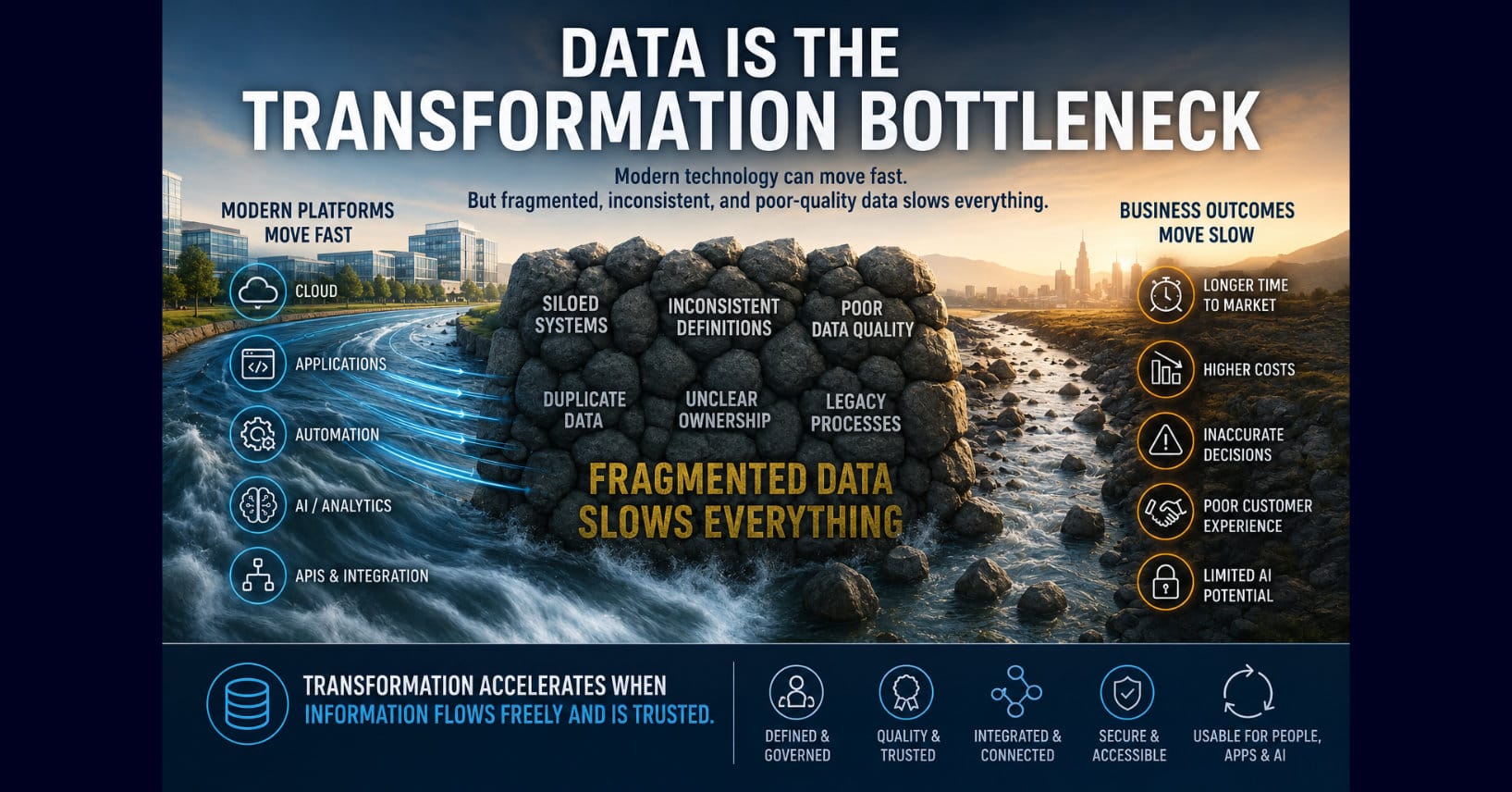
Enterprises can modernize applications, migrate infrastructure to the cloud, automate processes, and deploy artificial intelligence while their underlying information remains fragmented.
Data Is the Transformation Bottleneck examines why information is often harder to modernize than technology. Organizational boundaries become data boundaries, different systems develop conflicting definitions, employees compensate through spreadsheets and manual reconciliation, and automation can amplify poor data rather than eliminate the problem.
The article explores data availability versus usability, information fitness, master data, contextual data quality, ownership, lineage, and the growing relationship between data lineage and automated decision-making. It also examines how AI is exposing information problems that organizations have tolerated for years.
The central argument is simple: an enterprise cannot become digitally integrated while its information remains organizationally fragmented.
The application has been modernized.
The infrastructure is in the cloud.
The customer experience has been redesigned.
APIs connect the major systems.
Automation handles tasks employees once performed manually.
Then someone asks a simple question:
How many active customers do we have?
Sales provides one number.
Finance provides another.
Operations provides a third.
The data warehouse produces a fourth.
Nobody is necessarily wrong.
Each system defines “active customer” differently.
One counts anyone who purchased during the past twelve months.
Another counts customers with an open account.
Another excludes suspended accounts.
Another organizes customers by billing relationship rather than legal entity.
The enterprise has modernized its technology.
Its information remains fragmented.
This is one of the most persistent problems in digital transformation.
Applications can be replaced.
Infrastructure can be migrated.
Interfaces can be redesigned.
Processes can be automated.
But eventually, transformation encounters the information underneath them.
And information is considerably harder to modernize than technology.
The Enterprise Runs on Meaning
Technology discussions frequently treat data as if it were primarily a technical asset.
Rows.
Columns.
Tables.
Files.
Objects.
Documents.
Events.
Streams.
Data lakes.
Warehouses.
APIs.
Those are ways information is stored, processed, and transported.
But enterprises do not operate on storage mechanisms.
They operate on meaning.
What is a customer?
What is a product?
What constitutes revenue?
When is an order complete?
Who owns an account?
What is an employee?
What qualifies as an active supplier?
When does an opportunity become a sale?
What constitutes a service interruption?
These questions sound straightforward until different parts of the organization answer them differently.
That is where the data problem becomes an enterprise problem.
The difficult part is rarely determining whether a database can store a customer record.
The difficult part is determining what the enterprise means by customer.
Organizational Boundaries Become Data Boundaries
Most enterprise data environments reflect the organizations that created them.
Sales builds systems around sales processes.
Finance builds systems around financial processes.
Operations builds systems around operational processes.
Marketing builds systems around campaigns and prospects.
Customer service builds systems around cases and interactions.
Each function creates data that supports its responsibilities.
Over time, the same real-world entity appears in multiple systems.
A customer exists in CRM.
The same customer exists in billing.
The same customer exists in the support platform.
The same customer exists in marketing automation.
The same customer exists in the data warehouse.
But those systems may not agree on identity, status, relationships, attributes, or history.
This is not simply duplication.
It is fragmentation of enterprise meaning.
The organizational structure has become embedded in the information architecture.
That creates a fundamental transformation problem.
An enterprise cannot become digitally integrated while its information remains organizationally fragmented.
The Digital Front End Can Hide an Analog Back End
Organizations have become remarkably good at creating sophisticated digital experiences.
Customers see polished websites.
Mobile applications provide self-service capabilities.
Chatbots answer questions.
Digital forms replace paper.
Notifications arrive automatically.
But behind the interface, the enterprise may still depend on employees reconciling information manually.
A customer changes an address online.
One system updates immediately.
Another receives the change overnight.
A third requires manual intervention.
A fourth maintains a separate record.
The customer sees one digital interaction.
The enterprise performs several reconciliation activities behind it.
This creates a strange condition: the organization appears digitally integrated from the outside while remaining informationally fragmented inside.
Employees become the integration layer.
They know which system is authoritative for which field.
They understand which reports disagree.
They know which spreadsheet contains the corrected version.
They recognize that a status in one application means something slightly different in another.
They compensate for the architecture.
Transformation often exposes these workarounds because automation cannot rely on the same informal knowledge humans use.
Automation Amplifies Data Quality
Automation creates enormous efficiency when the underlying information is reliable.
When it is not, automation can increase the speed at which errors propagate.
Consider a manual process.
An employee receives information from one system, checks another system, notices a discrepancy, recognizes that one value is probably outdated, and corrects it before proceeding.
The process is inefficient.
But the human is performing an invisible data-quality function.
Now automate it.
The automated process retrieves the value, assumes it is correct, and processes the transaction instantly.
The inefficiency disappears.
So does the human judgment that was compensating for poor information.
The enterprise has not eliminated the data problem.
It has automated its consequences.
This is why process automation and data quality cannot be treated independently.
Automation scales whatever information environment already exists—good or bad.
AI Makes the Bottleneck Impossible to Ignore
Artificial intelligence is making enterprise information problems considerably more visible.
Organizations understandably want AI systems capable of answering questions, generating insights, assisting employees, automating decisions, and interacting with customers.
But enterprise AI depends on enterprise information.
A model can be extraordinarily capable and still produce poor results when the information supplied to it is incomplete, contradictory, outdated, inaccessible, or poorly understood.
Suppose an AI assistant is asked:
What is the current status of Customer X?
The answer may require information from CRM, billing, customer support, order management, contract management, and perhaps several data repositories.
Which system is authoritative?
Which information is current?
How are duplicate customer records reconciled?
Which relationships matter?
What does “current status” mean?
The AI problem quickly becomes an information architecture problem.
Generative AI makes this even more interesting because enterprises are now attempting to combine structured data with documents, policies, email, knowledge bases, contracts, presentations, support records, and other unstructured information.
The volume of accessible information is increasing.
That does not automatically increase the amount of trustworthy information.
AI can retrieve more.
The enterprise still needs to know what it means.
Accessible Data Is Not Necessarily Usable Data
Modern data platforms have dramatically improved the ability to collect and store information.
Data warehouses centralized reporting data.
Data lakes expanded the types and volumes of information organizations could retain.
Cloud platforms made storage inexpensive and scalable.
Lakehouses, data fabrics, data meshes, streaming architectures, and modern analytics platforms continue expanding enterprise data capabilities.
These technologies solve important problems.
But moving information into a shared platform does not resolve disagreements about meaning.
An enterprise can have petabytes of accessible data and still struggle to answer basic business questions consistently.
This is the difference between data availability and data usability.
Usable enterprise data requires more than access.
It requires context.
Definition.
Ownership.
Quality.
Lineage.
Relationships.
Timeliness.
Consistency.
Appropriate controls.
Without those characteristics, a centralized data platform can become a very sophisticated collection of organizational disagreement.
The Spreadsheet Is Trying to Tell You Something
Spreadsheets are often criticized in enterprise technology discussions.
Sometimes appropriately.
Critical business processes should not depend on undocumented spreadsheets stored on individual computers.
But spreadsheets also provide useful diagnostic information.
When employees export data from enterprise systems into spreadsheets, combine multiple sources, correct values, add classifications, and create their own reports, they are revealing something.
The enterprise systems are not providing the information they need in a usable form.
The spreadsheet is compensating for an information gap.
Before eliminating it, ask why it exists.
What information is being combined?
What corrections are being made?
What definitions are being applied?
What calculations are missing?
Which systems disagree?
What business context is being added manually?
A spreadsheet can be a symptom of poor process design.
It can also be an informal information architecture built by someone who understands what the enterprise actually needs.
That does not mean the spreadsheet should remain.
It means the knowledge embedded in it should not disappear when the spreadsheet does.
Data Ownership Is Usually More Complicated Than It Sounds
Organizations frequently respond to data problems by assigning data owners.
That is necessary.
It is also insufficient.
Consider customer information.
Sales may create the customer relationship.
Finance may own billing information.
Operations may maintain service status.
Legal may define the contractual entity.
Marketing may manage communication preferences.
Customer service may maintain interaction history.
Which department owns the customer?
The better question may be:
Who is accountable for which aspects of customer information, under which business conditions, for which purposes?
Enterprise information rarely aligns neatly with a single organizational owner.
That is why data governance becomes important.
Ownership must include responsibility for definitions, quality expectations, authoritative sources, lifecycle management, access, and appropriate use.
Otherwise, “data owner” becomes another title without corresponding decision authority.
Master Data Is an Enterprise Agreement
Master data management is often approached as a technology initiative.
Select a platform.
Identify master records.
Build matching rules.
Create golden records.
Synchronize systems.
Those capabilities matter.
But the most difficult part of master data is not mastering records.
It is achieving enterprise agreement.
Which attributes define a customer?
Which system is authoritative for each attribute?
How are duplicates identified?
How are parent-child relationships represented?
What happens when systems disagree?
Which identifiers persist through mergers, acquisitions, account changes, or organizational restructuring?
Those are business decisions implemented through technology.
The master record is the technical expression of an enterprise agreement about meaning.
Without the agreement, the platform simply centralizes ambiguity.
Data Quality Is Contextual
Organizations often discuss data quality as though information is either good or bad.
Reality is more nuanced.
Data can be sufficiently accurate for one purpose and inadequate for another.
A customer’s mailing address might be acceptable for marketing analysis but insufficient for shipping a high-value product.
A product classification might support internal reporting but fail to meet regulatory requirements.
A monthly financial metric might be appropriate for strategic planning but too stale for real-time operational decisions.
AI raises the stakes further because information collected for one purpose may suddenly be used to train, retrieve, infer, or automate something entirely different.
This means data quality must be evaluated relative to use.
The important question is not simply:
Is this data accurate?
It is:
Is this information sufficiently trustworthy for the decision or process that will depend on it?
That is a much more demanding standard.
Data Lineage Becomes Decision Lineage
As enterprises automate more decisions, data lineage becomes increasingly important.
Traditional data lineage asks:
Where did this information originate?
How was it transformed?
Which systems processed it?
Where is it consumed?
Those questions are essential.
But when information contributes to automated or AI-assisted decisions, another question appears:
Which information influenced this outcome?
A credit decision.
A pricing recommendation.
A fraud alert.
A hiring recommendation.
A maintenance prediction.
A customer offer.
A supply-chain intervention.
The ability to understand those outcomes increasingly depends on understanding the information that produced them.
Data lineage therefore begins to intersect with decision lineage.
This is one reason information architecture and data governance are becoming more strategically important as AI adoption expands.
The enterprise is no longer using data merely to describe what happened.
It is increasingly using data to determine what happens next.
The Cost of Fragmentation Appears Everywhere
Poor information architecture rarely appears as a single line item.
Its cost is distributed throughout the enterprise.
Employees reconcile reports.
Developers build duplicate integrations.
Analysts clean data.
Customer service representatives search multiple systems.
Finance resolves discrepancies.
Operations creates manual controls.
Executives debate whose numbers are correct.
Projects spend months locating and preparing information.
AI teams build pipelines around inconsistent sources.
Acquisitions struggle to integrate.
Compliance teams reconstruct lineage.
The enterprise experiences these as separate operational problems.
They may share the same root cause.
Information was never designed as an enterprise asset.
It was created as a by-product of applications and processes.
That model becomes increasingly expensive as the enterprise attempts to integrate, automate, and apply intelligence across organizational boundaries.
Transformation Requires Information Design
Digital transformation therefore needs to include deliberate information design.
Before building the next digital capability, organizations should ask:
What information does this capability require?
What does that information mean?
Where does it originate?
Which source is authoritative?
Who is accountable for it?
How current must it be?
What quality is required?
How is it related to other enterprise information?
Who may use it?
How will changes propagate?
How will we know where it came from?
These questions sound less exciting than selecting a new AI platform or designing a new customer application.
But they determine whether those technologies can operate reliably at enterprise scale.
Do Not Try to Fix All Data Before Transforming
There is an important practical caution.
The answer is not to launch a five-year program to “clean all enterprise data” before transformation can proceed.
That objective is usually unrealistic.
Not all data has equal strategic value.
Not every inconsistency matters.
Not every historical record needs remediation.
Information improvement should be aligned with enterprise capabilities.
If customer onboarding is a transformation priority, identify the information required for customer onboarding.
If predictive maintenance matters, focus on the information needed for that capability.
If AI-assisted customer service is strategic, identify the sources that must become trustworthy and accessible for that use case.
This creates a capability-driven approach to information modernization.
Fix the information that constrains the capabilities the enterprise needs next.
Then expand deliberately.
That is far more sustainable than attempting to perfect the entire data estate at once.
From Data Volume to Information Fitness
Enterprises have spent years measuring data by volume.
Terabytes stored.
Sources integrated.
Records processed.
Queries executed.
Models trained.
Those measures describe infrastructure activity.
They do not tell leadership whether the enterprise’s information is fit for transformation.
A more useful view asks whether critical information is:
Defined — Do we agree on what it means?
Owned — Is someone accountable for it?
Authoritative — Do we know which source to trust?
Accessible — Can authorized users and systems obtain it when needed?
Reliable — Is its quality appropriate for its intended use?
Connected — Can it be related to other relevant enterprise information?
Traceable — Can we determine where it came from and how it changed?
Usable — Can people, applications, analytics, automation, and AI consume it effectively?
Those characteristics describe information fitness.
And information fitness is becoming a prerequisite for enterprise transformation.
The Information Layer Outlives the Application
Applications come and go.
Enterprise information persists.
A customer relationship may exist across several generations of CRM systems.
An employee’s history may span multiple HR platforms.
A product may outlive the applications originally used to design, manufacture, sell, and support it.
A contract may remain legally significant long after the system that created it has been retired.
Yet enterprises frequently organize information around applications rather than around the business concepts that persist beyond them.
This creates recurring migration problems.
Every major application replacement becomes an information reconstruction project.
What does this field mean?
Which records should migrate?
How do identifiers map?
Which historical relationships matter?
Which system contains the authoritative value?
A more durable approach treats applications as temporary mechanisms for interacting with information.
The information itself belongs to the enterprise.
That distinction will become increasingly important as software architectures become more modular and AI changes how users interact with enterprise systems.
The Transformation Bottleneck
Digital transformation ultimately depends on the enterprise’s ability to connect processes, systems, decisions, customers, employees, and increasingly intelligent agents.
All of them depend on information.
If that information remains fragmented, poorly defined, difficult to access, or unreliable, transformation eventually slows.
The bottleneck may appear to be an application.
It may appear to be an integration.
It may appear to be an AI problem.
It may appear to be an analytics problem.
It may appear to be a process problem.
But underneath it may be something more fundamental.
The enterprise does not possess a sufficiently coherent understanding of its own information.
Technology cannot resolve that problem by itself.
It can store the disagreement faster.
Move it farther.
Analyze it more efficiently.
And now, with AI, explain it more convincingly.
But the enterprise still has to decide what its information means.
Executive Question
Which strategic capability would become dramatically easier if everyone in the enterprise could reliably access and interpret the same information?
The answer identifies more than a data problem.
It identifies a transformation opportunity.
Because the objective is not to accumulate more data.
It is to create an enterprise in which trustworthy information can move wherever value is being created.
Coming Next
Article 6: Transformation Requires a Different Software Delivery Model
The operating model can be redesigned. Architecture can become more modular. Information can become more usable.
But the enterprise still needs a mechanism for turning ideas into working software.
Traditional project-based delivery was designed for a world in which systems were implemented, handed over, and maintained.
Digital enterprises operate differently.
In Article 6, we will examine why continuous transformation requires persistent product teams, platform engineering, automation, DevSecOps, technical ownership, and a software delivery model designed for continuous change rather than temporary projects.