Digital Transformation Series | Article 4 of 8
Digital Transformation: Redesigning the Enterprise for Continuous Change
Summary
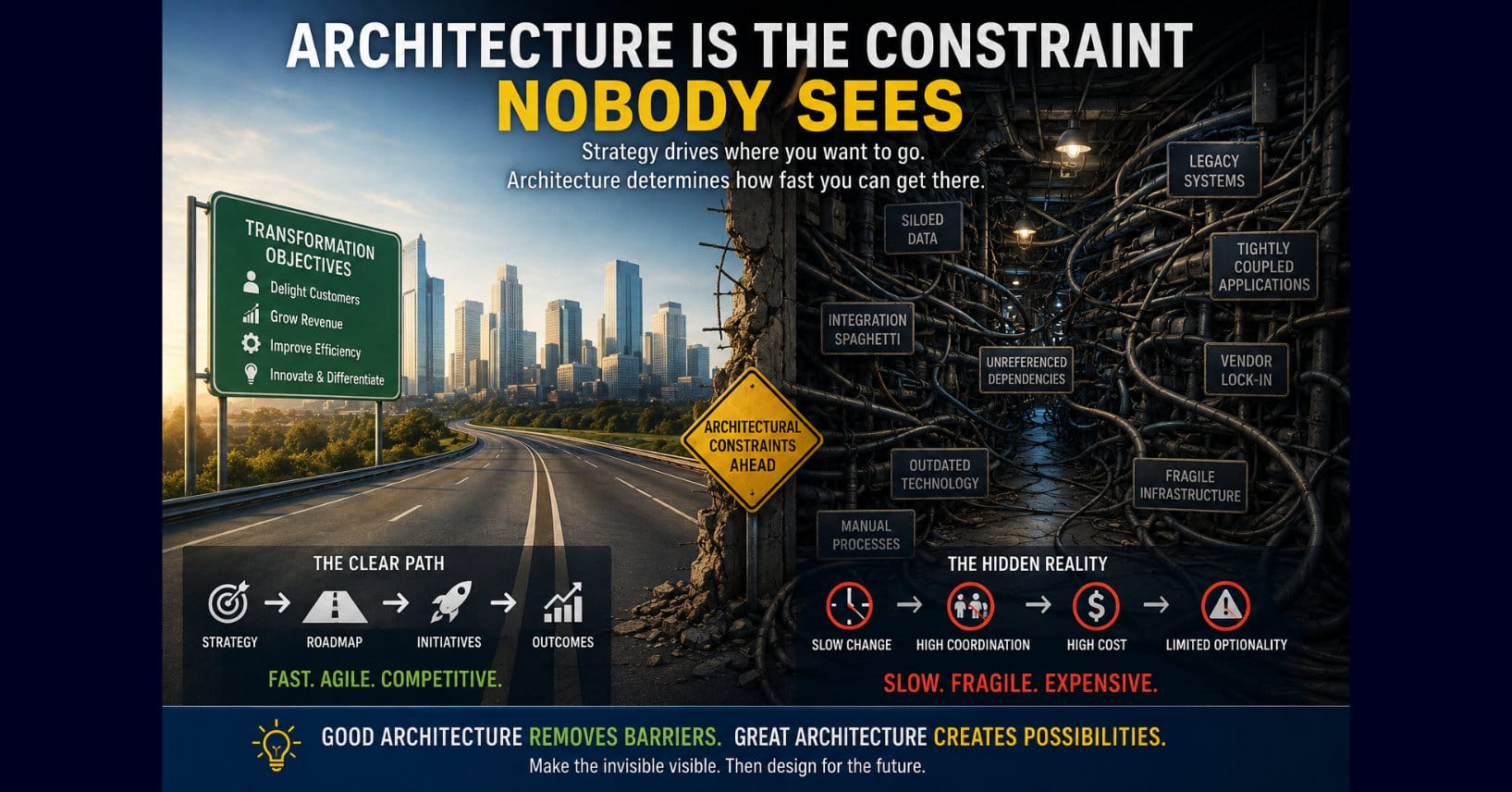
Digital transformation strategies describe where the enterprise wants to go, but existing architecture often determines how quickly, safely, and economically it can get there.
Architecture Is the Constraint Nobody Sees examines how years of technology decisions accumulate into architectural dependencies that eventually limit enterprise change. The article explores technical debt, integration debt, tight coupling, legacy systems, cloud complexity, AI readiness, architectural runway, and architectural optionality.
Rather than modernizing technology simply because it is old, organizations should identify the architectural components creating the greatest constraints on future capabilities. The article argues that architecture should be treated as a business conversation because it directly affects speed, cost, integration, vendor flexibility, software delivery, acquisition integration, and strategic choice.
Good architecture supports today’s requirements. Great architecture preserves tomorrow’s options.
A leadership team decides the company needs to launch a new digital product.
The business case is compelling.
Customers want it.
The market opportunity exists.
Funding is available.
The executive team agrees.
Then someone asks technology how long it will take.
Nine months.
Perhaps twelve.
Why?
The customer information exists in three systems.
The pricing engine cannot be accessed through an API.
The order-management platform requires custom integration.
Identity is implemented differently across several applications.
A legacy system contains business rules nobody has completely documented.
Changes to one application require coordinated releases with four others.
The data required by the new product is owned by multiple business units.
The infrastructure team needs several weeks to provision a new environment.
Testing requires access to systems that cannot easily be replicated outside production.
And one critical application runs on technology understood by three people, two of whom are approaching retirement.
Nothing in the strategy presentation mentioned any of this.
But the architecture knew.
Architecture is the accumulated consequence of thousands of technology decisions made over years or decades. Most of the time, those decisions remain invisible to executive leadership.
Until the enterprise tries to do something new.
Then architecture becomes strategy.
Architecture Is Usually Invisible When It Works
Enterprise architecture has an unusual characteristic.
When it works well, people rarely notice it.
Applications communicate.
Information moves.
Employees access the capabilities they need.
Developers build on established platforms.
Systems scale.
Changes can be made without destabilizing unrelated parts of the enterprise.
Architecture becomes visible primarily when something cannot be done.
A new product takes too long to launch.
An acquisition cannot be integrated.
A customer experience requires information the organization cannot assemble.
A cloud migration becomes unexpectedly complicated.
An AI initiative discovers that enterprise data is fragmented.
A business process cannot be automated because the underlying systems were never designed to communicate.
A seemingly small application change requires months of coordination.
At that moment, architecture stops looking like a technical discipline and starts looking like a business constraint.
The problem is that the constraint may have been developing for twenty years.
Every Technology Decision Leaves Something Behind
Enterprise technology environments rarely emerge from a single coherent design.
They accumulate.
A company implements an ERP platform.
Then acquires another company with a different ERP.
A business unit purchases a specialized SaaS application.
A custom integration is created.
A new customer portal is built.
A merger adds another identity system.
A regulatory requirement creates a new workflow.
A temporary database becomes permanent.
A vendor product reaches end of life but remains because replacing it would disrupt operations.
An application is modernized, but the legacy system remains because another application still depends on it.
A point-to-point integration solves an urgent problem.
Then another does.
Then another.
Every decision may have been reasonable when it was made.
Collectively, however, those decisions create the architecture the enterprise inherits.
This is why technical debt is often misunderstood.
Technical debt is not simply bad code.
It is the accumulated cost of previous decisions that makes future change more difficult.
That debt can exist in applications, integrations, infrastructure, data, security, platforms, processes, and operating models.
Eventually, the enterprise pays interest on it every time it tries to change.
The Transformation Roadmap Meets the Dependency Map
Transformation strategies are usually designed around business outcomes.
Improve customer experience.
Increase automation.
Deploy artificial intelligence.
Reduce operating costs.
Accelerate product development.
Create new digital revenue streams.
Those objectives make sense.
But each one creates demands on the technology architecture.
Customer experience may require integrated customer data.
Automation may require accessible business rules and reliable interfaces.
AI may require governed, usable information across multiple systems.
Faster product development may require modular software, automated infrastructure, reusable platforms, and independent deployment.
Digital revenue may require APIs, scalable platforms, identity services, payment capabilities, and real-time integration.
The transformation roadmap says what leadership wants to accomplish.
The dependency map reveals what must change before the enterprise can accomplish it.
Those two views are often developed separately.
They should not be.
Tight Coupling Creates Organizational Drag
One of the most important architectural characteristics affecting transformation is coupling.
Systems are coupled when changes to one depend heavily on changes to another.
Some coupling is unavoidable.
Enterprise systems need to interact.
The problem is excessive coupling.
Imagine an application that cannot be modified without changing several upstream and downstream systems.
Each change requires coordination.
Each coordinating team has its own priorities.
Each system has its own release schedule.
Each release creates testing requirements.
Each dependency introduces delay.
A change that might require two days of development can become a two-month organizational exercise.
The architecture has converted a technical change into a coordination problem.
At enterprise scale, this becomes significant.
Hundreds of tightly coupled systems create thousands of dependencies.
Those dependencies create meetings, tickets, approvals, release calendars, integration testing, escalation paths, and project-management overhead.
What appears to be organizational bureaucracy may actually be an architectural consequence.
This is an important point:
Architecture determines how much coordination the enterprise requires to change.
Better architecture does not eliminate coordination.
It reduces unnecessary coordination.
Integration Debt Is Transformation Debt
Most large enterprises have accumulated substantial integration complexity.
Point-to-point interfaces.
Batch transfers.
File exchanges.
Custom middleware.
Database connections.
Vendor-specific connectors.
ETL pipelines.
Message queues.
APIs created at different times using different standards.
Some integrations are documented.
Some are understood mainly by the people who built them.
Some have been operating so long that nobody wants to touch them.
Integration complexity becomes particularly visible during transformation because new capabilities rarely exist inside a single system.
They require information and functionality from across the enterprise.
The more difficult those capabilities are to access and combine, the slower transformation becomes.
This creates what might be called integration debt: the accumulated cost of connecting systems in ways that solved yesterday’s problems while making tomorrow’s combinations harder.
A transformation strategy that ignores integration debt will repeatedly underestimate effort.
The application may be easy to build.
Connecting it to the enterprise may not be.
Legacy Does Not Mean Old
The word “legacy” is often used as shorthand for old technology.
That definition is too simplistic.
A twenty-year-old system that is stable, well understood, properly integrated, economically efficient, and capable of supporting business requirements may not be the enterprise’s biggest problem.
A three-year-old platform that is expensive to modify, tightly coupled, poorly understood, difficult to integrate, and dependent on a vendor’s proprietary architecture may be a much greater constraint.
Legacy should therefore be understood functionally.
A system becomes a transformation constraint when it materially limits the enterprise’s ability to change.
Age is one indicator.
It is not the definition.
This matters because modernization programs frequently target technology based on age rather than constraint.
Replacing the oldest systems may feel logical.
But the better question is:
Which architectural components impose the greatest cost on future change?
Those are the constraints transformation should prioritize.
The Hidden Cost of a Simple Change
One of the clearest indicators of architectural health is the cost of making a small change.
Suppose the business wants to add one field to a customer record.
In a modular architecture with well-defined ownership and interfaces, the change may be straightforward.
In a tightly coupled enterprise environment, that field may affect:
The customer database.
The CRM platform.
The billing system.
The data warehouse.
The customer portal.
The mobile application.
Reporting.
Analytics.
Integration feeds.
Downstream partners.
Regulatory reports.
Data retention rules.
Access controls.
Suddenly, a field is not a field.
It is an enterprise event.
This is why estimates that appear unreasonable to business leaders may sometimes be perfectly rational responses to architectural complexity.
The development work is not necessarily difficult.
The dependency work is.
Transformation programs often focus on making developers faster when the real constraint is the number of things developers must coordinate before making a safe change.
Cloud Does Not Automatically Fix Architecture
Cloud computing has provided enterprises with extraordinary capabilities.
Elastic infrastructure.
Managed services.
Global deployment.
Automation.
Serverless computing.
Container platforms.
Advanced data services.
AI platforms.
But cloud adoption does not automatically create good architecture.
A tightly coupled application moved to cloud infrastructure remains tightly coupled.
A poorly designed integration architecture remains difficult to change.
Fragmented data remains fragmented.
Manual deployment processes can remain manual.
An application portfolio can become cloud-hosted without becoming cloud-native.
In some cases, organizations add cloud complexity while retaining most of their existing complexity.
They operate legacy infrastructure, multiple cloud platforms, SaaS applications, integration platforms, containers, serverless functions, and older enterprise applications simultaneously.
The result can be more architectural surface area rather than less.
Cloud is an architectural capability.
It is not an architectural strategy.
AI Is Exposing Architectural Weakness Faster
Artificial intelligence is now providing enterprises with another architectural stress test.
The model itself may be remarkably capable.
The enterprise environment surrounding it may not be.
An AI system may need customer information from multiple platforms.
It may need product data from several repositories.
It may need access to policies, procedures, contracts, transactions, historical decisions, and operational data.
It may need to initiate actions across existing applications.
Suddenly, problems that were tolerable when humans manually navigated organizational complexity become barriers to automation.
Humans are remarkably effective integration layers.
They know which system contains which information.
They copy data.
They reconcile inconsistencies.
They interpret undocumented rules.
They remember exceptions.
They call someone in another department when the system cannot answer the question.
AI exposes how much of the enterprise operating model depends on humans compensating for architectural fragmentation.
This is one reason AI readiness is not simply a model-selection problem.
It is increasingly an architecture problem.
Architectural Runway Determines Transformation Speed
Transformation requires what software architects sometimes call architectural runway: enough underlying capability to support the next set of changes without first rebuilding everything beneath them.
At enterprise scale, architectural runway might include:
Reliable APIs.
Shared identity services.
Modern integration capabilities.
Reusable platforms.
Automated infrastructure.
Observable systems.
Accessible data.
Standardized engineering pipelines.
Modular applications.
Clear service boundaries.
Automated testing.
Consistent security capabilities.
These investments may not produce immediately visible customer features.
That can make them difficult to prioritize.
But without them, every future initiative must rebuild foundational capabilities before delivering business value.
The organization repeatedly pays the same entry fee for change.
A healthy architectural runway lowers that fee.
Modernization Should Target Constraints
This leads to a different way of thinking about modernization.
Instead of asking:
Which systems are oldest?
Ask:
Which systems create the greatest constraints on the capabilities we need next?
Instead of asking:
How many applications can we migrate this year?
Ask:
Which architectural changes will remove the most dependencies from future initiatives?
Instead of asking:
Which technologies should we replace?
Ask:
Where does architecture make routine business change unnecessarily expensive?
This moves modernization from a technology-refresh exercise to a transformation-enablement strategy.
It also helps prioritize investments that may otherwise struggle for executive attention.
Replacing an integration layer may not sound as exciting as launching a new AI application.
But if the integration layer enables twenty future AI capabilities, its strategic value may be considerably greater.
Architecture Creates or Destroys Optionality
Good architecture does more than support today’s requirements.
It preserves choices.
An enterprise with modular systems, accessible data, standardized interfaces, reusable platforms, and loosely coupled capabilities has options.
It can replace components.
Add channels.
Introduce new products.
Change vendors.
Integrate acquisitions.
Adopt new technologies.
Experiment without destabilizing core operations.
An enterprise with tightly coupled systems and proprietary dependencies has fewer options.
Each strategic decision becomes constrained by what the technology estate can tolerate.
This is architectural optionality: the degree to which architecture preserves the enterprise’s ability to make future choices without disproportionate cost.
Optionality is difficult to place on a traditional technology ROI spreadsheet.
But it becomes extremely valuable when the future is uncertain.
And the future of enterprise technology is becoming increasingly uncertain.
AI alone is changing application development, user interfaces, information access, automation, and software economics at a pace that makes rigid five-year architecture assumptions increasingly dangerous.
The architecture does not need to predict the future.
It needs to leave room for it.
Architecture Is a Business Conversation
Architecture discussions often become unnecessarily technical.
Microservices.
Containers.
Event streams.
APIs.
Data fabrics.
Service meshes.
Cloud-native platforms.
Those technologies matter to architects and engineers.
Executive leadership needs a different translation.
Architecture determines:
How quickly the company can launch something new.
How expensive it is to change an existing process.
How easily information can move.
How difficult acquisitions are to integrate.
How dependent the enterprise is on particular vendors.
How safely software can change.
How rapidly new technologies can be adopted.
How much organizational coordination routine change requires.
How many strategic options remain available.
Those are business consequences.
Architecture is the mechanism underneath them.
This is why architecture should not enter the transformation discussion after strategy has already been decided.
Architecture helps determine which strategies are practical, what they will cost, how long they will take, and which foundational investments must happen first.
Make the Invisible Constraint Visible
Transformation leaders need a way to expose architectural constraints before those constraints derail initiatives.
A useful assessment can begin with six questions.
1. Dependency
Which systems require coordinated change?
2. Integration
How easily can capabilities and information be accessed across the enterprise?
3. Changeability
How difficult is it to modify, test, and deploy routine changes?
4. Knowledge
Which critical systems depend on undocumented knowledge or a small number of people?
5. Optionality
Which architectural decisions limit future technology, vendor, or business-model choices?
6. Runway
Which foundational capabilities must exist before the next generation of transformation initiatives can scale?
These questions turn architecture from an abstract technical discipline into a visible transformation dependency.
They also change the conversation.
The question stops being:
Why is technology taking so long?
It becomes:
What architectural conditions make this change expensive, and what should we change so the next one is easier?
That is a much more valuable question.
Transformation Should Leave Better Architecture Behind
Every transformation program changes architecture whether leadership intends it to or not.
New systems are introduced.
New integrations are created.
New platforms are adopted.
New data stores appear.
New vendors enter the environment.
The important question is whether the transformation leaves the architecture better or worse.
Did dependencies decrease?
Did interfaces become clearer?
Did data become more accessible?
Did deployment become easier?
Did platform capabilities become reusable?
Did obsolete technology disappear?
Did the enterprise gain strategic options?
Or did the transformation simply add another layer?
This connects directly to the Transformation Theater Problem discussed earlier in this series.
One of the strongest forms of transformation evidence is not simply what was implemented.
It is whether future change became easier.
Executive Question
What strategic initiative would we pursue today if our existing architecture were not making it too expensive, too slow, or too risky?
That question can reveal architectural constraints that conventional technology metrics never expose.
It can also reveal something more important.
Architecture is not merely the structure of the technology environment.
It is part of the structure of enterprise possibility.
What the enterprise can become tomorrow depends partly on the architecture it is building today.
Coming Next
Article 5: Data Is the Transformation Bottleneck
Applications can be modernized. Infrastructure can move to the cloud. New digital experiences can be built.
But transformation eventually encounters the information underneath them.
Customer records conflict. Product definitions differ. Data ownership is unclear. Business meaning changes across departments. AI initiatives discover that accessible data is not necessarily usable data.
In Article 5, we will examine why organizations often discover that applications are easier to modernize than information—and why an enterprise cannot become digitally integrated while its information remains organizationally fragmented.