Enterprise Architecture Series—Article 6
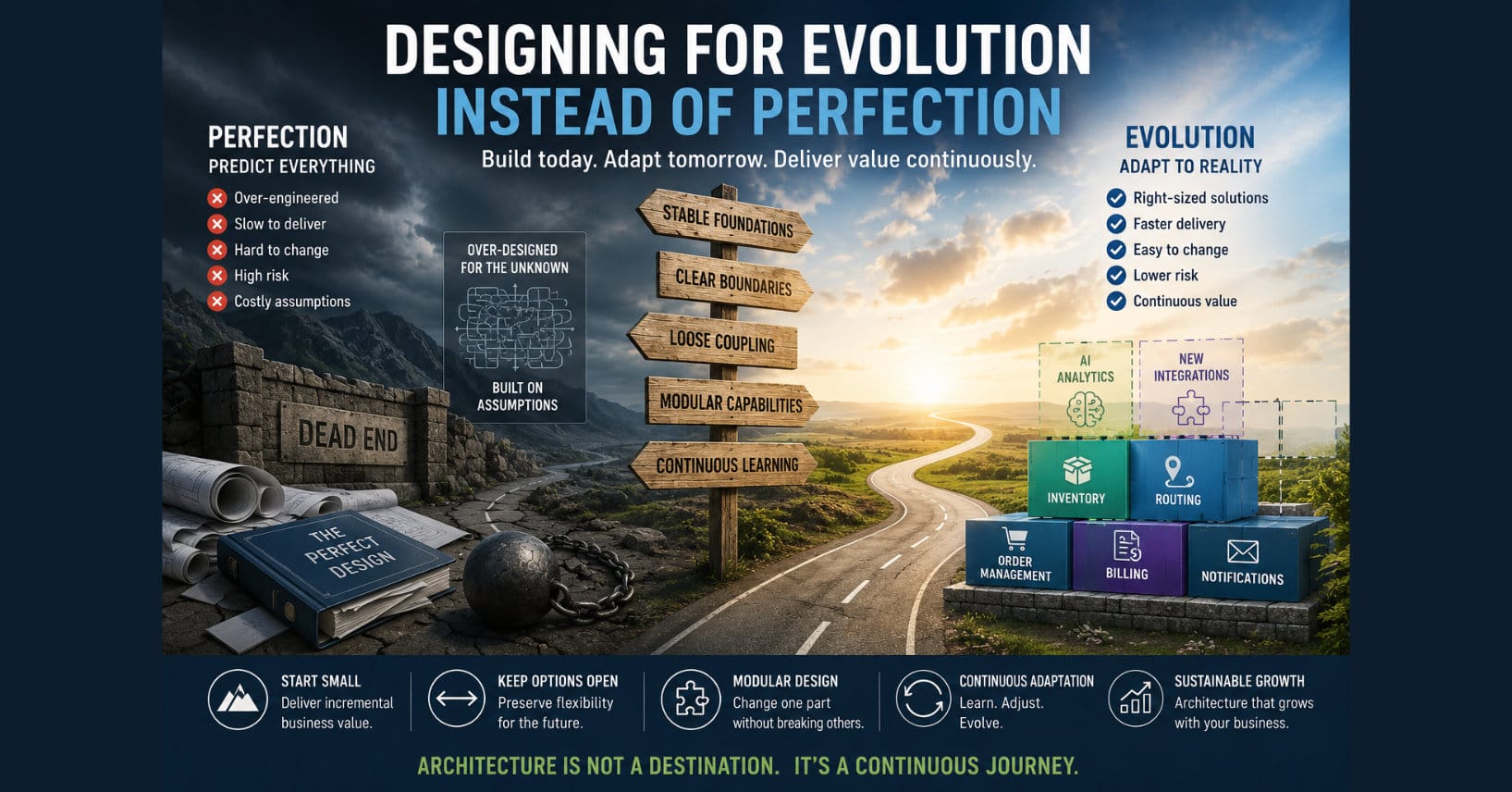
Attempting to design the perfect architecture often results in unnecessary complexity and delayed business value. This article explains why successful enterprise architects focus on preserving options instead of predicting every future requirement. Discover how modular design, stable boundaries, and incremental evolution create resilient systems that adapt as organizations grow and technology changes.
Executive Brief
One of the most common mistakes in enterprise architecture is attempting to design the perfect system before building the first one.
Architects try to anticipate every future requirement.
Developers create elaborate extension points for capabilities that may never exist.
Projects spend months refining architectures intended to solve problems the business has not yet encountered.
The result is often an elegant design that arrives too late—or solves the wrong problem.
Enterprise architecture should not optimize for perfection.
It should optimize for evolution.
The organizations that adapt most successfully are rarely those with flawless architectures. They are those whose architectures make continuous improvement safe, predictable, and economical.
The Business Problem
Business leaders rarely ask technology teams to build the same system forever.
Markets change.
Customers evolve.
Regulations emerge.
Competitors innovate.
Artificial intelligence reshapes expectations.
Growth introduces entirely new operational challenges.
Yet many architecture initiatives begin by assuming today’s understanding of tomorrow is complete.
Teams attempt to model every possible scenario.
Complex abstractions are introduced “just in case.”
Frameworks are selected because they might eventually support future requirements.
Months are invested solving theoretical problems while practical business value waits.
Ironically, many of those anticipated requirements never materialize.
Others emerge in completely unexpected forms.
Perfect architectures fail because they assume certainty.
Successful architectures embrace uncertainty.
The Architectural Principle
Enterprise architecture should preserve options.
Not predictions.
Good architects recognize that future requirements are largely unknowable.
Rather than attempting to anticipate every change, they build systems capable of accommodating change.
This means establishing stable boundaries.
Defining clear interfaces.
Separating business capabilities.
Avoiding unnecessary dependencies.
Documenting architectural decisions.
Most importantly, it means accepting that architecture is never finished.
It continuously evolves alongside the organization it serves.
The objective is not to create an architecture that never changes.
The objective is to create one that changes well.
Enterprise Example
A rapidly growing logistics company begins modernizing its order fulfillment platform.
One architecture team attempts to anticipate every future expansion.
Support for international shipping, autonomous vehicles, blockchain verification, predictive analytics, and dozens of hypothetical integrations are incorporated into the initial design.
Development slows considerably.
Many components remain unused.
Business priorities shift before implementation is complete.
A second team takes a different approach.
They identify stable business capabilities such as order management, inventory, routing, billing, and customer notifications.
Each capability communicates through well-defined contracts.
Future enhancements can be introduced by extending existing capabilities rather than redesigning the entire platform.
When new regulations require shipment tracking changes, only one capability evolves.
When artificial intelligence is later introduced for route optimization, it integrates without disrupting unrelated services.
The architecture was not perfect.
It was prepared to evolve.
Common Mistakes
One common mistake is confusing flexibility with complexity.
Architectures designed to support every conceivable scenario often become difficult to understand and expensive to maintain.
Another mistake is assuming that future requirements can be accurately predicted.
History consistently demonstrates otherwise.
Some organizations delay implementation while striving for architectural completeness.
Others rush implementation without creating sufficient structural boundaries for future change.
Neither extreme succeeds.
Good architecture balances today’s delivery with tomorrow’s adaptability.
It acknowledges that evolution is inevitable while resisting the temptation to engineer speculative solutions.
Architecture Insight
An architecture that can adapt to unexpected requirements is more valuable than one perfectly optimized for requirements that never arrive.
Future resilience depends upon preserved options—not perfect predictions.
Questions Architects Should Ask
Before expanding an architecture, ask:
- Are we solving a current business problem or a hypothetical one?
- Does this design preserve future options?
- Can new capabilities be introduced without widespread disruption?
- Have we separated stable concepts from changing implementations?
- Are we adding flexibility where evidence justifies it?
- Will this decision simplify or complicate future evolution?
Architect’s Checklist
Architectures designed for evolution typically demonstrate these characteristics:
- Stable business boundaries.
- Clearly defined interfaces.
- Independent business capabilities.
- Documented architectural decisions.
- Minimal speculative implementation.
- Low dependency between components.
- The ability to introduce change incrementally instead of through large-scale redesign.
Conclusion
There is no such thing as a perfect enterprise architecture.
Every architecture reflects the current understanding of current business needs.
What distinguishes exceptional architects is not their ability to predict the future.
It is their ability to prepare organizations for it.
Systems designed for evolution remain valuable because they welcome change instead of resisting it.
They reduce the cost of innovation.
They shorten the path from business opportunity to technical implementation.
Most importantly, they recognize that architecture is not a destination reached through perfect planning.
It is a continuous discipline of enabling organizations to evolve with confidence.
In enterprise architecture, perfection is temporary.
Adaptability endures.