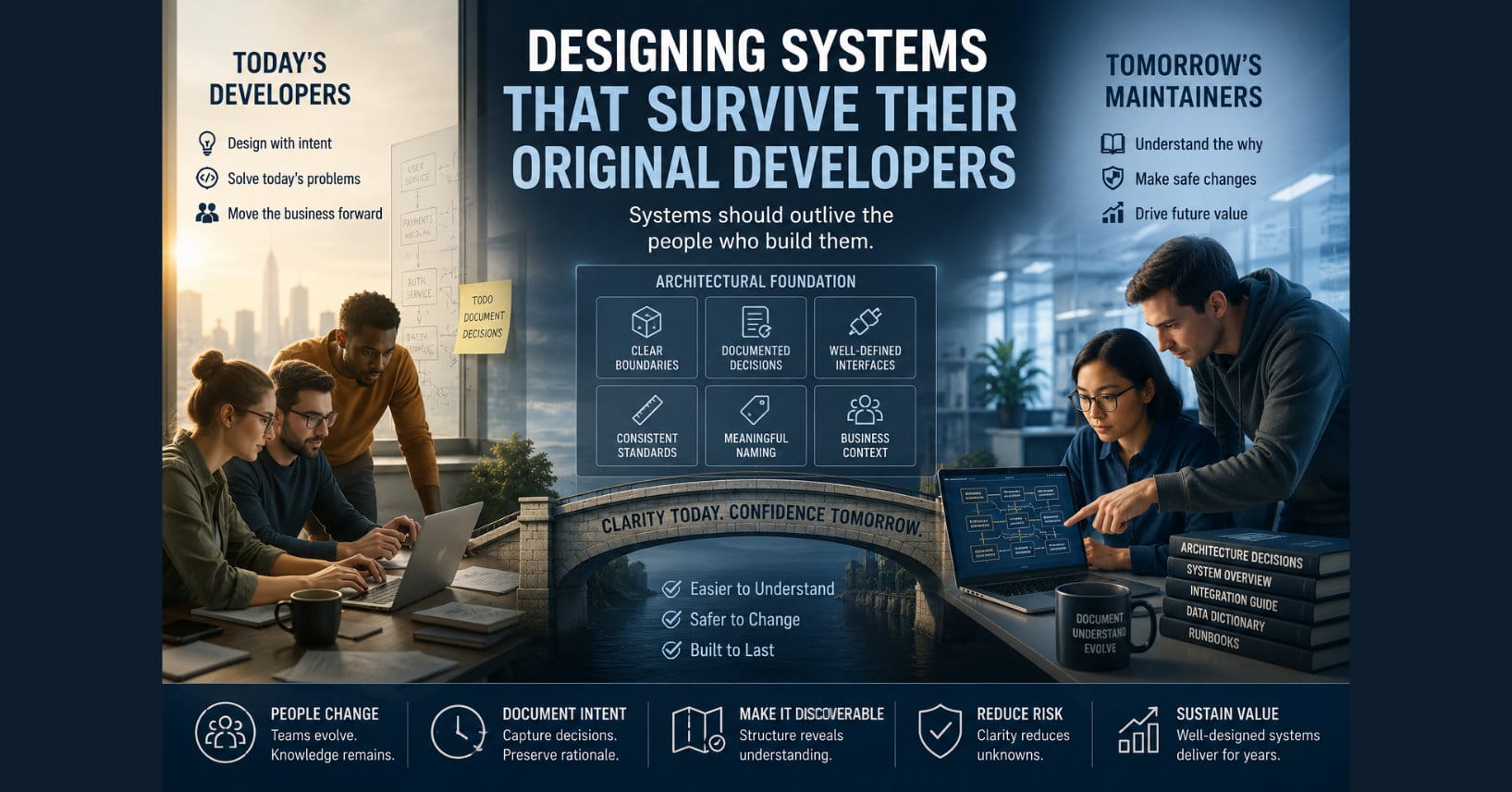
Enterprise Architecture Series—Article 5
Great enterprise architecture is measured not by how well today’s developers understand it, but by how easily tomorrow’s engineers can maintain and extend it. This article explores how documentation, clear boundaries, consistent standards, and intentional architectural decisions reduce organizational risk and ensure enterprise systems remain valuable long after their original developers have moved on.
Executive Brief
One of the greatest misconceptions in software development is believing that systems are built for the people creating them.
They are not.
Enterprise systems are built for the people who will inherit them.
Every architect eventually leaves.
Developers change jobs.
Project managers retire.
Consultants complete their engagements.
Business leadership evolves.
The software, however, often remains.
Many enterprise applications outlive the teams that designed them by decades. The question is not whether someone else will maintain your architecture.
The question is whether they will be able to understand it.
The most successful enterprise architectures are not those that require brilliant engineers to sustain them. They are the ones that allow competent engineers to make safe, predictable changes long after the original designers are gone.
The Business Problem
Organizations frequently invest significant effort delivering software.
Far less attention is given to ensuring future teams can safely maintain it.
This creates a dangerous dependency.
Critical business knowledge becomes concentrated within a handful of individuals.
Architectural decisions exist only in meeting notes.
Business rules remain embedded inside undocumented code.
Naming conventions evolve inconsistently.
Integration assumptions live exclusively in the memories of senior developers.
Everything works—until those individuals leave.
Suddenly, every enhancement becomes an investigation.
Developers fear modifying code because they cannot predict the consequences.
Business initiatives slow while engineering teams reverse-engineer decisions that should have been documented years earlier.
The organization is not maintaining software.
It is rediscovering it.
The Architectural Principle
Good architecture reduces dependence on individual knowledge.
It transforms tribal knowledge into organizational knowledge.
This requires intentional design.
Business capabilities should be obvious.
Interfaces should communicate purpose.
Architectural decisions should be documented.
Standards should be consistent.
Naming should be predictable.
System behavior should be discoverable through structure rather than institutional memory.
An architecture succeeds when future engineers understand why decisions were made—not merely what was implemented.
The objective is not to preserve today’s team.
The objective is to preserve tomorrow’s productivity.
Enterprise Example
A healthcare organization develops an enterprise case management platform over seven years.
The original architects establish clear domain boundaries, maintain Architecture Decision Records (ADRs), define service ownership, document integration contracts, and enforce consistent naming conventions.
Several members of the original team eventually move on.
New engineers join the organization.
Within weeks, they understand how patient intake connects to scheduling, billing, reporting, and regulatory compliance.
Enhancements continue without significant disruption.
A competing organization follows a different path.
Architecture exists primarily in whiteboard sessions and undocumented design discussions.
Developers integrate systems according to local preferences.
Business rules are duplicated.
Naming conventions vary by project.
When senior developers leave, productivity drops dramatically.
Months are spent tracing dependencies before meaningful development resumes.
The technology remained largely the same.
The architecture did not.
One organization preserved institutional knowledge.
The other preserved only source code.
Common Mistakes
Many organizations assume comments inside source code constitute documentation.
Comments explain implementation.
Architecture explains intent.
Another common mistake is documenting systems only during initial delivery.
Architecture evolves.
Documentation must evolve with it.
Some teams over-document every technical detail, creating documents that nobody maintains.
Others document almost nothing, relying upon experienced developers to mentor future teams.
Neither approach scales.
Perhaps the most expensive mistake is designing systems that require extraordinary expertise to modify safely.
Great architecture should reduce cognitive load, not increase it.
A well-designed system should become easier to understand as experience grows—not more mysterious.
Architecture Insight
Every undocumented architectural decision creates a future meeting where someone asks,
“Why was it designed this way?”
The longer it takes to answer that question, the more expensive the architecture becomes.
Questions Architects Should Ask
Before completing a major design, ask:
- Would a new engineer understand this architecture within a reasonable timeframe?
- Are architectural decisions documented alongside the system?
- Does the naming reflect business capabilities?
- Is ownership clearly defined?
- Can business rules be located quickly?
- Does understanding the system depend upon a specific individual?
Architect’s Checklist
Architectures that survive personnel changes typically demonstrate these characteristics:
- Architectural decisions are documented and maintained.
- Business capabilities are clearly separated.
- Interfaces are intentionally designed.
- Naming conventions remain consistent.
- Ownership is explicit.
- Operational documentation reflects production reality.
- Knowledge is distributed throughout the organization instead of concentrated in individuals.
Conclusion
Software longevity is not determined by programming languages, frameworks, or infrastructure.
It is determined by whether future engineers can confidently understand and evolve the system.
Every enterprise eventually experiences personnel changes.
Architectures built around individual expertise become organizational liabilities.
Architectures built around clarity become long-term organizational assets.
The greatest compliment an architect may never hear is this:
“We inherited your system, understood it quickly, and continued improving it without needing to call you.”
That is the true measure of an architecture designed to outlive its original developers.