Enterprise WordPress Series—Article 5
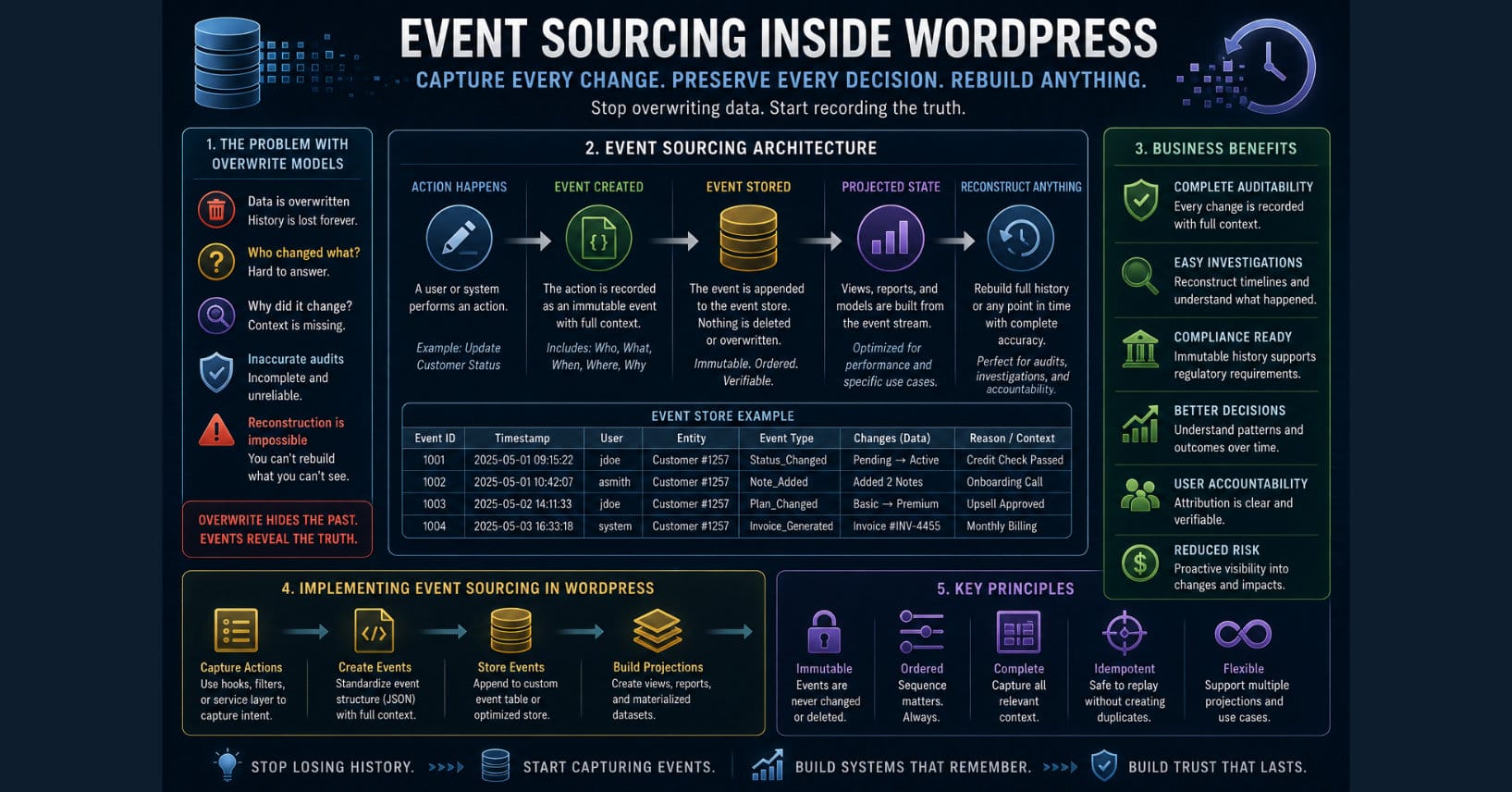
Traditional applications record the current state of data. Event sourcing records the business events that created it. This article explores how enterprise WordPress and Formidable Forms applications can preserve business history, improve analytics, strengthen governance, and support compliance by capturing meaningful events throughout the application lifecycle.
Most applications answer one question exceptionally well.
“What does the data look like right now?”
Enterprise systems ask a second question.
“How did it get here?”
That distinction changes everything.
Knowing the current state of a record is useful.
Knowing every significant event that created that state is often invaluable.
This architectural pattern is known as Event Sourcing, and although it is rarely discussed in WordPress circles, it has enormous value for enterprise applications built with WordPress and Formidable Forms.
Executive Brief
Event Sourcing records business events rather than simply storing the latest state of data.
Instead of replacing existing records whenever information changes, the application captures meaningful events that describe what occurred.
The result is a complete historical narrative of business activity.
This enables auditing, analytics, troubleshooting, compliance, replay, and governance capabilities that are difficult—or impossible—to achieve through traditional CRUD applications alone.
The Difference Between State and Events
Consider a simple assessment.
A traditional application stores:
Status: Approved
That tells us where we are.
It tells us nothing about how we arrived there.
An event-driven application stores:
- Assessment Created
- Reviewer Assigned
- Evidence Submitted
- Review Completed
- Assessment Approved
The current status becomes the result of those events.
The events themselves become valuable business information.
Business History Matters
Many organizations eventually ask questions like:
Who approved this?
When?
Who changed the priority?
How many times was it reassigned?
When did risk increase?
How long did approval take?
Traditional databases often struggle because they overwrite history.
Event sourcing preserves it.
Event Sourcing Is Not Audit Logging
Developers frequently confuse these concepts.
An audit log records technical activity.
An event stream records business activity.
For example:
Audit log:
“User updated Record 427.”
Event stream:
“Vendor Risk Assessment Approved.”
One describes a database operation.
The other describes a business event.
Enterprise architects care about business events.
Events Become Business Assets
Once events are captured, they become reusable information.
Applications can calculate:
- Approval times
- Workflow bottlenecks
- SLA compliance
- Risk trends
- Process efficiency
- Organizational throughput
- Historical reporting
- Operational metrics
The application evolves from recording information to understanding behavior.
WordPress Already Provides Events
Most developers don’t think of WordPress this way, but the platform is fundamentally event-driven.
Hooks such as actions and filters represent events occurring throughout the application lifecycle.
Formidable Forms extends this model.
Examples include:
- Entry created
- Entry updated
- Form submitted
- Payment completed
- Workflow advanced
Each event represents an opportunity to capture business history.
Formidable Forms Makes Event Capture Practical
Imagine a cybersecurity governance platform.
A user submits an assessment.
Rather than updating a status field alone, the application records:
Assessment Created
Reviewer Assigned
Evidence Attached
Control Validated
Exception Requested
Exception Approved
Assessment Closed
Each event becomes immutable business history.
Reports no longer ask only:
“What is the assessment status?”
They also ask:
“How did this assessment evolve?”
Building an Event Store
An event store is intentionally simple.
Each record typically contains:
- Event ID
- Business object
- Object identifier
- Event type
- Timestamp
- User
- Event payload
Notice what is missing.
Current state.
That state can always be reconstructed from the event history.
Supporting Operational Systems
One of the advantages of combining an Operational Data Store with Event Sourcing is that each solves a different problem.
The ODS provides optimized current information.
The event store provides historical truth.
Dashboards consume the ODS.
Auditors consume events.
Leadership benefits from both.
Events Power Better Analytics
Imagine asking:
Which department generates the most assessment revisions?
Which reviewers require the longest approval cycle?
Which workflow step creates the greatest delays?
Which vendors repeatedly require exceptions?
These questions become remarkably easy once the business captures meaningful events instead of merely updating records.
WordPress Does Not Need to Become an Event Store
Event sourcing should complement WordPress—not replace it.
WordPress continues managing:
- Users
- Authentication
- Forms
- Content
- Workflows
- Administration
The event store simply records important business milestones as they occur.
Applications gain enterprise capabilities without abandoning the platform.
Preparing for Enterprise Governance
Although event sourcing often begins as a reporting strategy, its long-term value is governance.
Organizations increasingly need to demonstrate:
Who acted?
When?
What changed?
Which decision was made?
What information supported that decision?
An event stream provides the historical foundation required to answer those questions with confidence.
Looking Ahead
Once applications begin exposing event data, another architectural shift naturally follows.
Instead of designing pages first and exposing APIs later, enterprise developers reverse the process.
They design the data contracts first.
Pages become consumers of APIs rather than the primary interface.
That API-first philosophy enables headless applications, mobile clients, external integrations, and modern enterprise ecosystems.
We’ll examine that transition in the next article.
Enterprise Takeaway
Enterprise applications are rarely judged solely by the accuracy of their current data.
Increasingly, they are evaluated by their ability to explain how that data came to exist.
Event sourcing transforms WordPress from a platform that stores business information into one that preserves business history.
That history becomes one of the most valuable assets an enterprise application can possess.