Enterprise WordPress Series—Article 7
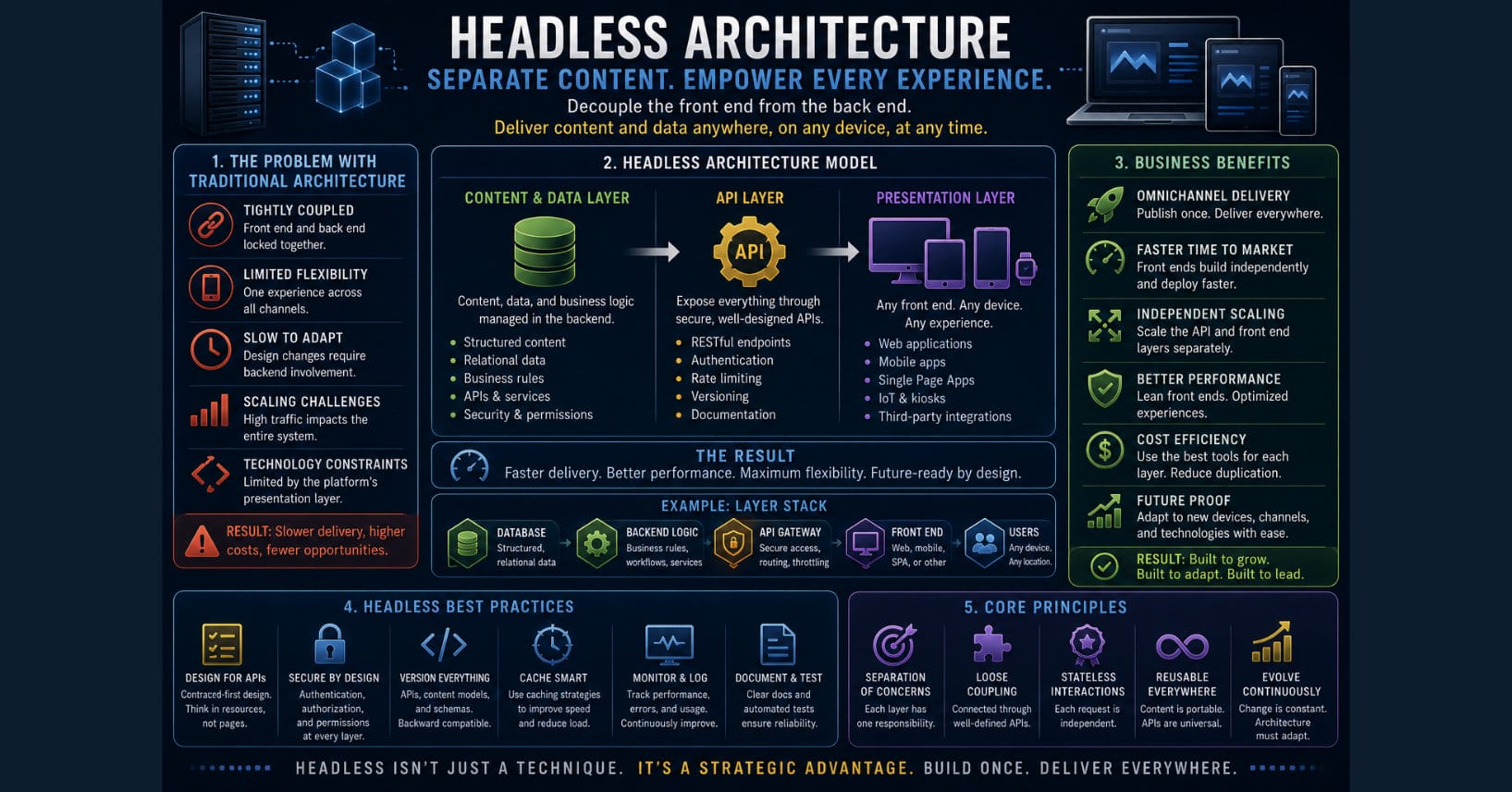
Headless WordPress is more than a JavaScript trend—it’s an architectural pattern that separates business logic from presentation. This article explores how WordPress can serve as an enterprise application platform while APIs power websites, mobile applications, AI assistants, dashboards, and future user experiences.
Mention “headless WordPress” and one framework almost immediately enters the conversation.
React.
For many developers, the two have become nearly synonymous.
That association is understandable, but it misses the larger architectural picture.
Headless WordPress is not a JavaScript framework.
It is an architectural pattern.
Once WordPress exposes well-designed business services through APIs, the presentation layer becomes a separate concern entirely.
React is one option.
It is far from the only one.
Executive Brief
Headless architecture separates the user interface from the application platform.
WordPress remains responsible for authentication, business logic, workflows, APIs, and content management.
Any technology capable of consuming HTTP services can become the front end.
The result is an architecture that is more flexible, more maintainable, and better prepared for future technologies.
What Does “Headless” Really Mean?
Traditional WordPress combines two responsibilities.
It stores information.
It renders information.
Headless architecture separates those responsibilities.
WordPress becomes the application platform.
Another application becomes the presentation layer.
Both communicate through APIs.
Each evolves independently.
The API Is the Contract
The previous article introduced API-first design.
Headless architecture depends upon it.
When APIs expose stable business contracts, user interfaces no longer care how information is stored.
Likewise, WordPress no longer cares which technology displays it.
The API becomes the agreement between them.
Everything else becomes replaceable.
React Is Only One Consumer
React deserves its popularity.
It offers excellent component composition, rich ecosystems, and outstanding developer tooling.
But enterprise architecture is technology-agnostic.
The same API may serve:
- React
- Vue
- Angular
- Svelte
- Native iOS applications
- Native Android applications
- Desktop software
- Kiosk systems
- Internal portals
- AI assistants
- Another WordPress installation
Every consumer speaks the same language.
HTTP.
WordPress Remains the Enterprise Platform
One misconception surrounding headless development is that WordPress somehow becomes less important.
The opposite is often true.
WordPress continues providing:
- Authentication
- Authorization
- User management
- Content management
- Form processing
- Workflow automation
- Business rules
- Media management
- Plugin ecosystem
- REST APIs
Only the presentation layer moves elsewhere.
Everything that makes WordPress valuable remains intact.
Formidable Forms Fits Naturally
Enterprise developers frequently ask whether Formidable Forms still has value in a headless application.
Perhaps more than ever.
Forms continue collecting structured business information.
Workflows continue executing.
Validation continues occurring.
Hooks continue firing.
Business events continue being captured.
The front end merely changes how users interact with those services.
The underlying application remains remarkably similar.
Performance Benefits
Separating presentation from application creates opportunities unavailable in traditional architectures.
Front ends can:
- Render statically
- Cache aggressively
- Load incrementally
- Consume optimized APIs
- Deploy independently
- Scale separately
Meanwhile, WordPress concentrates exclusively on business processing.
Each component performs fewer responsibilities.
Performance generally improves.
Deployment Flexibility
Traditional WordPress often requires deploying the entire application together.
Headless systems allow independent release cycles.
A user interface update does not require backend changes.
API enhancements do not require redesigning the front end.
Infrastructure teams gain considerably more flexibility.
This becomes increasingly valuable as organizations grow.
Security Advantages
Headless architecture also changes the security model.
Instead of exposing large portions of the application directly to public traffic, organizations may expose carefully controlled API endpoints.
Presentation servers become largely disposable.
Application services remain protected behind authentication and authorization layers.
The attack surface often becomes easier to understand and secure.
Artificial Intelligence Changes the Conversation
Headless architecture was originally discussed in terms of websites.
Today another consumer has emerged.
Artificial intelligence.
Large language models do not consume HTML effectively.
They consume structured information.
Organizations with mature API ecosystems are already positioned to integrate AI assistants, autonomous workflows, and intelligent reporting without redesigning their core systems.
The architectural investment pays dividends well beyond web development.
Headless Is About Independence
The greatest advantage of headless architecture is not JavaScript.
It is independence.
Independent teams.
Independent deployments.
Independent technologies.
Independent user experiences.
Independent scaling.
Applications become collections of specialized components rather than one monolithic system.
That is a defining characteristic of modern enterprise software.
Knowing When Headless Makes Sense
Not every WordPress site should become headless.
A marketing website probably should not.
A personal blog certainly should not.
An enterprise application serving multiple interfaces often should.
Indicators include:
- Mobile applications
- Multiple consumer applications
- Rich client experiences
- External integrations
- Independent deployment requirements
- AI consumers
- High-performance interfaces
Architecture should follow business requirements—not industry trends.
Looking Ahead
Separating application logic from presentation creates enormous flexibility.
It also introduces a new challenge.
How do we maintain consistently high performance as APIs, dashboards, reporting systems, mobile applications, and AI consumers all begin requesting information simultaneously?
The answer lies in enterprise caching strategies.
Caching is far more than page optimization.
It becomes an architectural layer in its own right.
We’ll explore that in the next article.
Enterprise Takeaway
Headless WordPress is not about replacing WordPress.
It is about allowing WordPress to specialize.
When business logic lives behind stable APIs, every future interface—whether built with React, Vue, native applications, AI, or technologies that have not yet emerged—can leverage the same enterprise platform.
That is the true promise of headless architecture.
It is not framework independence.
It is architectural independence.