Enterprise Architecture Series—Article 8
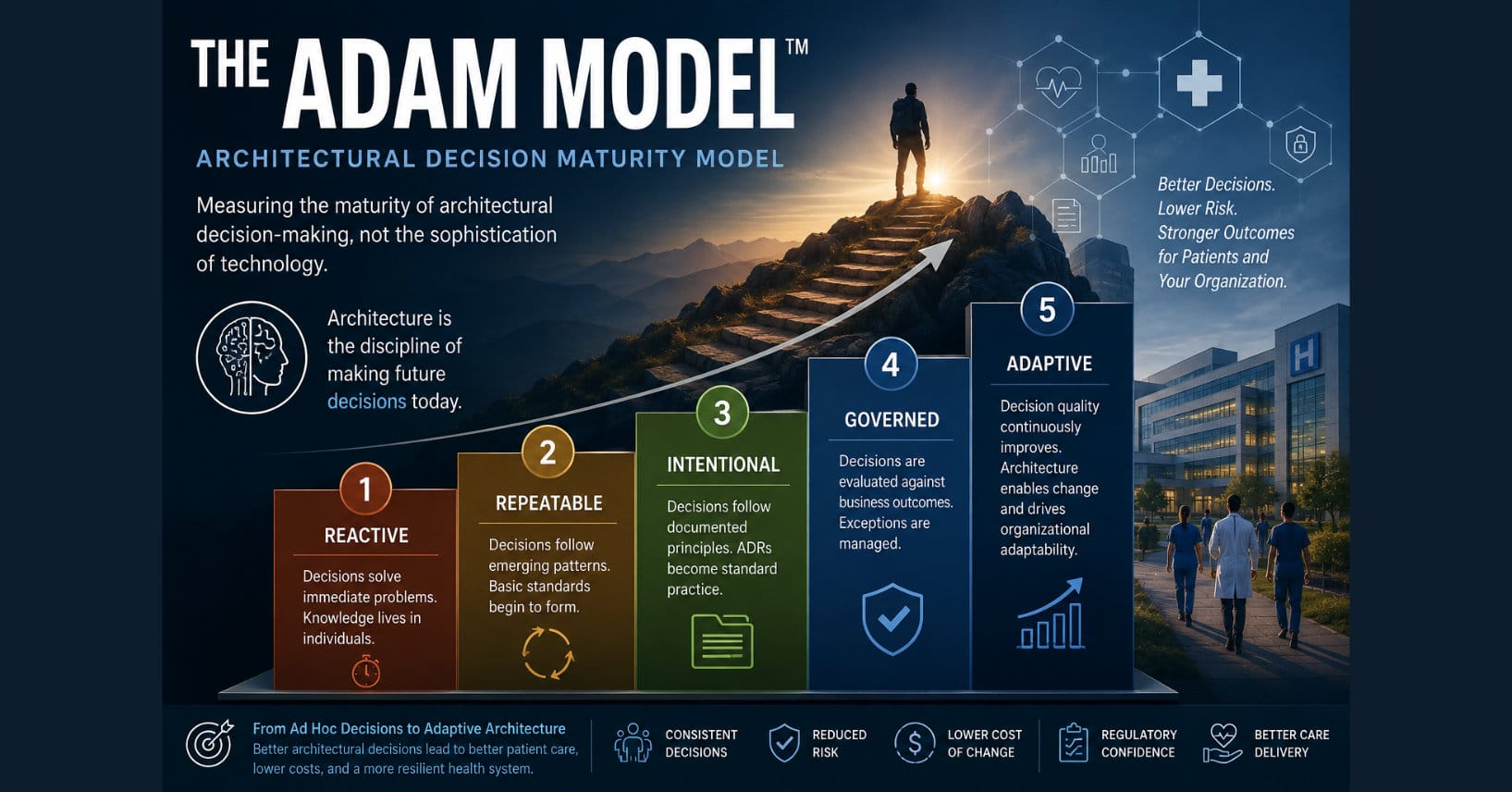
Most maturity models evaluate processes, frameworks, or technology capabilities. The ADAM Model™ (Architectural Decision Maturity Model) introduces a different perspective by measuring the quality and consistency of architectural decision-making. Through five progressive levels—Reactive, Repeatable, Intentional, Governed, and Adaptive—the model helps organizations assess how effectively architecture supports business agility, governance, and long-term organizational resilience.
Measuring Architectural Decision Maturity
Executive Brief
Organizations routinely measure cybersecurity maturity, software development maturity, and operational maturity.
Few measure something even more fundamental:
The maturity of their architectural decisions.
Enterprise architecture is often evaluated by the quality of its diagrams, documentation, frameworks, or technology standards.
Those artifacts matter.
They are not the architecture.
Architecture is the discipline of making future decisions today.
If that principle is true, then architectural excellence should be measured by the quality and consistency of architectural decision-making.
That idea forms the foundation of the Architectural Decision Maturity Model™ (ADMM)—or simply, the ADAM Model™.
Rather than evaluating architecture as a collection of documents, the ADAM Model measures how effectively an organization makes, governs, documents, and continuously improves the architectural decisions that shape its future.
The Business Problem
Most organizations can answer questions like:
- Are we in the cloud?
- Are we using microservices?
- Have we adopted TOGAF?
- Do we have architecture diagrams?
- Do we conduct architecture reviews?
Far fewer can answer questions such as:
- Are architectural decisions consistent?
- Are they aligned with business strategy?
- Are they documented and traceable?
- Do they reduce future cost and risk?
- Are they becoming better over time?
Technology maturity does not guarantee decision maturity.
An organization can deploy modern technology while continuing to make inconsistent architectural decisions.
Conversely, organizations with disciplined decision-making frequently outperform competitors using newer technology.
Technology changes.
Decision quality compounds.
The Architectural Principle
Every architecture is the product of thousands of decisions.
Technology choices.
Integration strategies.
Data ownership.
Security boundaries.
Business capability definitions.
Deployment models.
Documentation practices.
Individually, these decisions appear small.
Collectively, they determine whether an enterprise becomes adaptable—or increasingly constrained.
The ADAM Model measures the maturity of those decisions rather than the sophistication of the technology implementing them.
The Five Levels of the ADAM Model™
Level 1 — Reactive
Architectural decisions are driven by immediate project needs.
Knowledge resides within individuals.
Success depends upon experience rather than discipline.
Architecture happens after problems appear.
Level 2 — Repeatable
Teams begin reusing successful patterns.
Basic standards emerge.
Architectural decisions become more consistent, although governance remains uneven.
Organizations begin developing institutional knowledge.
Level 3 — Intentional
Architectural principles guide decision-making.
Business capabilities are clearly defined.
Architectural Decision Records (ADRs) become part of normal engineering practice.
Decisions are made deliberately rather than accidentally.
Level 4 — Governed
Architectural decisions become measurable business assets.
Governance evaluates exceptions.
Technical debt is understood as the consequence of previous architectural decisions.
Business strategy and architectural strategy become closely aligned.
Level 5 — Adaptive
The organization continuously improves its architectural decision-making.
Architecture enables change rather than resisting it.
Governance accelerates innovation instead of slowing it.
Decision quality becomes a competitive advantage.
The enterprise evolves because its architecture evolves.
Enterprise Example
Consider two regional healthcare systems embarking on nearly identical digital transformation initiatives.
Both invest in modern electronic health record platforms.
Both migrate significant workloads to the cloud.
Both implement API integrations with laboratories, imaging systems, pharmacy services, and patient portals.
On paper, their technology strategies appear remarkably similar.
Five years later, however, their results are dramatically different.
The first organization continues making architectural decisions independently within individual projects. Clinical departments introduce new applications with minimal architectural review. Integration patterns vary from team to team. Business rules become duplicated across scheduling, billing, patient engagement, and reporting systems. Every major initiative requires extensive coordination because previous architectural decisions were never consistently documented or governed.
The second organization follows the ADAM Model.
Architectural decisions are documented through Architecture Decision Records (ADRs). Shared architectural principles guide every major initiative. Governance evaluates exceptions without preventing innovation. Business capabilities such as patient identity, scheduling, billing, clinical documentation, and reporting have clearly defined ownership. New technologies are evaluated not only for technical capability, but also for their long-term impact on architectural decision quality.
Both organizations purchased modern technology.
Only one matured its architectural decision-making.
As regulatory requirements, cybersecurity threats, reimbursement models, and patient expectations continue to evolve, one health system adapts with confidence while the other struggles to keep pace.
The difference is not technology.
It is Architectural Decision Maturity.
Architecture Insight
Technical debt is often nothing more than visible decision debt.
Organizations rarely inherit poor software.
They inherit years of inconsistent architectural decisions.
Questions Architects Should Ask
When evaluating architectural maturity, ask:
- Are architectural decisions documented?
- Are they repeatable?
- Do they align with business strategy?
- Can their outcomes be measured?
- Does governance improve decision quality?
- Is the organization becoming more adaptive over time?
Architect’s Checklist
Organizations demonstrating high Architectural Decision Maturity consistently:
- Make intentional architectural decisions.
- Document significant decisions.
- Govern architectural exceptions.
- Measure architectural outcomes.
- Preserve institutional knowledge.
- Reduce decision debt.
- Continuously improve architectural judgment.
Conclusion
Enterprise architecture is not ultimately measured by frameworks, diagrams, or technology platforms.
It is measured by the quality of the decisions that shape every technology investment.
The ADAM Model shifts the conversation from architecture as documentation to architecture as disciplined decision-making.
Because organizations do not succeed simply by making good decisions once.
They succeed by making good architectural decisions consistently.
That is the purpose of architectural maturity.
That is the purpose of the ADAM Model.