Data Governance Series | Article 7 of 20
Governing the Information That Drives the Enterprise
Summary
Metadata has traditionally described enterprise data through schemas, definitions, classifications, ownership, and technical attributes. As information spreads across cloud platforms, SaaS applications, APIs, analytics environments, collaboration systems, and AI, that role is becoming substantially more important.
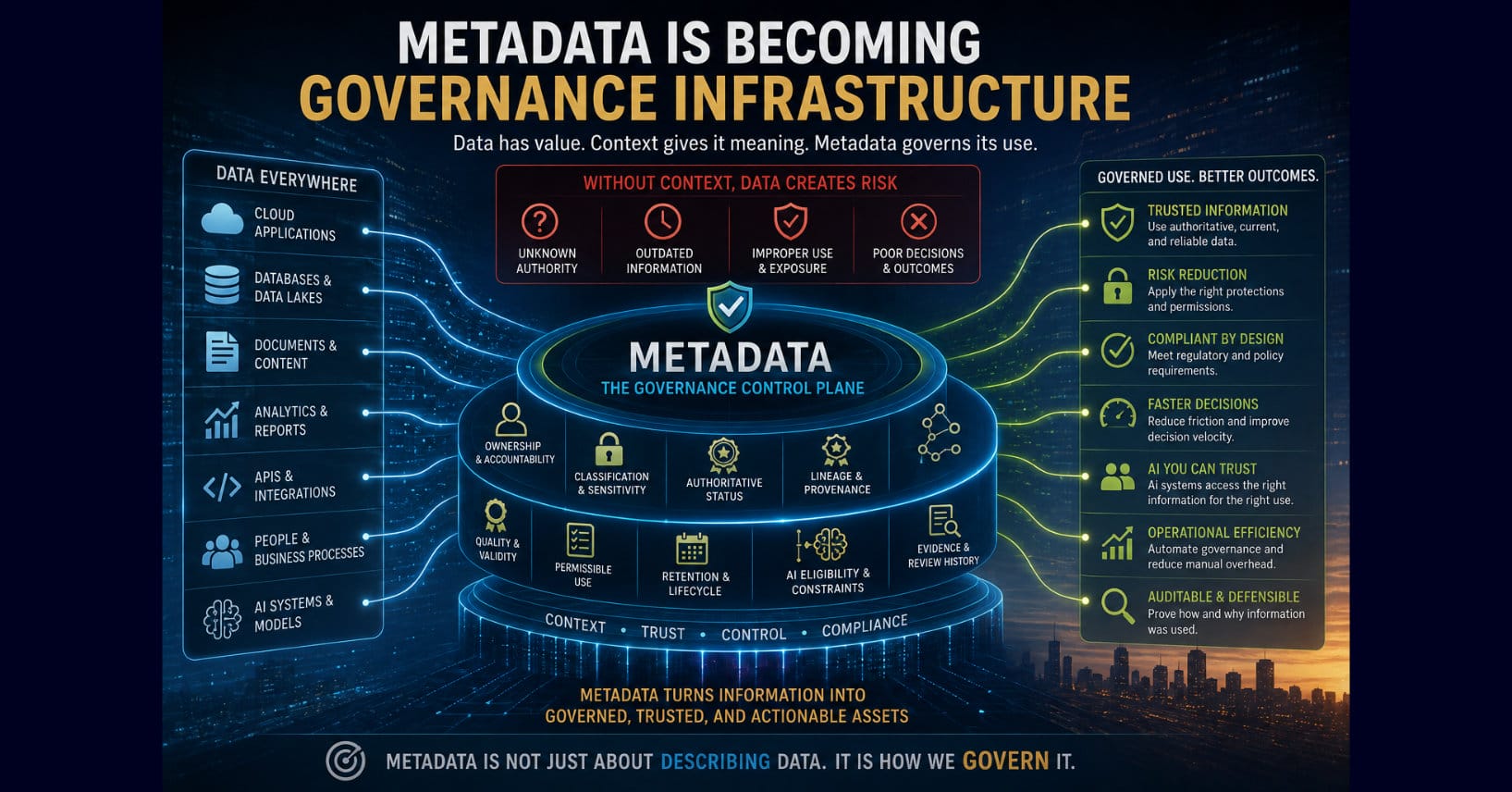
This article examines how metadata is evolving into a governance control plane. Structured governance metadata can communicate ownership, authoritative status, classification, lineage, provenance, quality, retention, permissible use, AI eligibility, and review requirements to both people and machines.
The article also explores why AI makes metadata strategically important, why search relevance is different from governance relevance, and why governance context must remain connected to information as it moves and replicates. As metadata increasingly drives access, retrieval, lifecycle, and AI decisions, metadata quality itself becomes part of data quality.
For years, metadata was easy to treat as documentation.
A field name.
A description.
A schema.
A classification.
A creation date.
A data type.
A business definition.
Useful information about information.
Important, certainly.
Strategic, perhaps.
But infrastructure?
Not usually.
That is changing.
As enterprise information spreads across cloud platforms, SaaS applications, data lakes, warehouses, APIs, collaboration systems, analytics environments, and artificial intelligence, organizations need more than the data itself.
They need machines and people to understand the context surrounding it.
What does this information mean?
Where did it come from?
Who owns it?
Is it authoritative?
How current is it?
What classification applies?
Who may access it?
What uses are permitted?
Has it been superseded?
What transformations occurred?
May an AI system retrieve it?
Can it support a consequential decision?
Those questions are answered increasingly through metadata.
That means metadata is moving beyond documentation.
Metadata is becoming governance infrastructure.
Data Without Context Is Just a Value
Consider the number:
1,250,000
What does it mean?
Revenue?
Units?
Customers?
Dollars?
Euros?
Annual?
Quarterly?
Forecast?
Actual?
Gross?
Net?
Approved?
Preliminary?
Without context, the value is almost useless.
Add metadata:
Revenue: $1,250,000.
Better.
Add more:
North American recurring revenue for Q2.
Better still.
Then:
Q2 North American recurring revenue, calculated according to the approved Finance definition, sourced from the enterprise revenue warehouse, refreshed at 6:00 a.m., owned by Finance, with a completeness score of 99.8 percent.
Now the number begins to become governable information.
The data value did not change.
The context did.
Metadata created that context.
The Enterprise Has a Context Problem
Modern organizations do not generally suffer from a shortage of data.
They suffer from a shortage of reliable context around that data.
A dataset exists.
But employees do not know whether it is current.
A report exists.
But nobody knows which definition produced the metric.
A document appears in search results.
But users cannot tell whether it is still authoritative.
A database contains customer information.
But downstream teams do not understand the classification requirements.
An analyst discovers a useful table.
But lineage is unclear.
An AI assistant retrieves a policy.
But nothing tells the system that the policy was superseded two years ago.
These are metadata failures.
The content exists.
The context necessary to govern its use does not.
Metadata Answers Governance Questions
Traditional metadata programs frequently concentrate on describing technical structures.
Table names.
Column names.
Data types.
Relationships.
Schemas.
Those remain essential.
Governance metadata adds another layer.
For consequential information, organizations may need metadata describing:
Ownership — Who is accountable?
Authority — Who can approve changes or uses?
Classification — How sensitive is the information?
Authoritative status — Is this the approved source?
Currency — When was it created, updated, or reviewed?
Validity — During what period should it be used?
Lineage — Where did it originate and how was it transformed?
Provenance — What evidence establishes its origin?
Quality — Does it meet required thresholds?
Permissible use — For what purposes may it be used?
Retention — How long should it exist?
Jurisdiction — What geographic or regulatory constraints apply?
AI eligibility — May an AI system retrieve, train on, infer from, or act upon it?
Human review requirements — Does use require additional oversight?
Once these attributes become structured and reliable, governance becomes less dependent on institutional memory.
The information begins carrying its governance context with it.
From Catalog to Control Plane
Data catalogs helped organizations solve an important discovery problem.
What data do we have?
Where is it?
What does it mean?
Who owns it?
Those capabilities remain valuable.
But the next generation of governance infrastructure must do more than help humans browse information.
Metadata increasingly needs to influence system behavior.
A classification should affect access controls.
A retention attribute should influence lifecycle management.
An authoritative-source designation should influence analytics and AI retrieval.
A quality status should influence whether data may support a consequential process.
A jurisdictional attribute should influence where information may be processed.
An AI-use restriction should influence which models or agents may consume it.
At that point, metadata is no longer simply describing governance.
It is helping execute governance.
That is the transition from catalog to control plane.
Policies Humans Read Are Not Enough
Traditional governance assumes that people read policies and apply them.
That model has obvious limits.
An enterprise may have a 40-page data-handling policy explaining classifications, retention requirements, permitted uses, and approval processes.
A human employee can theoretically read it.
An API cannot.
A data pipeline cannot.
A retrieval engine cannot.
An AI agent cannot reliably infer every governance requirement from a policy document and apply it consistently across millions of transactions.
Automated environments require governance rules to become machine-interpretable.
Metadata provides part of that translation layer.
Instead of relying solely on:
“Restricted data must not be used for unapproved AI purposes,”
the organization can attach structured attributes indicating:
Classification: Restricted.
AI Retrieval: Prohibited.
External Model Use: Prohibited.
Training Use: Prohibited.
Human Approval Required: Yes.
Now technology has something operational to enforce.
Policy establishes intent.
Metadata helps convert intent into control.
AI Makes Metadata Strategic
Artificial intelligence dramatically increases the importance of metadata because AI systems consume context at scale.
Consider an enterprise retrieval-augmented generation system connected to a document repository.
The repository contains:
the current cybersecurity policy;
three superseded versions;
draft revisions;
meeting notes;
an employee training presentation;
a regulatory interpretation memo;
an outdated FAQ;
and an executive briefing.
A human subject-matter expert may recognize the distinctions immediately.
A retrieval system sees documents.
Without reliable metadata, the AI system may retrieve whichever content appears semantically relevant.
That creates an obvious problem.
The organization needs to communicate:
Current policy: authoritative.
Prior policy: superseded.
Draft: not approved.
Meeting notes: informational only.
Training presentation: derivative.
Regulatory memo: jurisdiction-specific.
FAQ: expired.
Executive briefing: confidential.
Those are metadata distinctions.
AI systems cannot consistently respect governance distinctions the enterprise has never encoded.
Search Relevance Is Not Governance Relevance
This introduces an important distinction.
Search engines and AI retrieval systems are designed to find relevant information.
Governance requires them to find appropriate information.
Those are not the same thing.
A five-year-old policy may be highly relevant to a search query.
It may also be completely inappropriate as current guidance.
A confidential legal analysis may be semantically relevant.
The user may not be authorized to receive it.
A draft strategy document may contain the exact answer requested.
It may never have been approved.
A low-quality dataset may correlate strongly with the query.
It may not be suitable for the decision being made.
Traditional retrieval asks:
Does this information match the request?
Governed retrieval must also ask:
Should this information be used for this request?
Metadata helps answer the second question.
Authority Needs to Be Machine-Readable
Humans frequently understand authority through organizational context.
They know that a signed policy outranks a meeting note.
They know Finance owns the official revenue figure.
They know a particular spreadsheet is unofficial.
They know a draft marked “For Discussion” should not be treated as approved policy.
Machines need those distinctions represented explicitly.
This suggests that authoritative status should become a first-class metadata attribute for critical information.
Examples might include:
Draft.
Under Review.
Approved.
Authoritative.
Superseded.
Archived.
Expired.
Reference Only.
The exact taxonomy matters less than the discipline.
Enterprise systems should be able to distinguish information that exists from information that governs.
That distinction will become increasingly important as AI systems participate in knowledge work.
Metadata Must Follow the Information
Another challenge is persistence.
Metadata often exists in one system but disappears when information moves.
A source database knows the classification.
An export does not.
A document-management platform knows the owner.
A downloaded copy does not.
A data catalog contains lineage.
A spreadsheet created from the dataset does not.
A SaaS platform contains retention attributes.
An API response strips them away.
An AI pipeline retrieves content but not the metadata needed to interpret its authority.
Governance breaks when context is separated from content.
Organizations therefore need to think about metadata portability.
Where practical, critical governance attributes should travel with—or remain reliably linked to—the information they govern.
Otherwise, every copy becomes a potential context-loss event.
Copies Are a Metadata Problem
Enterprise information replicates constantly.
Data is exported.
Cached.
Copied.
Synchronized.
Backed up.
Embedded.
Indexed.
Transformed.
Downloaded.
Included in reports.
Converted into vector embeddings.
Sent to third parties.
Every copy creates a governance question.
Does the copy inherit the original classification?
Does retention still apply?
Is lineage preserved?
Does the owner remain the same?
Is the copy authoritative?
Can it be used independently?
What happens when the source changes?
What happens when the source is deleted?
Without metadata, copies become detached from governance.
This is one reason organizations accumulate contradictory information.
The content replicated successfully.
The governance context did not.
Metadata Quality Becomes Data Quality
If metadata drives governance decisions, metadata itself must be trustworthy.
An incorrect classification can expose sensitive information.
An outdated owner can prevent escalation.
An incorrect retention date can cause premature deletion or excessive preservation.
A false authoritative designation can cause users or AI systems to trust the wrong source.
Broken lineage can conceal the origin of a defect.
An incorrect AI-use flag can allow prohibited information into a model workflow.
This creates an important principle:
When metadata controls how data is governed, metadata quality becomes part of data quality.
Organizations therefore need ownership, validation, monitoring, and change control for critical metadata.
The control plane must itself be governed.
Manual Metadata Will Not Scale
Many governance programs rely heavily on employees manually entering metadata into catalogs.
That is necessary for attributes requiring human judgment.
It is also insufficient.
Enterprise information changes too quickly.
New datasets appear.
Schemas change.
Files move.
Owners leave.
Applications are retired.
Pipelines are modified.
Policies expire.
AI systems generate new content.
A governance model dependent entirely upon manual updates will drift away from reality.
The future will require hybrid metadata management.
Some attributes will be assigned by accountable humans.
Others will be discovered automatically.
Systems can detect:
schemas;
data types;
lineage;
access patterns;
locations;
creation dates;
modifications;
technical dependencies;
duplication;
and potentially sensitive content.
AI may assist with classification and semantic enrichment.
But automated metadata should not be confused with automated authority.
A model may suggest that a document appears to be a policy.
It should not necessarily declare that document authoritative.
Some governance decisions require accountable human judgment.
Automation should reduce the administrative burden while preserving decision authority.
Metadata Can Make Governance Continuous
Traditional governance often operates periodically.
Annual reviews.
Quarterly certifications.
Scheduled audits.
Manual inventories.
Those activities remain useful.
Metadata enables something more dynamic.
Suppose a critical dataset’s owner changes.
A governance system can flag dependent processes for review.
Suppose quality falls below an approved threshold.
Downstream systems can receive a warning.
Suppose a policy reaches its expiration date.
AI retrieval can exclude it automatically.
Suppose a dataset’s classification changes from Internal to Restricted.
Access controls and AI permissions can be reevaluated.
Suppose lineage reveals that a high-risk AI application now depends upon a new external source.
Governance can trigger review.
This moves governance from periodic inspection toward continuous awareness.
Metadata becomes the sensor network of the governance system.
The Governance Graph
The most valuable metadata may eventually be relational.
Not simply:
This dataset is owned by Finance.
But:
This dataset is owned by Finance.
It originates from these systems.
It contains these classifications.
It supports these reports.
It feeds these AI systems.
It influences these decisions.
It is governed by these policies.
It is subject to these regulations.
It has these known quality limitations.
It is consumed by these business processes.
That begins to form a governance graph.
The enterprise can see relationships among information, systems, people, controls, decisions, and obligations.
This is substantially more powerful than a static inventory.
It allows organizations to ask:
If this dataset becomes unreliable, what decisions are affected?
If this regulation changes, what information must be reviewed?
If this owner leaves, what data loses accountability?
If this system is compromised, what downstream AI applications are exposed?
If this policy expires, which automated processes depend upon it?
Governance becomes navigable.
Evidence Can Become Metadata Too
Evidence itself can also be represented through metadata.
A dataset was reviewed on a particular date.
A definition was approved by a particular authority.
A quality exception expires next month.
An AI-use decision was authorized under a specific governance process.
A retention decision was approved by Legal.
A lineage change was reviewed.
These attributes create a governance history.
They answer not only:
What is true about this data?
But:
Who determined that, when, under what authority, and based upon what evidence?
That is where metadata begins intersecting with evidentiary architecture.
Governance becomes reconstructable.
Metadata Changes the Role of the Data Catalog
The enterprise data catalog is therefore likely to evolve.
The first generation answered:
What data do we have?
The next generation must increasingly answer:
What does it mean?
Who governs it?
Can we trust it?
What depends upon it?
How may it be used?
What controls apply?
Can AI consume it?
What decisions does it influence?
What evidence supports its governance status?
At that point, calling it a catalog may undersell its role.
It becomes part registry, part policy engine, part lineage system, part evidence repository, and part governance control plane.
Governance Infrastructure Must Be Designed
Organizations should resist the temptation to solve this simply by purchasing another platform.
Technology matters.
Architecture matters more.
Before selecting tools, enterprises need to determine which governance attributes actually matter.
What information requires authoritative designation?
Which decisions require lineage?
Which classifications affect AI use?
Which metadata must follow data across platforms?
Which attributes can be discovered automatically?
Which require accountable approval?
Which governance events should trigger automated controls?
Which evidence must be preserved?
Without those decisions, a sophisticated metadata platform can become an expensive dictionary.
The goal is not more metadata.
The goal is metadata that changes governance behavior.
From Documentation to Infrastructure
The transition can be summarized simply.
Traditional metadata says:
Here is information about this data.
Governance metadata says:
Here is how this data should be understood, trusted, controlled, and used.
Operational metadata goes one step further:
And systems can act upon those governance requirements.
That is infrastructure.
As enterprises become more automated, the distinction becomes increasingly important.
Human governance does not disappear.
Instead, human decisions must increasingly be translated into structures machines can respect.
Metadata becomes part of that translation.
Boardroom Takeaway
Executives should stop thinking about metadata solely as technical documentation maintained by data teams.
As information moves across platforms and AI systems increasingly retrieve and act upon enterprise knowledge, metadata becomes essential to determining authority, classification, provenance, quality, permissible use, and governance status.
The leadership question is:
“Can our systems determine not merely what information exists, but which information is authoritative, trustworthy, permitted, and appropriate for the decision being made?”
If the answer depends entirely upon an experienced employee knowing where to look, governance has not yet become infrastructure.
The future governed enterprise will require information to carry enough context for people and machines to understand how it should be used.
Metadata is becoming that context.
And increasingly, that makes metadata part of the enterprise control plane.
Coming Next
Article 8: Data Lineage Is the Enterprise Chain of Custody
Knowing that information exists is not enough.
Organizations increasingly need to demonstrate where consequential data originated, how it moved, what transformations occurred, who changed it, which systems consumed it, and what decisions ultimately depended upon it.
The next article examines why data lineage should be understood not merely as a technical map of pipelines, but as the enterprise chain of custody for information.