Enterprise WordPress Series—Article 9
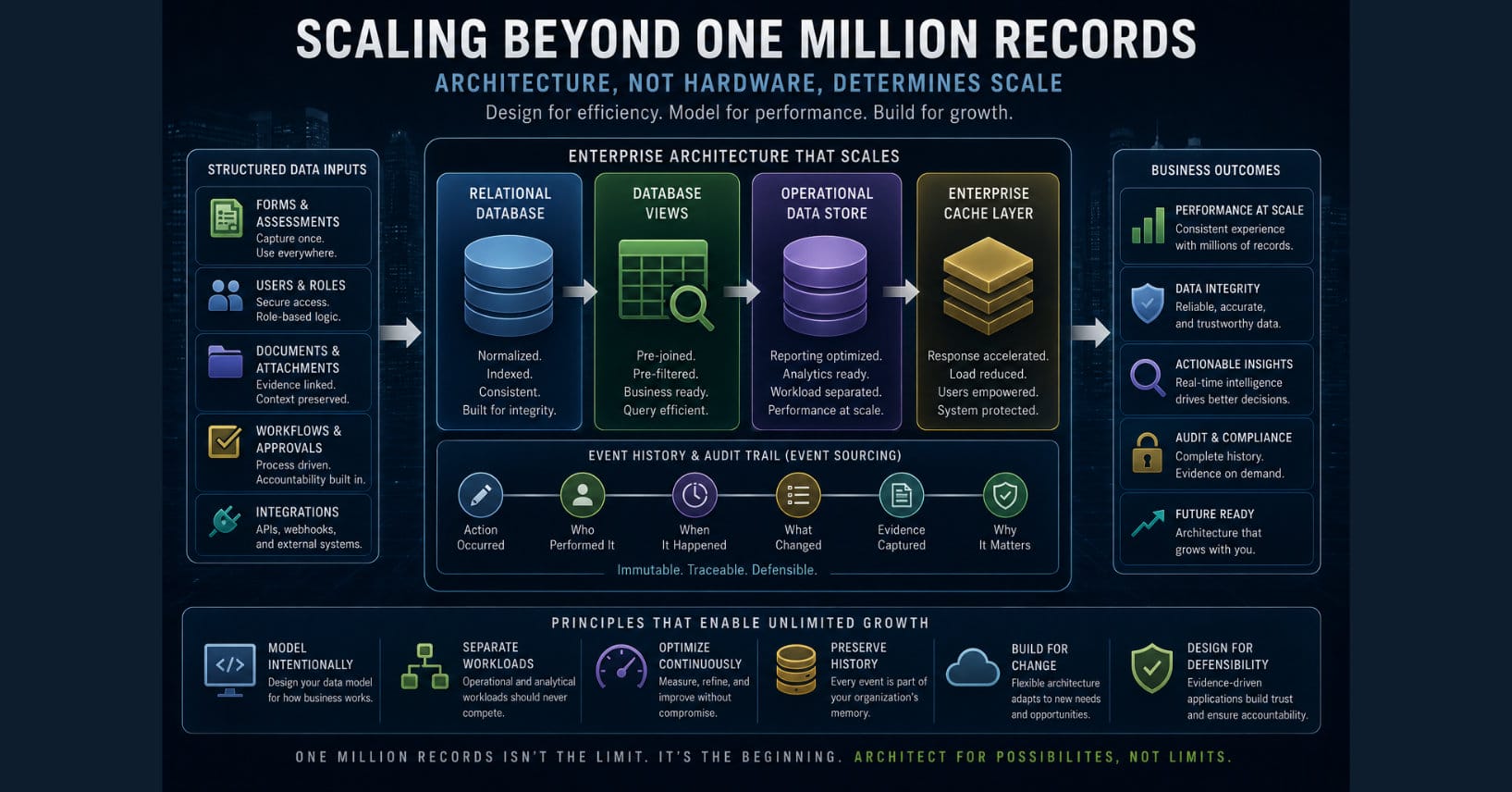
Can WordPress scale beyond one million records? Absolutely—but scalability is an architectural challenge, not a database limitation. This article explains how relational models, database Views, Operational Data Stores, event sourcing, API-first design, and enterprise caching work together to build high-performance Formidable Forms applications that continue to grow predictably.
There is a question every enterprise WordPress developer eventually hears.
“Can WordPress scale?”
The answer is usually followed by another question.
“What do you mean by scale?”
If scale means serving millions of page views, WordPress has already answered that question.
If scale means storing millions of business records while supporting dashboards, reporting, APIs, workflows, analytics, and real-time operations, the answer is still yes—but only with the right architecture.
Enterprise applications do not become successful because they avoid large datasets.
They become successful because they are designed for them.
Executive Brief
One million records is not an architectural limit.
It is an architectural milestone.
Applications that scale successfully separate operational workloads from reporting, leverage relational models, expose APIs, employ intelligent caching, and allow each architectural layer to perform the work it was designed to do.
Growth becomes predictable because complexity has already been addressed.
The Wrong Question
Developers often ask:
“Can Formidable Forms handle one million records?”
That question misses the point.
The better questions are:
How are the records modeled?
How are they queried?
How are they reported?
How are they cached?
How are APIs consuming them?
How are business relationships represented?
Scale is rarely determined by record count alone.
It is determined by architecture.
The Metadata Myth
Earlier in this series we discussed metadata.
Metadata itself is not the obstacle.
Poor architectural decisions are.
Applications that repeatedly perform expensive metadata joins, duplicate calculations, and generate complex reports directly against operational tables eventually encounter performance challenges.
Applications that introduce relational models, database Views, Operational Data Stores, and business caching continue growing far more gracefully.
Separate Operational and Analytical Workloads
One of the most important architectural decisions is separating data collection from data consumption.
Users continue submitting forms.
Managers continue approving workflows.
Executives continue reviewing dashboards.
Analysts continue running reports.
Each workload deserves infrastructure optimized for its purpose.
The architecture—not the hardware—creates scalability.
Formidable Forms Remains the Operational Engine
Enterprise developers sometimes assume large applications eventually outgrow Formidable Forms.
Experience often demonstrates the opposite.
Formidable Forms remains exceptionally effective for:
- Structured data collection
- Workflow execution
- Validation
- User interfaces
- Automation
- Business rules
What changes is not the data collection platform.
What changes is the supporting architecture surrounding it.
Query Less. Prepare More.
Applications that scale well rarely calculate everything during every request.
Instead they prepare information ahead of time.
Operational Data Stores organize reporting.
Database Views simplify relationships.
Business metrics become cached.
Event streams preserve history.
APIs expose prepared business objects.
Users receive answers.
They do not wait while applications reconstruct them.
Scaling Teams
Enterprise architecture also scales people.
When business logic exists consistently within:
- APIs
- Database Views
- Event streams
- Operational Data Stores
new developers understand the system more quickly.
Maintenance becomes simpler.
Knowledge becomes reusable.
Architecture supports both software and the teams responsible for it.
Infrastructure Is the Last Optimization
Many organizations attempt to solve performance problems by purchasing larger servers.
Sometimes that helps.
More often it delays necessary architectural improvements.
Better architecture frequently produces larger gains than faster hardware.
Enterprise developers optimize design before infrastructure.
Scaling Beyond a Single Server
Well-designed software eventually reaches the limits of a single machine.
Fortunately, enterprise architecture does not assume that every workload executes on one server.
As applications continue growing, the infrastructure itself can scale horizontally.
Common enterprise strategies include:
- Load balancers distributing requests across multiple application servers
- Dedicated database servers optimized for transactional workloads
- Read replicas supporting reporting and API queries
- Separate caching servers using technologies such as Redis or Memcached
- Dedicated search platforms for full-text indexing
- Background job processors handling long-running workflows independently of user requests
Each component performs a specialized role rather than forcing one server to do everything.
This separation improves both performance and reliability while allowing individual layers to scale independently.
Architecture Before Hardware
Hardware should amplify good architecture—not compensate for poor architecture.
Adding CPUs, memory, or additional servers rarely fixes inefficient queries, poorly designed data models, or unnecessary computation. It simply allows inefficient software to consume more resources.
Once an application has been optimized through relational design, Operational Data Stores, event sourcing, API-first services, and intelligent caching, infrastructure scaling becomes remarkably straightforward. Load balancers, clustered application servers, database replication, and distributed caching extend an already efficient architecture rather than masking its weaknesses.
Enterprise systems scale because every layer—from software to database to infrastructure—works together. Hardware is an important part of that equation, but it delivers its greatest value only after the application itself has been designed to scale.
Monitoring Matters
Large applications require visibility.
Architects should monitor:
- Query execution
- Cache effectiveness
- API response times
- Background jobs
- Synchronization processes
- Database growth
- Reporting workloads
Scaling without measurement becomes guesswork.
Scaling with measurement becomes engineering.
Planning for Ten Million Records
Applications designed for one million records often scale to ten million with surprisingly few changes.
Why?
Because the important architectural decisions were made much earlier.
Business services already exist.
Caching already exists.
Operational reporting already exists.
Presentation is already separated.
Growth becomes a capacity planning exercise rather than an architectural emergency.
Enterprise Applications Continue Evolving
Enterprise architecture is never static.
New interfaces appear.
Artificial intelligence becomes another consumer.
Reporting requirements evolve.
Compliance expectations increase.
Business processes change.
Applications designed around services rather than pages adapt naturally.
Applications tightly coupled to implementation details struggle.
That difference becomes increasingly apparent as organizations mature.
Looking Ahead
Throughout this series we’ve transformed the way WordPress is viewed.
No longer merely a content management system.
No longer simply a website platform.
Instead, WordPress has emerged as the foundation of an enterprise application ecosystem built upon relational models, operational reporting, event history, APIs, headless architecture, and intelligent caching.
One final concept remains.
How do all of these architectural patterns combine to create applications that produce trustworthy, defensible business evidence?
That is the focus of the next article.
Enterprise Takeaway
Enterprise WordPress applications do not scale because they avoid complexity.
They scale because complexity is organized.
Software architecture lays the foundation.
Database engineering transforms that architecture into efficient data access.
Infrastructure engineering allows the solution to grow horizontally through load balancing, distributed caching, replicated databases, and specialized application servers.
Each layer builds upon the previous one.
Organizations that invest deliberately in all three rarely find themselves redesigning systems simply because they became successful.
At enterprise scale, hardware is no longer a substitute for architecture—it is the platform that allows good architecture to realize its full potential.