Enterprise Software Engineering Series—Article 5
Cloud platforms, APIs, AI-assisted development, and low-code tools have made software development dramatically faster, but speed alone does not produce successful enterprise systems. This article explores the critical difference between assembling software components and intentionally designing systems that can evolve, scale, and support business objectives for years. Learn why architecture, business capability, governance, and long-term thinking distinguish enterprise engineering from simple implementation.
Executive Perspective
Modern software development has never been faster.
Organizations can assemble sophisticated applications using cloud services, open-source frameworks, APIs, low-code platforms, AI-assisted development, and commercial software components. Solutions that once required years of development can now be delivered in months—or even weeks.
This acceleration is an extraordinary achievement.
It has also created a dangerous misconception.
Many organizations now believe that assembling software components is the same as engineering a system.
It is not.
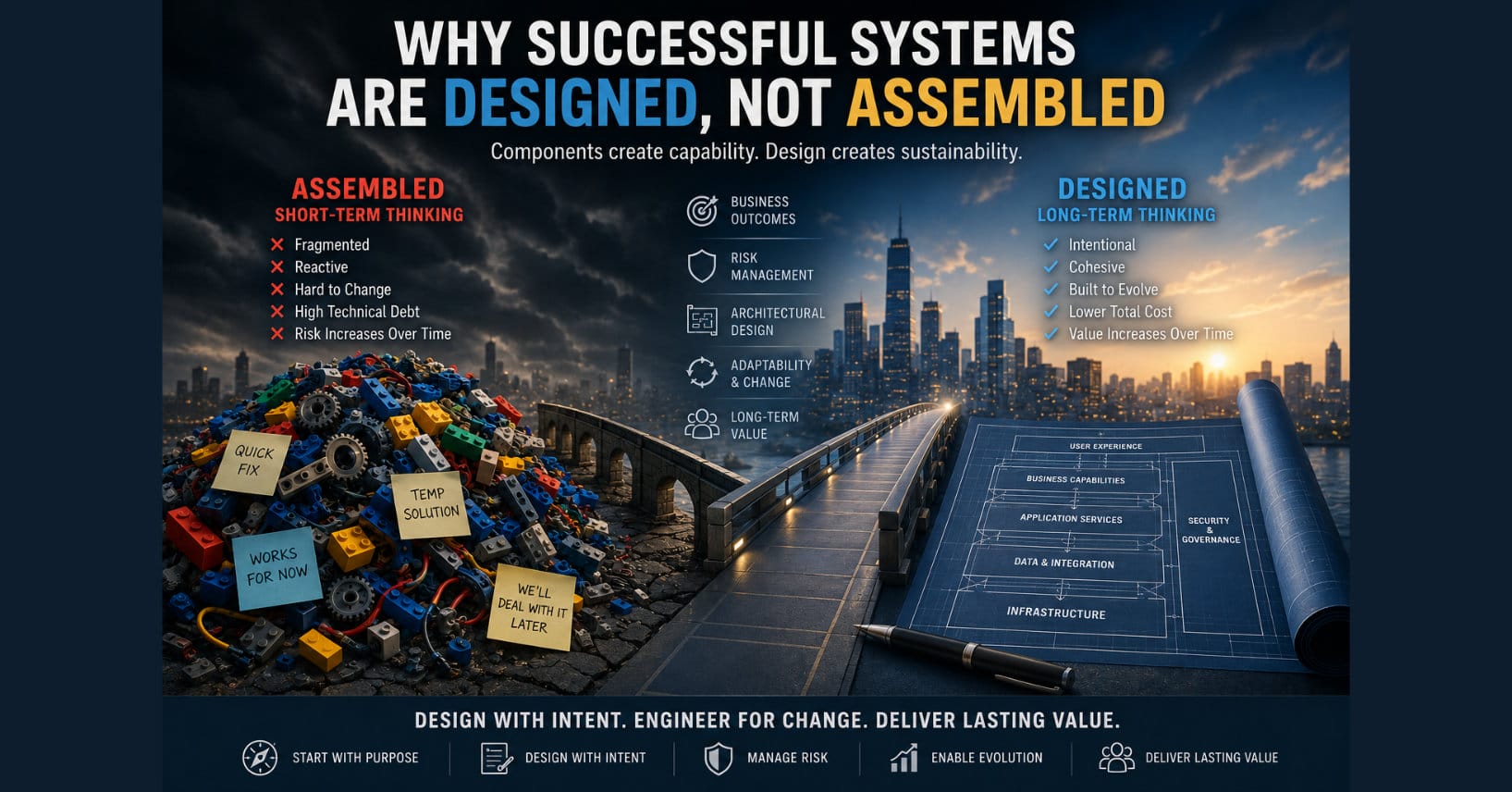
Components create capability.
Design creates sustainability.
Enterprise software succeeds not because the individual technologies are exceptional, but because those technologies have been intentionally designed to function as a coherent system throughout years of operational change.
Building Is Not the Same as Designing
Imagine constructing a commercial office building.
You would never begin by purchasing steel, concrete, windows, electrical equipment, and plumbing fixtures before understanding the purpose of the building.
The blueprint comes first.
The materials come second.
Software engineering should follow the same principle.
Unfortunately, many projects begin with discussions such as:
- Which framework should we use?
- Which cloud platform should we choose?
- Which database is fastest?
- Which AI tool should generate the code?
- Which low-code platform can build it quickest?
These are implementation decisions.
Design decisions come earlier.
What business capability are we creating?
What risks must be managed?
How will the system evolve?
How will it be governed?
How will it be maintained?
Until these questions are answered, technology selection remains premature.
Systems Are More Than Their Parts
A common misconception in software development is that excellent components naturally produce excellent systems.
Enterprise engineering demonstrates otherwise.
An application may include:
- High-quality source code.
- Modern frameworks.
- Secure infrastructure.
- Well-designed databases.
- Reliable cloud services.
- Comprehensive testing.
Yet still fail because the components were never designed to work together as a complete system.
Successful enterprise systems depend on relationships more than individual technologies.
Data flows.
Business rules.
Trust boundaries.
Operational processes.
Failure recovery.
Governance.
Integration.
Architecture exists to coordinate these relationships.
Design Begins with Business Capability
Organizations do not invest in software because they enjoy technology.
They invest in business outcomes.
Reducing processing time.
Improving customer service.
Managing operational risk.
Supporting regulatory compliance.
Increasing revenue.
Improving decision-making.
Technology enables these outcomes.
It should never become the objective itself.
The most successful engineering organizations begin by understanding the business capability they intend to create.
Only then do they determine the technology required to support it.
Design Anticipates Change
No enterprise system remains static.
Markets evolve.
Business processes improve.
Customers expect more.
Regulations change.
Security threats emerge.
Technology advances.
Design therefore cannot optimize solely for today’s requirements.
It must also reduce the cost of tomorrow’s changes.
This is why experienced architects emphasize:
- Loose coupling.
- Modular design.
- Stable interfaces.
- Clear data ownership.
- Documented business rules.
- Consistent engineering standards.
These principles are not about elegance.
They are about adaptability.
Successful systems remain successful because they can evolve.
Design Requires Intentional Constraints
Many developers view constraints as limitations.
Engineers recognize them as design tools.
Standard coding practices.
Architectural patterns.
Naming conventions.
Security requirements.
Interface standards.
Documentation expectations.
These constraints reduce unnecessary variation.
Without them, every project gradually becomes a unique engineering experiment.
Consistency improves maintainability.
Maintainability reduces risk.
Risk reduction creates business value.
Design establishes these boundaries before implementation begins.
Technology Changes Faster Than Design Principles
Every decade introduces new technologies.
Programming languages.
Frameworks.
Cloud platforms.
Artificial intelligence.
Development methodologies.
Many become widely adopted.
Some disappear entirely.
Design principles endure.
Clear separation of responsibilities.
Well-defined interfaces.
Thoughtful abstraction.
Reliable documentation.
Operational resilience.
Intentional governance.
These concepts remain valuable regardless of which technologies dominate the industry.
That is why experienced architects spend more time evaluating design quality than technology popularity.
Successful Systems Reflect Intentional Decisions
Enterprise systems rarely succeed by accident.
Their success is usually the result of hundreds of deliberate engineering decisions made throughout the life of the project.
Why was this architecture selected?
Why does this data belong here?
Why was this integration approach chosen?
Why was this security boundary established?
Why was this operational process implemented?
Each decision contributes to a system that is understandable, maintainable, and resilient.
When those decisions are absent, systems often become collections of disconnected features rather than coherent business platforms.
Enterprise Engineering Is System Stewardship
The role of an enterprise engineer extends beyond delivering software.
Enterprise engineers become stewards of systems that organizations depend upon every day.
Their responsibility includes:
- Protecting business continuity.
- Preserving architectural integrity.
- Managing technical debt.
- Supporting future engineers.
- Reducing operational risk.
- Enabling organizational growth.
That responsibility cannot be fulfilled by assembling technologies alone.
It requires intentional design.
Looking Ahead
This concludes the Foundation section of the Enterprise Software Engineering series.
The articles that follow move from philosophy into practice, beginning with enterprise architecture itself.
The next article examines one of the most overlooked realities in software engineering: architectural drift—how successful systems gradually become more expensive, more fragile, and more difficult to maintain when intentional design gives way to incremental change.
Engineering Principle
Successful systems are not defined by the quality of their components. They are defined by the quality of the decisions that connect those components into a coherent whole.