AI Strategy Series | Article 11 of 20
Building the Intelligent Enterprise
Summary
Artificial intelligence is delivering measurable improvements in individual productivity, yet many enterprises struggle to translate those gains into corresponding improvements in operating margins, revenue growth, and return on invested capital.
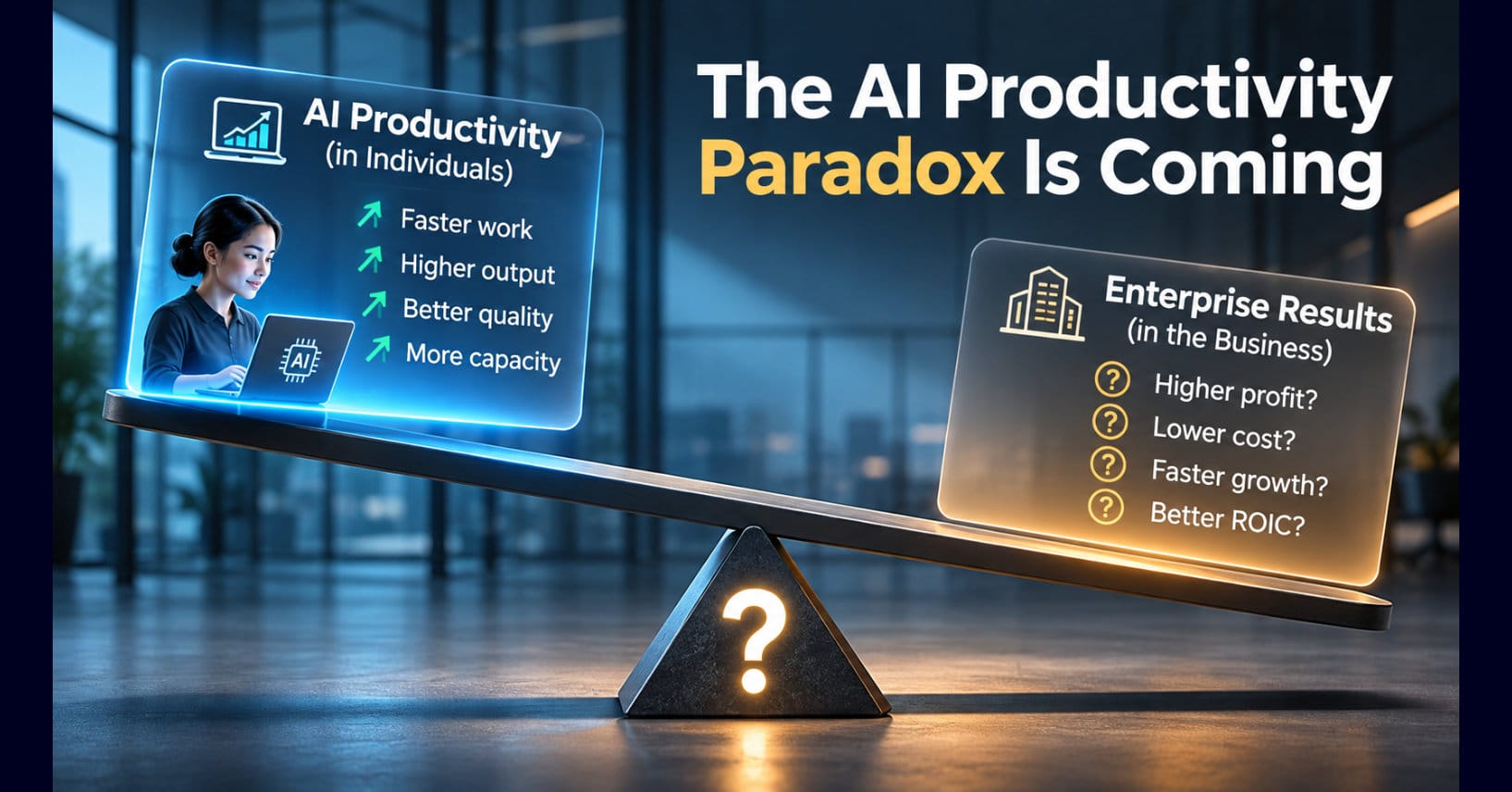
In Article 11 of the AI Strategy: Building the Intelligent Enterprise series, Victor M. Font Jr. examines the emerging AI productivity paradox: the disconnect between task-level efficiency and enterprise economic performance.
Drawing on historical research into information technology productivity, the article explains why AI-generated efficiency gains can become stranded capacity, encounter unchanged process bottlenecks, create additional downstream work, or be offset by new technology and operating expenses.
The article challenges conventional AI business cases that calculate financial returns by multiplying employee hours saved by average labor costs. An illustrative scenario demonstrates how 1,000 employees saving four hours weekly can create $14.4 million in theoretical annual labor capacity without necessarily generating equivalent financial savings.
To address this challenge, the article introduces the productivity conversion gap, describing the barriers that prevent localized efficiency improvements from becoming measurable enterprise outcomes.
A six-dimensional framework examines task efficiency, process throughput, capacity conversion, operating-model adaptation, total economic cost, and realized business value.
An accompanying executive scorecard connects operational productivity measures to financial outcomes, including operating margins, revenue productivity, unit economics, cash flow, and return on invested capital.
The article also examines the responsibilities of CIOs, CFOs, business executives, and boards in establishing credible productivity measurements and ensuring that AI investments deliver defensible economic returns.
The central argument is that enterprise AI success should be measured not by how much faster individual employees work, but by how effectively the organization converts those improvements into sustainable business value.
Artificial intelligence is making individual employees more productive.
Developers are writing code faster. Analysts are preparing reports in minutes instead of hours. Customer service representatives are resolving inquiries with AI-generated recommendations. Marketing teams are producing content at unprecedented speed. Financial professionals are accelerating research, reconciliation, and forecasting.
Across the enterprise, the evidence of increased individual productivity is becoming difficult to ignore.
Yet a more consequential question is emerging.
If artificial intelligence is making so many employees more productive, why aren’t enterprises experiencing corresponding improvements in profitability, operating margins, revenue growth, and return on invested capital?
This is the AI productivity paradox.
And for many organizations, it is coming.
The paradox does not arise because artificial intelligence lacks productive capability. It arises because organizations frequently confuse improvements in individual task execution with improvements in enterprise economic performance.
Those are fundamentally different outcomes.
An employee who completes a task 40 percent faster does not automatically reduce operating expenses by 40 percent. A department that produces twice as many reports does not necessarily make better decisions. A software development team that generates more code does not necessarily deliver more business value.
The relationship between productivity and enterprise performance is mediated by business processes, organizational structures, operating constraints, management practices, and the economic architecture of the enterprise.
Unless those structures change, AI-generated productivity gains may remain trapped inside the activities where they originate.
The next competitive advantage in artificial intelligence will not come from making individual tasks faster. It will come from converting those improvements into measurable enterprise outcomes.
That requires a different understanding of productivity—and a different approach to AI strategy.
The Original Productivity Paradox
The relationship between technological investment and economic performance has troubled researchers and executives for decades.
In 1987, economist Robert Solow famously observed that computers were visible everywhere except in productivity statistics.
His observation captured a persistent problem in the early information technology era.
Organizations were investing heavily in computing infrastructure, enterprise applications, and automation. Yet the anticipated productivity improvements were not immediately evident in aggregate economic measurements.
The technology was advancing faster than organizations could reorganize themselves to exploit it.
Subsequent research demonstrated that information technology could generate substantial productivity improvements, but those gains frequently depended on complementary investments in organizational redesign, workforce capabilities, and management practices.
Erik Brynjolfsson and Lorin Hitt, among others, helped establish that the economic value of information technology could not be understood solely through technology expenditure.
The benefits depended on how organizations changed their operations.
Artificial intelligence presents a similar challenge, potentially on a much larger scale.
Generative AI can improve performance within existing workflows without requiring extensive changes to enterprise systems. Employees can adopt AI assistants independently, departments can introduce specialized tools, and organizations can report impressive productivity improvements within weeks.
This accessibility is one of AI’s greatest strengths.
It is also a strategic vulnerability.
Because the technology can improve individual activities without changing the enterprise operating model, organizations may mistake localized efficiency for enterprise transformation.
The result is an accumulation of productivity statistics that do not necessarily correspond to improved financial performance.
The Fundamental Measurement Problem
Consider a financial analyst who previously required eight hours to prepare a monthly management report.
With AI assistance, the analyst completes the same report in four hours.
Measured task productivity improvement: 50 percent reduction in execution time.
That is a meaningful achievement.
But what happens to the four hours saved?
Perhaps the analyst prepares additional reports.
Perhaps the analyst spends more time reviewing financial anomalies.
Perhaps the analyst attends additional meetings.
Perhaps the analyst performs work that had previously been deferred.
Or perhaps the time is simply absorbed into the normal variability of the working day.
None of these outcomes automatically reduces the enterprise’s operating expenses.
The analyst still receives the same compensation. The department maintains the same staffing level. The reporting process may retain the same approval requirements. The executive decision supported by the report may occur on exactly the same schedule.
The task became more efficient.
The enterprise’s financial performance may remain unchanged.
This distinction is essential.
Time saved is not the same as cost removed. Capacity created is not the same as revenue generated. Output increased is not the same as value realized.
Organizations that fail to distinguish among these outcomes will systematically overestimate the financial return on their AI investments.
Five Reasons AI Productivity Gains Fail to Reach the Bottom Line
1. Productivity Gains Become Stranded Capacity
When AI reduces the effort required to complete a task, it creates capacity.
But capacity has no automatic financial value.
An employee who saves five hours per week does not generate an economic return merely because those hours are available.
The organization must decide how that capacity will be used.
There are several possibilities.
The capacity can be redirected toward higher-value activities.
It can support additional business volume without proportional staffing increases.
It can improve service quality or responsiveness.
It can reduce overtime, contractor expenditures, or future hiring requirements.
It can support the elimination of unnecessary activities.
Or it can remain unused.
Only some of these outcomes produce immediate, measurable financial benefits.
Others create strategic value that may be substantial but requires a different measurement approach.
For example, consider a customer service organization that uses AI to reduce average handling time.
If call volume remains constant and staffing schedules remain unchanged, the immediate labor expense may not decline.
However, if the organization can accommodate 25 percent more customer interactions without adding personnel, the economic benefit may appear as avoided future hiring rather than reduced current spending.
That distinction matters.
Cost avoidance is not the same as realized cost reduction.
Both may be legitimate benefits, but they should not be represented as equivalent financial outcomes.
An AI business case that claims millions of dollars in savings by multiplying employee hours saved by average compensation is not necessarily measuring realized savings.
It may be measuring theoretical labor capacity.
That capacity must be converted into an operational or economic outcome before the organization can claim the corresponding return.
2. The Enterprise Bottleneck Remains Unchanged
Business processes are systems of interdependent activities.
Improving one activity does not necessarily improve the performance of the overall system.
Consider a software development organization.
AI coding assistants help developers produce code more quickly.
Development throughput increases.
But the organization still relies on manual security reviews, constrained testing environments, lengthy change approval processes, and infrequent production deployment windows.
The additional code accumulates in queues.
Development productivity improves while the delivery system remains constrained.
The organization may even experience higher costs as increased output creates additional review, testing, and maintenance demands.
This is a classic systems problem.
Eliyahu Goldratt’s Theory of Constraints provides a useful conceptual foundation: the performance of a system depends on its limiting constraint.
Accelerating activities outside that constraint may create inventory or work in progress without improving total throughput.
AI introduces this problem across numerous enterprise functions.
A procurement team may generate purchase requests faster while supplier onboarding remains slow.
A sales organization may produce more proposals while contract approvals remain unchanged.
A finance department may accelerate reconciliations while month-end close continues to depend on unresolved data quality issues.
A healthcare organization may reduce documentation time while patient throughput remains constrained by staffing, facilities, or clinical capacity.
The lesson is straightforward.
The value of an AI productivity improvement depends on whether it changes the performance of the end-to-end business process.
Organizations must identify the actual constraint before deciding where AI investment will produce economic value.
Otherwise, they risk accelerating activities that were never limiting enterprise performance.
3. Increased Output Creates Additional Work
One of AI’s less obvious consequences is that making an activity cheaper can increase demand for that activity.
When producing a report requires eight hours, managers may request reports selectively.
When the same report requires ten minutes, requests can multiply.
When software code becomes easier to generate, organizations may authorize more features, prototypes, and experiments.
When marketing content becomes inexpensive, campaigns can expand across additional channels.
The marginal cost of producing an output declines.
Demand for the output increases.
This phenomenon resembles the rebound effects observed in other areas of economics.
Improved efficiency can stimulate additional consumption rather than reduce total resource use.
In enterprise AI, the consequences can be particularly significant because increased output often creates downstream obligations.
More reports require interpretation.
More software requires testing, security assessment, integration, and maintenance.
More customer communications require monitoring and quality assurance.
More AI-generated recommendations require decisions.
The organization may reduce the cost of creating work while increasing the cost of managing its consequences.
This is not necessarily undesirable.
Additional output may create genuine business value.
But the economic case must account for the complete cost of the expanded activity.
AI can make production cheaper while making coordination, validation, and governance more expensive.
A credible productivity measurement must consider both sides of that equation.
4. The Operating Model Preserves the Original Cost Structure
Many enterprises introduce AI into business processes without reconsidering how those processes are organized.
They retain the same departmental boundaries.
They preserve existing management hierarchies.
They maintain established approval chains.
They continue using legacy staffing models.
They measure employee utilization using assumptions developed before AI became available.
In this environment, AI becomes another technology layer supporting an operating model designed for human execution.
The enterprise gains efficiency within existing structures but does not capture the full opportunity to redesign those structures.
Consider a claims-processing organization.
AI accelerates document classification, information extraction, policy interpretation, and preliminary assessment.
Yet every claim continues through the same sequence of departmental handoffs and supervisory approvals.
The organization has automated portions of the process without reconsidering which activities require human intervention.
The economic benefit remains constrained by the original workflow.
A more consequential redesign might establish different processing paths based on claim complexity, confidence levels, financial exposure, and decision authority.
Routine cases could move through a controlled automated workflow.
Exceptions could be routed to qualified specialists.
High-impact decisions could require explicit human authorization.
Supervisors could focus on exceptions, control effectiveness, and performance rather than reviewing every transaction.
The objective would not simply be faster task execution.
It would be a different cost and service structure.
This is why AI strategy cannot be separated from operating-model strategy.
Organizations cannot expect transformative financial results while preserving every organizational assumption that existed before AI.
5. AI Introduces New Costs That Offset Productivity Gains
AI adoption creates expenses that are frequently underestimated during initial business-case development.
These may include:
- Model subscriptions, inference charges, and usage-based fees.
- Enterprise integration and API development.
- Data preparation, retrieval infrastructure, and information governance.
- Identity management, security controls, monitoring, and auditability.
- Evaluation, testing, and ongoing model performance management.
- Employee training and organizational change management.
- Human review, exception handling, and remediation.
- Vendor management, resilience, and operational support.
The economics become more complicated as organizations move from AI assistance to autonomous execution.
An AI assistant that helps an employee draft a response may have relatively modest integration requirements.
An AI agent that can modify customer records, initiate financial transactions, or execute operational workflows requires considerably more infrastructure and control.
Those costs are legitimate investments.
But they must be included in the financial analysis.
An organization may save $2 million in estimated labor capacity while spending $1.5 million on AI technology, integration, governance, and support.
If the labor capacity does not translate into realized economic value, the organization may have increased its operating expenses despite improving task productivity.
That is not a failure of AI capability.
It is a failure of investment economics.
Why the Traditional AI Business Case Is Often Misleading
Many AI business cases follow a familiar formula.
Estimate the number of employees affected.
Estimate the hours saved per employee.
Multiply those hours by average compensation.
Subtract the cost of the technology.
Declare the difference to be the expected return.
The arithmetic may be correct.
The economic assumptions frequently are not.
Consider an illustrative organization with 1,000 employees.
Each employee saves an average of four hours per week through AI assistance.
At 48 working weeks per year, that produces 192,000 hours of theoretical annual capacity.
At an assumed fully loaded labor cost of $75 per hour, the calculated value is $14.4 million.
Illustrative AI productivity calculation
| Measure | Annual amount |
|---|---|
| Employees using AI | 1,000 |
| Hours saved per employee per week | 4 |
| Working weeks | 48 |
| Total hours of capacity created | 192,000 |
| Assumed fully loaded hourly cost | $75 |
| Theoretical capacity value | $14.4 million |
The calculation is straightforward.
But has the organization actually saved $14.4 million?
Not necessarily.
If compensation expenses remain unchanged, staffing levels remain constant, and business output does not improve, the financial return may be substantially smaller.
The organization has created capacity, not necessarily captured economic value.
A defensible business case must establish how that capacity will be converted into measurable results.
Will the organization avoid planned hiring?
Will it reduce contractor expenditures?
Will it increase transaction volume?
Will it accelerate revenue-generating activities?
Will it improve customer retention?
Will it reduce error rates, rework, or financial losses?
Will it shorten process cycle times in ways that improve cash flow?
These are economic outcomes.
Hours saved are an input to the analysis, not the conclusion.
The Productivity Conversion Gap
I would describe the difference between task-level efficiency and realized enterprise value as the productivity conversion gap.
The gap represents the organizational, architectural, and economic barriers that prevent improvements in individual activities from becoming measurable business outcomes.
It is not a single technical problem.
It is a combination of process constraints, management decisions, workforce allocation, operating-model design, and financial measurement.
The larger the gap, the less likely an enterprise is to realize the returns implied by its AI productivity statistics.
The relationship can be expressed conceptually:
AI Productivity Improvement → Operational Capacity → Process Improvement → Economic Value
Each transition requires deliberate action.
A task-level improvement creates potential capacity.
That capacity must be deployed within a business process.
The process must produce a measurable operational improvement.
The operational improvement must translate into a financial or strategic outcome.
Skipping any of these steps introduces uncertainty into the business case.
An enterprise that measures only the first step cannot reliably claim the value associated with the fourth.
A Six-Dimension Framework for Converting AI Productivity Into Enterprise Value
Enterprise leaders need a systematic method for evaluating whether AI productivity improvements are becoming business results.
I recommend examining six dimensions.
1. Task Efficiency
Question: Is AI improving the speed, cost, accuracy, or quality of individual activities?
This is where most organizations begin.
Measures may include execution time, employee effort, output volume, error rates, and task completion quality.
These metrics establish whether the technology is delivering a local productivity improvement.
They are necessary.
They are not sufficient.
2. Process Throughput
Question: Is the end-to-end business process performing better?
The enterprise must determine whether localized improvements affect the entire workflow.
Relevant measures include cycle time, queue length, throughput, rework, exception rates, and time to decision.
If AI reduces task duration but overall process performance remains unchanged, the organization must identify the remaining constraint.
This is where process architecture becomes essential.
3. Capacity Conversion
Question: What happens to the capacity AI creates?
Leadership must explicitly determine whether released capacity will support growth, service improvement, risk reduction, cost avoidance, or expense reduction.
The conversion mechanism should be defined before the investment is approved.
Otherwise, organizations may discover that the productivity gains are real but economically unclaimed.
4. Operating-Model Adaptation
Question: Have organizational structures and responsibilities changed to capture the improvement?
AI may require redesigned workflows, revised decision rights, different staffing assumptions, and new management responsibilities.
If the operating model remains unchanged, the enterprise may preserve unnecessary coordination costs.
The degree of adaptation should reflect the business opportunity and associated risk.
Not every productivity improvement requires organizational restructuring.
But transformative outcomes frequently require changes beyond the technology itself.
5. Total Economic Cost
Question: What does the complete AI-enabled process cost to operate?
Financial analysis must include technology, integration, infrastructure, support, governance, monitoring, workforce development, and exception handling.
It must also account for costs created by increased output.
A process that operates faster but costs more may still be strategically valuable.
However, leadership must understand the tradeoff.
6. Realized Business Value
Question: What measurable enterprise outcome has improved?
The final dimension connects AI investment to financial and strategic performance.
Measures may include operating margin, revenue per employee, cost per transaction, customer lifetime value, working capital efficiency, cash conversion, risk-adjusted losses, and return on invested capital.
The appropriate measure depends on the business objective.
Not every AI initiative should be evaluated solely on immediate expense reduction.
Some investments create strategic capabilities whose benefits emerge over time.
But the enterprise must distinguish realized results from anticipated benefits.
The Enterprise AI Productivity Scorecard
A practical executive scorecard should connect technical performance to economic outcomes.
| Measurement Layer | Illustrative Metrics | Executive Question |
|---|---|---|
| Task productivity | Time saved, accuracy, output per employee | Is AI improving individual work? |
| Process performance | Cycle time, throughput, rework, queue length | Is the workflow improving? |
| Capacity utilization | Redeployed hours, avoided hiring, increased volume | Are we using the capacity created? |
| Operating-model effectiveness | Handoffs, approval latency, exception handling | Have we redesigned how work is performed? |
| Total cost | Technology spend, integration, oversight, support | What is the complete cost of the AI-enabled process? |
| Business outcomes | Margin, revenue, unit economics, cash flow, ROIC | Is the enterprise capturing measurable value? |
The most important principle is that these measures must be connected.
A dashboard showing millions of hours saved may be impressive.
But without evidence of capacity conversion, process improvement, or financial outcomes, it is not a complete enterprise productivity dashboard.
It is an activity-efficiency dashboard.
That distinction should matter to boards, CFOs, CIOs, and business executives.
The CFO’s Role in AI Productivity Measurement
AI productivity is increasingly becoming a financial management problem.
Technology leaders can demonstrate model performance, system reliability, and user adoption.
Business executives can evaluate operational improvements.
But financial leadership must establish whether those improvements translate into credible economic value.
This requires a shared measurement discipline.
The CFO should challenge assumptions about labor savings, avoided expenditures, revenue attribution, and the timing of benefits.
For example, if an AI initiative claims $5 million in annual productivity savings, the financial analysis should identify the corresponding operational and accounting consequences.
Will compensation expenses decline?
Will contractor spending decrease?
Will planned positions remain unfilled?
Will transaction volume increase without proportional expense growth?
Will working capital requirements change?
Will customer retention improve?
Some benefits may not appear immediately as reductions in an expense account. Avoided future hiring, for example, may be visible through a lower cost trajectory relative to a credible baseline.
That can be valuable.
But it should be measured as cost avoidance, not misrepresented as a reduction in current expenditure.
Similarly, revenue acceleration should not be confused with incremental revenue unless the organization can demonstrate the difference.
The CFO’s responsibility is not to dismiss operational productivity improvements. It is to distinguish economic value from productivity potential.
This discipline protects the enterprise from investing in initiatives whose benefits exist primarily in presentation materials.
The CIO’s Role: Architecture That Allows Productivity to Scale
The CIO faces a different but equally consequential responsibility.
AI productivity improvements often begin within individual departments.
Marketing adopts content-generation tools.
Finance introduces analytical assistants.
Customer service deploys conversational AI.
Software development teams use coding agents.
Each initiative may demonstrate measurable local value.
But enterprise-wide value requires integration across systems, workflows, and organizational boundaries.
This is an architecture problem.
Consider a customer service agent that can summarize customer history and recommend a resolution.
That capability may reduce handling time.
But if the employee must manually retrieve information from multiple applications, enter the same data repeatedly, and navigate separate approval systems, the overall process remains constrained.
Greater value becomes possible when the architecture supports governed access to authoritative information, coordinated workflows, controlled execution, and measurable outcomes.
This requires capabilities such as enterprise integration, reliable data services, identity and authorization, workflow orchestration, operational observability, and evidence of executed decisions.
The CIO must also address a growing architectural risk: the accumulation of disconnected AI tools that each improve individual activities while increasing enterprise complexity.
Fragmented AI adoption can create duplicate subscriptions, inconsistent controls, overlapping functionality, and integration debt.
The enterprise may become more productive locally while becoming more expensive and difficult to operate globally.
The CIO’s strategic responsibility is to ensure that AI-enabled productivity can move across organizational boundaries and become enterprise capability.
That is fundamentally different from simply providing employees with access to AI tools.
Why Revenue Productivity May Matter More Than Labor Productivity
Much of the AI productivity conversation concentrates on labor efficiency.
That focus is understandable.
Employee time is measurable, and labor represents a significant expense for many organizations.
But reducing the effort required to perform existing work is only one possible source of economic value.
AI can also increase the enterprise’s ability to generate revenue.
Consider a professional services organization.
AI reduces the time required to research client problems, prepare deliverables, and develop recommendations.
If the organization maintains the same pricing structure and client volume, it may create unused capacity.
If it uses that capacity to serve additional clients, develop new offerings, improve delivery quality, or accelerate project completion, the economic effect can be much greater.
The same principle applies to other industries.
A manufacturer may use AI to improve production planning and increase throughput without adding equivalent capacity.
A financial institution may reduce onboarding friction and improve customer conversion.
A logistics provider may improve asset utilization and serve more customers with existing infrastructure.
A healthcare organization may improve scheduling and care coordination, potentially expanding service capacity within clinical and regulatory constraints.
These outcomes cannot be adequately evaluated through employee hours saved alone.
They require measures of revenue productivity, asset productivity, process economics, and capital efficiency.
The strategic question becomes:
How much additional business value can the enterprise produce with its existing resources?
That question is often more consequential than how many hours AI can remove from individual activities.
AI Productivity and the Return on Invested Capital
Boards and investors ultimately evaluate enterprise performance through financial outcomes.
Operating margin matters.
Cash flow matters.
Revenue growth matters.
Capital efficiency matters.
Return on invested capital matters.
AI investments should therefore be evaluated within the broader economics of the enterprise.
Consider two organizations making similar investments in AI.
The first uses AI primarily to accelerate employee tasks.
It reports high adoption, strong user satisfaction, and substantial estimated hours saved.
But its staffing model, business processes, and operating expenses remain largely unchanged.
The second uses AI to redesign a constrained business process.
It improves throughput, reduces rework, avoids planned capacity expansion, and increases revenue without proportional operating expense growth.
Both organizations may report successful AI adoption.
Only the second has clearly demonstrated a mechanism for translating AI capability into improved capital productivity.
The difference is not necessarily model quality.
It is the relationship between technology investment and business economics.
This is why AI portfolio management should evaluate more than technical feasibility and expected productivity.
It should consider the investment’s potential to improve enterprise unit economics and capital allocation.
An initiative that creates impressive task-level efficiency but no credible path to economic value may deserve less investment than a technically modest initiative that removes a major operating constraint.
The enterprise must distinguish between AI activity and AI advantage.
The Time-Lag Problem
Not every AI investment will produce immediate financial results.
This is an important qualification.
Research into general-purpose technologies suggests that productivity benefits can take time to emerge because organizations must develop complementary capabilities and adapt their operating models.
AI may follow a similar pattern.
Initial investments may increase expenses as organizations acquire technology, train employees, integrate systems, and redesign processes.
During this period, measured productivity improvements may be uneven.
Some functions may improve rapidly.
Others may experience temporary disruption.
Enterprise-level results may lag behind operational improvements.
This does not necessarily mean the strategy is failing.
But it creates a measurement challenge.
Executives must distinguish between a legitimate investment maturation period and an initiative that lacks a credible path to value.
The solution is not to abandon financial accountability.
It is to establish staged evidence requirements.
Early-stage investments should demonstrate technical feasibility and task-level improvements.
Subsequent stages should demonstrate process performance and capacity conversion.
Mature deployments should demonstrate realized operational and economic outcomes.
The evidence expected should become stronger as investment increases.
A long-term investment horizon is not a substitute for measurable progress.
Organizations should be patient with investments that are developing strategic capabilities, but disciplined about initiatives that cannot validate their underlying assumptions.
The Danger of Measuring AI Adoption Instead of AI Value
AI adoption is an important operational indicator.
It tells leadership whether employees are using the technology.
It may also reveal training requirements, organizational resistance, or opportunities for broader deployment.
But adoption is not the same as value realization.
An enterprise may report that 85 percent of employees use AI tools every week.
That statistic does not establish whether the organization has improved profitability, customer outcomes, or operational performance.
Similarly, the number of prompts submitted, agents deployed, workflows automated, or AI applications purchased provides limited insight into economic results.
These are measures of activity and utilization.
They may be useful leading indicators.
They are not substitutes for business outcomes.
An organization can achieve widespread AI adoption while simultaneously increasing its cost structure.
It can deploy hundreds of AI agents without improving end-to-end process performance.
It can automate thousands of activities while preserving the same organizational bottlenecks.
Executives should therefore resist treating AI usage statistics as evidence of strategic success.
The relevant question is not how much AI the organization uses.
It is what measurable improvement the organization achieves because of that use.
A Practical Example: The AI-Enabled Finance Function
Consider an enterprise finance organization responsible for accounts payable.
The traditional process includes invoice receipt, data extraction, purchase-order matching, exception identification, approval routing, payment scheduling, and reconciliation.
AI can improve several activities.
It can extract invoice information.
It can identify anomalies.
It can recommend coding classifications.
It can assist with exception resolution.
Suppose these improvements reduce the time required to process an invoice by 40 percent.
That is a meaningful operational result.
But if invoices still accumulate in approval queues, supplier master data remains inconsistent, and payment scheduling is disconnected from working capital objectives, the enterprise may realize only a fraction of the potential value.
A more strategic redesign would examine the entire process.
The organization might establish automated processing for invoices meeting defined validation and authorization criteria.
Exceptions could be routed according to risk, complexity, and financial exposure.
Approval requirements could be redesigned around explicit decision authority.
Supplier data quality controls could be strengthened.
Payment scheduling could be integrated with cash management objectives.
The performance measures would expand beyond employee processing time.
Leadership would examine cost per invoice, exception rates, cycle time, payment accuracy, duplicate payments, supplier experience, and working capital effects.
The economic outcome could include lower processing costs, fewer errors, improved supplier relationships, and better cash management.
This is the difference between automating tasks and reconstructing work.
It is also the difference between reporting AI productivity and realizing enterprise value.
What Boards Should Demand From AI Productivity Reporting
Boards should not need to interpret dozens of technical productivity indicators to determine whether the enterprise’s AI strategy is working.
Management should provide a clear connection between AI investment, operating performance, and economic outcomes.
That reporting should answer several fundamental questions:
- What business constraint or economic opportunity justified the investment?
- What measurable productivity improvement has AI produced?
- How has that improvement affected end-to-end business processes?
- What capacity has been created, and how has management deployed it?
- What changes to workflows, decision authority, and operating structures were required?
- What is the complete cost of operating the AI-enabled capability?
- What financial or strategic value has actually been realized?
- What evidence supports management’s claims?
These questions move the conversation beyond adoption and activity.
They establish whether AI investments are changing enterprise performance.
Boards should also expect management to distinguish between projected benefits, validated operational improvements, and realized financial outcomes.
Those categories should not be combined into a single headline savings figure.
The distinction is particularly important when organizations begin making large capital commitments to AI infrastructure, enterprise platforms, and autonomous systems.
The greater the investment, the stronger the evidence required to justify continued funding.
The Strategic Implication: Productivity Must Be Designed Into the Enterprise
The AI productivity paradox is not inevitable.
Organizations can avoid much of it by changing how they select, design, implement, and measure AI investments.
The starting point is business architecture.
Identify the enterprise outcome that matters.
Determine which process or constraint limits that outcome.
Evaluate how AI could change the work required to produce it.
Redesign the workflow where necessary.
Establish the appropriate distribution of human and machine responsibilities.
Define how improvements will translate into economic value.
Measure the results across the entire process.
This approach reverses the conventional sequence.
Instead of deploying AI tools and subsequently searching for productivity benefits, the enterprise begins with the business result and designs the AI-enabled capability around it.
That distinction should influence investment governance.
AI initiatives should not receive continued funding merely because employees like the tools or because pilot results demonstrate faster task execution.
They should advance when evidence supports a credible path toward measurable enterprise value.
Equally important, organizations must be willing to discontinue initiatives whose productivity gains cannot be converted into meaningful outcomes.
Technical success does not automatically justify ongoing investment.
The Boardroom Question
If our employees are becoming significantly more productive with AI, where should that improvement appear in our operating performance, financial results, or strategic capabilities—and what evidence demonstrates that it has?
This question should be central to every enterprise AI investment review.
It forces leadership to connect technology performance with business performance.
It also exposes the assumptions that often remain hidden inside AI productivity claims.
If the enterprise cannot explain how productivity improvements become economic value, it has not completed the business case.
It has documented an opportunity.
The Executive Imperative
The next phase of enterprise AI adoption will require a more sophisticated understanding of productivity.
Organizations must move beyond measuring how quickly employees complete individual activities.
They must determine whether AI changes the economics of the enterprise.
That requires coordination among the CIO, CFO, business executives, enterprise architects, workforce leaders, and governance functions.
The CIO must establish the architecture that enables AI capabilities to operate across business processes.
The CFO must distinguish theoretical productivity from realized economic value.
Business executives must redesign workflows and convert capacity into measurable outcomes.
Workforce leaders must prepare employees for changing responsibilities.
Governance functions must ensure that new operating arrangements remain within appropriate authority and risk boundaries.
These responsibilities are interconnected.
No single function can solve the productivity conversion problem independently.
The enterprise must treat AI productivity as an operating-model and investment-management discipline, not merely a technology deployment objective.
Conclusion: The Productivity Gains Are Real. The Economic Returns Must Be Earned.
Artificial intelligence is already demonstrating its ability to improve the performance of individual tasks.
That capability is important.
But it is only the beginning.
The organizations that struggle with the AI productivity paradox will be those that accumulate impressive efficiency statistics without changing how their businesses operate.
They will deploy AI assistants, celebrate hours saved, and expand automation while preserving the same bottlenecks, organizational boundaries, and cost structures.
The organizations that capture the greatest value will take a different approach.
They will identify where AI can change the economics of work.
They will redesign processes around measurable outcomes.
They will convert released capacity into additional value.
They will evaluate total operating costs rather than isolated efficiency gains.
And they will demand evidence that AI investment improves enterprise performance.
The strategic objective is not to make every employee more productive in isolation. It is to make the enterprise more productive as a system.
That is the distinction between AI adoption and AI transformation.
And it may become one of the defining competitive differences of the next decade.
References
Autor, David H. “Why Are There Still So Many Jobs? The History and Future of Workplace Automation.” Journal of Economic Perspectives 29, no. 3 (2015): 3–30.
Brynjolfsson, Erik, and Lorin M. Hitt. “Beyond Computation: Information Technology, Organizational Transformation and Business Performance.” Journal of Economic Perspectives 14, no. 4 (2000): 23–48.
Brynjolfsson, Erik, Daniel Rock, and Chad Syverson. “Artificial Intelligence and the Modern Productivity Paradox: A Clash of Expectations and Statistics.” In The Economics of Artificial Intelligence: An Agenda, edited by Ajay Agrawal, Joshua Gans, and Avi Goldfarb, 23–57. Chicago: University of Chicago Press, 2019.
Brynjolfsson, Erik, Daniel Li, and Lindsey R. Raymond. “Generative AI at Work.” Quarterly Journal of Economics 140, no. 2 (2025): 889–942.
Goldratt, Eliyahu M., and Jeff Cox. The Goal: A Process of Ongoing Improvement. Great Barrington, MA: North River Press, 1984.
Noy, Shakked, and Whitney Zhang. “Experimental Evidence on the Productivity Effects of Generative Artificial Intelligence.” Science 381, no. 6654 (2023): 187–192.
Solow, Robert M. “We’d Better Watch Out.” New York Times Book Review, July 12, 1987.
Coming Next
Article 12: AI Agents Will Force You to Redesign the Operating Model
The next article examines what happens when AI systems move beyond assisting employees and begin executing work across enterprise applications, business processes, and organizational boundaries.
AI agents introduce a fundamental operating-model challenge: systems that can independently coordinate activities, initiate transactions, and act within delegated authority do not fit neatly into organizational structures designed around human supervision and departmental accountability.
We will explore how enterprises must rethink workflow ownership, managerial oversight, decision rights, exception handling, operational controls, and accountability when intelligent agents become active participants in business execution.
The question is no longer simply how AI will change the work. It is how the enterprise must change when AI begins performing that work autonomously.