AI Strategy Series | Article 14 of 20
Building the Intelligent Enterprise
Summary
Enterprise AI workforce initiatives frequently emphasize prompt engineering, technical training, and employee adoption. While these capabilities are important, they address only a portion of the workforce challenges associated with artificial intelligence.
In Article 14 of the AI Strategy Series, Building the Intelligent Enterprise, Victor M. Font Jr. examines why the most consequential AI skills gap may not be a shortage of technical knowledge, but a shortage of the organizational capabilities required to operate an AI-enabled enterprise.
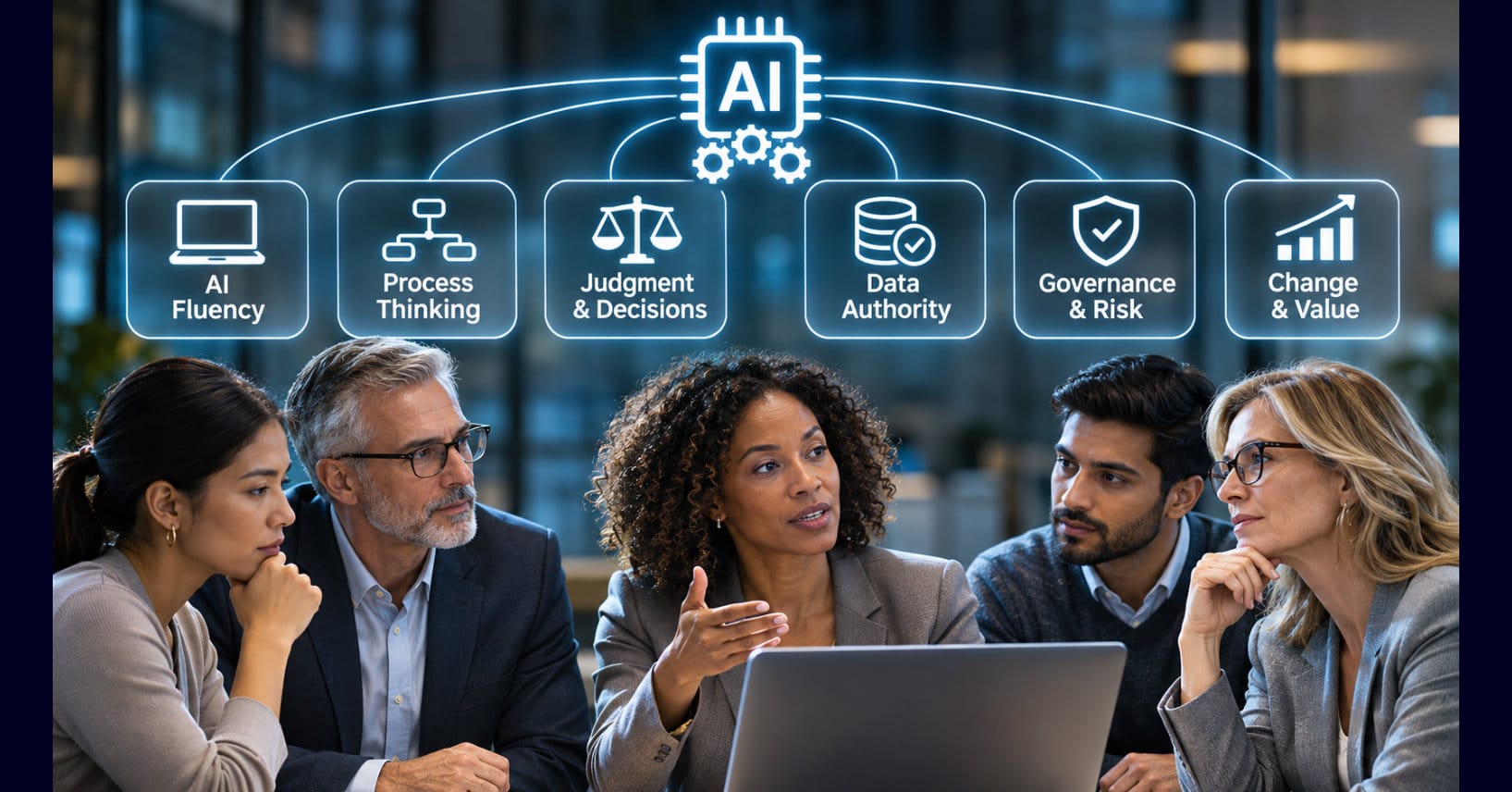
The article introduces six essential competency domains: AI and technology fluency, business process and systems thinking, decision-making and professional judgment, data and information authority, governance and accountability, and organizational change and value realization.
It examines how AI transforms managerial responsibilities, creates new requirements for human-agent supervision, and changes the competencies necessary for effective executive leadership.
Particular attention is given to the risk of automating entry-level professional work without preserving the development pathways through which employees acquire expertise and judgment.
The article also presents role-specific competency requirements for frontline employees, professional specialists, business process owners, middle managers, technology professionals, governance specialists, executives, and boards of directors.
A seven-stage workforce development strategy and a practical readiness measurement framework demonstrate how organizations can move beyond training completion statistics toward verified operational competence.
The central argument is that AI readiness cannot be measured solely through employee adoption or technical certification. It requires demonstrated capabilities in business process redesign, decision authority, professional judgment, operational governance, workforce development, and economic value realization.
The intelligent enterprise needs more than employees who understand artificial intelligence. It needs an organization capable of working intelligently with it.
Every major technological transformation produces a familiar executive concern: the workforce does not possess the skills necessary to take advantage of the new technology.
Artificial intelligence is no exception.
Organizations are investing in AI training programs, developing internal certification pathways, recruiting machine learning specialists, and encouraging employees to become proficient with generative AI tools.
Job descriptions increasingly reference prompt engineering, large language models, agentic AI, and AI-assisted workflows.
Technology vendors offer training programs designed to help employees become more productive with their platforms.
These investments are understandable.
Many are necessary.
But they may not address the most consequential workforce challenge facing the enterprise.
The AI skills gap is not simply a shortage of people who know how to use artificial intelligence. It is a shortage of people who understand how to redesign work, exercise judgment, govern decisions, and create measurable business value in an AI-enabled organization.
An employee may become proficient at prompting an AI model without understanding how to integrate its output into a controlled business process.
A manager may use AI to generate reports without understanding how the technology changes decision authority.
A software developer may build sophisticated AI agents without understanding the operational consequences of allowing those agents to modify enterprise records.
An executive may approve a substantial AI investment without understanding how productivity improvements will translate into financial performance.
These are different skills gaps.
And they cannot be resolved through a single enterprise-wide AI literacy program.
The intelligent enterprise requires a more comprehensive workforce strategy.
It must distinguish between technological fluency, professional expertise, process understanding, decision competence, governance responsibility, and organizational leadership.
It must also recognize that AI will change the relative value of these capabilities.
Some technical tasks will become easier.
Some forms of professional judgment will become more important.
Some management responsibilities will shift.
New competencies will emerge around human-agent coordination, operational assurance, and delegated authority.
The strategic workforce question is no longer simply, “How many employees understand AI?”
It is:
“Does our workforce possess the capabilities necessary to operate, manage, and continuously improve an enterprise in which intelligence is increasingly embedded in business execution?”
That is a considerably more demanding question.
The Problem With Defining AI Readiness as Tool Proficiency
Many organizations begin their AI workforce initiatives with training.
Employees attend introductory sessions explaining generative AI.
They learn how to write prompts.
They experiment with summarization, document generation, research assistance, and productivity tools.
Some organizations measure adoption through license utilization, active users, completed training modules, or the number of AI-assisted tasks.
These measures can provide useful information.
But they do not establish organizational readiness.
Consider an enterprise in which 80% of employees have completed an AI training program.
That sounds encouraging.
Now consider what the training actually covered.
Employees learned how to summarize documents, generate presentations, and improve email correspondence.
They understand basic prompting techniques.
They know how to interact with an AI assistant.
But they have not learned how to evaluate whether AI-generated information is authoritative.
They do not understand when automated recommendations require human authorization.
They cannot distinguish between an AI-assisted task and a redesigned business process.
Managers do not know how to measure the economic value of the time employees save.
Business leaders have not established which decisions AI may influence or execute.
The organization has improved tool familiarity.
It has not necessarily improved enterprise capability.
This distinction matters because AI adoption and AI readiness are not synonymous.
Adoption measures whether employees use the technology.
Readiness measures whether the enterprise can use it effectively, responsibly, and economically.
An organization can achieve widespread AI adoption while remaining fundamentally unprepared for AI-enabled operations.
The gap becomes particularly visible when AI moves beyond individual productivity tools into business processes and autonomous execution.
The Six Competency Gaps Behind Enterprise AI Adoption
I would distinguish six interdependent competency areas that enterprise leaders should evaluate.
Each addresses a different requirement for operating an intelligent enterprise.
1. AI and Technology Fluency
Employees need a practical understanding of what AI systems can and cannot do.
This includes familiarity with generative AI, machine learning, AI agents, model limitations, and the appropriate use of enterprise-approved tools.
Employees should understand that AI-generated responses may be inaccurate, incomplete, outdated, or unsupported by authoritative evidence.
They should recognize that fluent language is not proof of factual reliability.
They should understand the risks associated with entering sensitive information into unauthorized systems.
For employees working directly with AI-enabled applications, technical fluency may also include understanding tool integrations, retrieval mechanisms, model evaluation, and agent behavior.
But the required depth will vary by role.
A finance executive does not need the same technical expertise as an AI platform engineer.
A procurement manager does not need to become a machine learning researcher.
A customer service representative does not need to understand every architectural detail of a large language model.
The enterprise needs role-appropriate technological fluency.
Universal AI literacy is a foundation. It is not a substitute for role-specific competence.
2. Business Process and Systems Thinking
Employees must understand how their work contributes to larger business processes.
This is one of the most frequently overlooked AI competencies.
Many organizations train employees to improve individual tasks without teaching them to examine the workflow surrounding those tasks.
An employee may use AI to prepare a customer proposal in five minutes instead of thirty.
But if the proposal still requires multiple manual reviews, duplicated data entry, and sequential departmental approvals, the business outcome may change very little.
The employee has improved task productivity.
The enterprise has not necessarily improved process performance.
Business process competence requires employees and managers to understand dependencies, handoffs, bottlenecks, information flows, and end-to-end outcomes.
Systems thinking extends that understanding.
It asks how changing one activity affects other activities, controls, resources, and business results.
These capabilities become especially important as AI agents begin coordinating work across applications and departments.
Employees must be able to distinguish between automating an existing activity and redesigning the process that makes the activity necessary.
That distinction was central to Article 10, AI Does Not Automate Jobs. It Reconstructs Work.
The employees who create the greatest AI-enabled value may not be those who write the best prompts. They may be those who understand which work should be redesigned in the first place.
3. Decision-Making and Professional Judgment
AI can produce analyses, recommendations, forecasts, and proposed actions.
But organizations still need people capable of evaluating those outputs and exercising appropriate judgment.
This is particularly important when decisions involve uncertainty, competing objectives, incomplete information, or material consequences.
Consider a financial analyst using AI to evaluate an investment proposal.
The system may generate projections, compare scenarios, and identify financial risks.
The analyst must still understand the assumptions underlying those projections.
They must recognize when the analysis relies on incomplete or inappropriate information.
They must understand the business context.
They must evaluate whether the recommendation is consistent with organizational priorities and risk tolerance.
And they must know when the decision requires escalation.
The same principle applies to healthcare, engineering, cybersecurity, procurement, human resources, and enterprise operations.
AI may reduce the effort required to produce an analysis.
It does not eliminate the need to understand what the analysis means.
In fact, when AI makes analytical output inexpensive, the ability to evaluate that output may become more valuable.
This creates an important workforce development challenge.
Organizations must ensure that employees continue developing the professional expertise necessary to challenge AI-generated recommendations.
If employees become dependent on AI before acquiring sufficient domain knowledge, they may struggle to recognize errors.
If organizations eliminate foundational work without redesigning professional development, they may weaken the pathways through which future experts acquire judgment.
AI can accelerate the production of answers. It does not automatically develop the human expertise required to determine whether those answers deserve to be trusted.
4. Data and Information Authority
AI-enabled work depends on information.
But employees must understand that not all information is equally reliable, current, relevant, or authorized for use.
Enterprise data frequently contains conflicting definitions, inconsistent records, incomplete metadata, and unclear ownership.
A customer may have different classifications across sales, finance, and support systems.
An asset may have conflicting maintenance histories.
A supplier may have multiple records with inconsistent contractual terms.
An AI system may retrieve information from several sources without knowing which one possesses authority for a particular decision.
Employees and managers must therefore understand information provenance, authoritative sources, data quality, and appropriate information use.
They do not all need to become data engineers.
But they must recognize when an AI-generated conclusion depends on information whose authority has not been established.
This competency is especially important for employees supervising AI agents.
An agent may retrieve a record, interpret its contents, and initiate an action.
If the underlying information is unreliable, the resulting execution may be technically successful but operationally incorrect.
That is a different risk from an employee receiving a questionable summary.
The system may act before a human recognizes the problem.
The workforce must understand the relationship between data authority and decision authority.
An employee who cannot distinguish authoritative enterprise information from merely available information is not fully prepared to supervise AI-enabled decisions.
5. Governance, Risk, and Accountability
Employees and managers must understand the boundaries within which AI may operate.
This includes acceptable use, delegated authority, human supervision, control requirements, escalation conditions, and accountability.
The necessary knowledge varies by responsibility.
An employee using AI to draft an internal document needs to understand confidentiality and appropriate review.
A manager supervising an AI-assisted approval process must understand which decisions require human authorization.
A business process owner must understand the operational consequences of allowing an agent to execute transactions.
A CIO must understand how technical controls enforce authorized behavior.
An executive must understand which risks remain under their accountability.
These responsibilities cannot be reduced to a general statement that employees should use AI responsibly.
Responsible operation requires specific authority and control mechanisms.
Consider an AI agent authorized to prepare procurement recommendations.
If the agent is subsequently granted permission to create purchase orders, its operational responsibilities have changed.
The organization must determine who approved that authority, what limits apply, how actions are monitored, and what happens when the agent exceeds its permitted operating conditions.
Employees supervising the process must understand those controls.
Otherwise, the enterprise may possess sophisticated AI technology without the human competence necessary to govern its use.
AI governance is not solely a specialist function. It is an operational competency distributed across everyone who designs, authorizes, supervises, or relies upon AI-enabled decisions.
6. Organizational Change and Value Realization
The final competency gap concerns leadership.
Executives and managers must understand how to convert AI capabilities into sustainable business outcomes.
This requires more than encouraging adoption.
It requires defining business objectives, redesigning processes, reallocating capacity, establishing performance measures, and managing workforce transitions.
An organization may save thousands of employee hours without reducing operating costs or increasing revenue.
A department may automate routine work without improving customer outcomes.
An AI agent may accelerate transaction processing while creating additional supervision and control costs.
Leadership must understand these relationships.
Article 11, The AI Productivity Paradox Is Coming, examined the distinction between theoretical productivity gains and realized economic value.
That distinction is fundamentally a management competency.
Technology teams can measure system performance.
Business leaders must determine whether those capabilities produce meaningful improvements in enterprise performance.
The workforce must also be prepared for changing roles.
Employees need to understand how their responsibilities will evolve.
Managers need to develop new approaches to supervision.
Executives must communicate why changes are necessary and how employees will participate.
The AI transformation skills gap may ultimately be more significant in the management population than in the technical workforce.
A Competency Model for the Intelligent Enterprise
These six areas should be treated as complementary capabilities rather than interchangeable training topics.
| Competency Domain | Core Capability | Enterprise Consequence When Missing |
|---|---|---|
| AI and technology fluency | Understand and appropriately use AI capabilities | Misuse, unreliable outputs, and ineffective adoption |
| Business process and systems thinking | Redesign work around end-to-end outcomes | Faster tasks without meaningful process improvement |
| Decision-making and professional judgment | Evaluate recommendations and exercise authority | Poor decisions and excessive dependence on AI |
| Data and information authority | Identify trustworthy, relevant, and authorized information | Decisions based on unreliable or inappropriate data |
| Governance, risk, and accountability | Operate AI within defined authority and controls | Unauthorized execution and unclear responsibility |
| Organizational change and value realization | Convert AI capabilities into measurable business results | Adoption without sustainable economic value |
An enterprise AI workforce strategy should assess all six dimensions.
Training only the first may create employees who are comfortable using AI but unable to contribute effectively to AI-enabled transformation.
The other five determine whether that technological fluency becomes organizational capability.
Why Prompt Engineering Is Not an Enterprise Workforce Strategy
Prompt engineering has become one of the most visible AI-related skills.
Employees are encouraged to write clearer instructions, provide context, specify output formats, and evaluate responses.
These practices can improve interactions with generative AI systems.
They are useful.
But they are not sufficient to define an enterprise workforce strategy.
First, prompting techniques are only one element of interacting with AI.
Enterprise applications increasingly embed AI capabilities directly into workflows.
Employees may not interact with a general-purpose chatbot at all.
They may use AI-assisted functions within CRM, ERP, EAM, financial, or operational systems.
Second, model interfaces and capabilities continue to evolve.
Techniques that are useful for one generation of models may become less important as systems improve their ability to interpret instructions and context.
Third, the greatest business challenges frequently exist outside the prompt.
A perfectly written instruction cannot resolve unclear decision authority.
It cannot establish the correct source of truth when enterprise data ownership is disputed.
It cannot eliminate an unnecessary approval process.
It cannot determine whether an AI-generated recommendation is economically justified.
And it cannot make a manager accountable for a decision the organization has never formally assigned.
These problems require enterprise competencies.
Prompt engineering helps employees communicate with AI. Enterprise transformation requires employees who understand what AI should accomplish, how it should operate, and who remains responsible for the result.
Organizations should teach prompting where appropriate.
They should not mistake it for the central skill of the intelligent enterprise.
The Hidden Skills Gap in Middle Management
Middle managers may face some of the most significant changes associated with enterprise AI.
Traditionally, many managers spend substantial time coordinating activities, collecting information, reviewing work, preparing reports, and communicating priorities.
AI can reduce the effort required for portions of those responsibilities.
But the remaining management work may become more demanding.
Managers may need to supervise workflows executed by both employees and AI agents.
They may receive continuous operational intelligence rather than periodic reports.
They may need to evaluate more recommendations in less time.
They may be responsible for identifying when autonomous execution should be suspended.
They may need to develop employees whose roles are changing rapidly.
And they may be expected to demonstrate business outcomes rather than simply report activity.
This requires a different management skill set.
The effective AI-enabled manager must understand process performance, decision authority, exception handling, workforce development, and operational accountability.
They must also recognize the limitations of AI-generated management information.
A dashboard that reports an improving metric does not necessarily establish that the underlying business process is improving.
An AI-generated performance summary may omit context that experienced managers recognize as significant.
An agent may complete a transaction successfully while violating an important business expectation that was never encoded in its instructions.
Managers must be able to detect these conditions.
The challenge is not simply teaching managers to use AI.
It is teaching them to manage an operating environment in which AI participates directly in execution.
The future manager may spend less time supervising activities and more time supervising decisions, exceptions, outcomes, and the conditions under which autonomous work is permitted.
That is a substantial change in professional responsibility.
The Executive Skills Gap May Be the Most Expensive
Enterprise AI discussions frequently emphasize shortages of technical talent.
But a shortage of executive understanding can be more consequential.
A technically competent AI team may deliver a functioning system.
If executive leadership cannot establish its business purpose, decision authority, economic model, or organizational implications, the investment may fail to produce sustainable value.
Consider a company that deploys AI across several business functions.
Employees report significant time savings.
Adoption metrics are strong.
The technology performs as expected.
Yet operating expenses remain unchanged.
Customer outcomes show limited improvement.
Management structures remain intact.
The organization continues funding AI initiatives without a clear mechanism for converting productivity into economic value.
This is not primarily a machine learning skills problem.
It is a leadership problem.
Executives must understand the difference between technological capability and business transformation.
They must know how to evaluate AI investment assumptions.
They must understand the implications of delegated decision authority.
They must recognize when existing operating models constrain value realization.
They must coordinate technology, finance, operations, human resources, and governance functions.
And they must be prepared to discontinue initiatives that fail to justify continued investment.
The executive competency requirement is not technical mastery of every AI architecture.
It is sufficient technological and organizational understanding to make informed strategic decisions.
The most expensive AI skills gap may be the gap between what technology teams can build and what executive leadership knows how to turn into business value.
AI May Change How Professional Expertise Is Developed
There is another workforce issue that deserves particular attention.
Many professional careers depend on a progression from routine work toward increasingly complex judgment.
Junior software developers learn through coding, testing, debugging, and reviewing implementations.
Junior financial analysts develop expertise through data collection, modeling, reconciliation, and analysis.
Junior legal professionals develop judgment through research, document review, and supervised drafting.
Engineers develop practical understanding through calculations, design reviews, and operational problem-solving.
AI can perform portions of these foundational activities.
That creates productivity opportunities.
But it also raises an important question.
If AI performs the work through which junior professionals traditionally develop expertise, how will organizations develop the experienced professionals they will need tomorrow?
The answer cannot simply be that employees will supervise AI.
Effective supervision requires sufficient knowledge to recognize errors, understand context, and evaluate consequences.
An inexperienced employee may struggle to challenge an AI-generated result that appears convincing.
Organizations must therefore redesign professional development alongside workflow automation.
That may involve structured review of AI-generated work, supervised decision-making, simulations, practical exercises, and deliberate exposure to complex cases.
Employees may need to learn underlying principles even when AI can perform the associated calculations or documentation.
In some cases, the enterprise may need to preserve selected manual activities for training purposes.
In others, AI may become a valuable instructional partner, helping employees explore alternatives and understand errors.
The objective is not to preserve inefficient work indefinitely.
It is to preserve the development of professional competence.
Automating entry-level tasks without redesigning the pathway to expertise risks creating a future shortage of the very judgment organizations will depend upon to supervise AI.
This is a strategic workforce issue, not merely a training concern.
From Individual AI Literacy to Organizational AI Competence
Enterprise training programs frequently focus on individuals.
They ask whether an employee understands a technology or can perform a task.
But business performance depends on coordinated capabilities.
A procurement employee may understand AI.
A finance manager may understand financial controls.
An IT architect may understand agent integration.
A compliance specialist may understand regulatory obligations.
Yet the organization may still lack a shared understanding of how an AI-enabled procurement process should operate.
The missing capability is collective.
It exists between roles and functions.
This suggests that enterprise AI readiness must be evaluated at several levels.
Individual Competence
Can employees use AI appropriately and evaluate its outputs within their professional responsibilities?
Role Competence
Can employees perform the new responsibilities created by AI-enabled workflows, including supervision, exception handling, and decision support?
Team Competence
Can teams coordinate human and AI activities effectively while maintaining quality, accountability, and operational continuity?
Process Competence
Can the enterprise execute end-to-end workflows with clearly defined authority, reliable information, and appropriate controls?
Executive Competence
Can leadership align AI investments with business strategy, organizational design, workforce development, and measurable value?
These levels are interdependent.
A workforce may contain highly capable individuals while the organization remains unable to execute AI-enabled processes effectively.
Conversely, well-designed workflows cannot compensate indefinitely for employees who lack the judgment necessary to supervise them.
AI readiness is not the sum of individual training certificates. It is the enterprise’s demonstrated ability to coordinate people, technology, information, and authority to achieve business outcomes.
Role-Based AI Competency Requirements
A practical workforce strategy should distinguish the capabilities required by different enterprise roles.
Not everyone needs the same training.
| Enterprise Role | Priority AI Competencies |
|---|---|
| Frontline employees | AI literacy, output validation, data handling, workflow participation, and escalation |
| Professional specialists | Domain judgment, evidence evaluation, information authority, and AI-assisted analysis |
| Business process owners | Process redesign, delegated authority, operational performance, and accountability |
| Middle managers | Human-agent supervision, exception management, coaching, and outcome measurement |
| Technology professionals | AI architecture, integration, security, identity, evaluation, and operational reliability |
| Risk and governance professionals | Control design, assurance, monitoring, evidence, and regulatory obligations |
| Executive leadership | Strategic investment, operating-model redesign, workforce transformation, and value realization |
| Boards of directors | AI risk oversight, management accountability, strategic implications, and assurance expectations |
This approach provides a more defensible basis for training investment.
It also prevents the organization from confusing widespread exposure to AI tools with readiness for consequential AI-enabled responsibilities.
The Emerging Skill of Human-Agent Supervision
Agentic AI introduces a category of workforce responsibility that many organizations have not formally defined.
Employees may increasingly supervise software agents that perform work across enterprise applications.
That supervision is not equivalent to using a chatbot.
An agent may retrieve information, evaluate conditions, invoke tools, update records, initiate transactions, and coordinate activities.
The supervising employee must understand what the agent is permitted to do.
They must recognize the boundaries of delegated authority.
They must know which conditions require intervention.
They must be able to interpret operational evidence.
And they must understand how to suspend or escalate activity when necessary.
Consider a procurement manager supervising an AI agent authorized to initiate routine purchases within established limits.
The manager needs to understand the agent’s purchasing authority, approved suppliers, financial thresholds, data dependencies, and exception triggers.
They must also understand how to evaluate whether completed transactions complied with those requirements.
This is not simply AI literacy.
It is operational supervision of delegated execution.
The competency combines business process knowledge, control awareness, information interpretation, and professional judgment.
Organizations should treat it as a defined responsibility with appropriate training and evaluation.
Human oversight is meaningful only when the human possesses the competence, authority, information, and practical ability to intervene.
Assigning a person to supervise an AI system does not automatically establish effective supervision.
The Difference Between Knowing the Policy and Operating the Control
Governance training often emphasizes policies.
Employees learn acceptable-use requirements.
Managers learn approval procedures.
Technology teams learn security standards.
These are necessary foundations.
But agentic AI requires employees to understand how controls operate within actual workflows.
A manager may know that certain transactions require approval.
That does not mean they understand how an AI agent’s permissions enforce the requirement.
A business process owner may know that sensitive information must be protected.
That does not mean they understand how retrieval systems determine which records an agent can access.
An executive may know that AI decisions must be auditable.
That does not mean the enterprise preserves sufficient evidence to reconstruct an authorized action.
The skills gap exists between policy awareness and operational competence.
Organizations should therefore evaluate whether employees can demonstrate their responsibilities in realistic scenarios.
For example:
- Can a supervisor identify when an agent has exceeded delegated authority?
- Can a process owner determine whether an AI-generated recommendation relies on authoritative information?
- Can an operator distinguish successful technical execution from an authorized business outcome?
- Can a manager explain when a workflow must be suspended?
- Can a governance professional verify that required controls operated as intended?
These are practical demonstrations of competence.
They provide stronger evidence of readiness than attendance records alone.
A Seven-Stage Enterprise AI Workforce Strategy
Organizations need a structured approach to developing the capabilities required for AI-enabled operations.
I recommend seven stages.
Stage 1: Establish the Business Capability Requirements
Begin with the business outcomes the enterprise intends to achieve.
Identify the capabilities and workflows that AI will affect.
Do not begin by purchasing a generic training catalog.
Determine which business activities, decisions, and responsibilities are expected to change.
Stage 2: Map Existing Roles and Responsibilities
Document the work currently performed by employees, managers, specialists, and executives.
Separate routine information processing from professional judgment, decision authority, supervision, and accountability.
Identify the tasks AI may assist, automate, or coordinate.
Stage 3: Define Future-State Competencies
For each affected role, identify the capabilities required to operate within the redesigned workflow.
These may include AI fluency, process analysis, data authority, decision-making, agent supervision, control evaluation, or economic measurement.
Distinguish foundational competencies from advanced responsibilities.
Stage 4: Assess Demonstrated Capability
Evaluate employees against realistic job requirements.
Use practical exercises, scenario-based assessments, supervised demonstrations, and performance evidence where appropriate.
Avoid relying exclusively on self-reported confidence or training completion.
Stage 5: Build Role-Specific Development Pathways
Create targeted learning programs.
Technical professionals may require deeper architectural and integration training.
Managers may need decision-supervision and process-redesign capabilities.
Executives may require education in AI economics, organizational design, and governance.
Professional specialists may need training in evaluating AI-assisted work without losing foundational expertise.
Stage 6: Integrate Learning Into Operational Work
Training should not end when employees complete a course.
Employees need opportunities to apply their skills within controlled business processes.
Managers should evaluate performance and provide feedback.
Organizations should establish appropriate supervision for employees assuming new AI-related responsibilities.
Stage 7: Measure Capability and Business Outcomes
Evaluate whether the workforce can perform the redesigned work effectively.
Measure decision quality, process performance, control effectiveness, employee development, and realized business value.
Update competency requirements as technology and operating models evolve.
The objective is not to produce an AI-certified workforce. It is to produce a workforce capable of operating an AI-enabled enterprise.
Measuring Workforce Readiness Without Fooling Yourself
Enterprise leaders should be cautious about AI training dashboards.
A dashboard showing 10,000 completed training modules may demonstrate substantial learning activity.
It does not necessarily demonstrate improved organizational capability.
Similarly, high AI tool adoption does not prove that employees can supervise consequential decisions.
A useful workforce readiness scorecard should distinguish learning activity from demonstrated competence and business impact.
| Measurement Area | Illustrative Indicators |
|---|---|
| AI literacy | Role-appropriate knowledge and practical tool proficiency |
| Applied competence | Successful completion of job-relevant exercises and supervised tasks |
| Decision quality | Accuracy, appropriate escalation, and effectiveness of human review |
| Process competence | Ability to execute redesigned workflows and resolve exceptions |
| Governance competence | Demonstrated understanding of authority, controls, and accountability |
| Workforce development | Progression in professional expertise and readiness for changing roles |
| Business impact | Improvements in quality, cycle time, capacity utilization, and realized value |
These indicators should be interpreted in context.
An employee who uses AI infrequently may nevertheless possess the competence required for their role.
An employee who uses AI constantly may still exercise poor judgment.
A manager who completes advanced AI training may remain ineffective at supervising business outcomes.
The enterprise should measure demonstrated capability, not simply technological enthusiasm.
The CHRO and CIO Must Become Strategic Partners
The workforce implications of AI cannot be managed independently by human resources or IT.
The CIO understands the technological capabilities, architectural constraints, and operational risks associated with AI.
The chief human resources officer understands workforce development, role design, organizational structure, and employee transitions.
Business executives understand the capabilities and outcomes their functions must deliver.
The CFO understands the economic implications.
Governance and risk leaders understand the controls required to maintain accountability.
These perspectives must be integrated.
If IT introduces AI agents without coordinating workforce responsibilities, employees may not understand how their roles have changed.
If HR develops AI training programs without understanding future-state workflows, the training may address the wrong competencies.
If finance assumes productivity gains will automatically reduce costs, the organization may overstate expected benefits.
If business leaders fail to redesign processes, trained employees may have little opportunity to apply their new capabilities.
The workforce strategy must therefore follow the enterprise AI strategy and operating-model design.
The CIO and CHRO should not be running separate AI initiatives. They should be jointly preparing the workforce for a different model of enterprise execution.
The CEO’s Responsibility: Building Organizational Capability
AI workforce readiness is ultimately an executive leadership responsibility.
The CEO must ensure that the organization is developing the capabilities necessary to execute its strategy.
That requires more than approving a training budget.
Leadership must determine how work will change.
It must establish expectations for managerial judgment and accountability.
It must preserve pathways for professional development.
It must ensure that employees understand how AI affects their responsibilities.
And it must align workforce investments with business outcomes.
The organization should avoid presenting AI transformation solely as a workforce reduction initiative.
Such an approach may undermine trust and discourage employees from participating in process improvement.
At the same time, leadership should not promise that AI will leave every role unchanged.
Some activities will require fewer resources.
Some positions will evolve.
Some capabilities will become more valuable.
Others may decline in importance.
Responsible leadership requires acknowledging these possibilities while providing clear direction, development opportunities, and appropriate support.
The objective is not to protect every historical task.
It is to prepare the organization and its people for work that is changing.
What Boards Should Ask About the AI Skills Gap
Boards should expect management to explain how workforce development supports enterprise AI strategy.
The discussion should extend beyond the number of employees trained.
Relevant questions include:
- Which business capabilities will change most significantly as AI becomes embedded in enterprise operations?
- What new competencies will employees and managers need to perform their responsibilities effectively?
- How are we distinguishing basic AI literacy from operational and decision-making competence?
- Do managers understand how to supervise AI-enabled workflows and delegated execution?
- Are we preserving the development of professional expertise as foundational tasks become automated?
- How are the CIO, CHRO, CFO, and business leaders coordinating workforce transformation?
- What evidence demonstrates that training investments improve operational performance?
- How will management address the organizational consequences of changing roles and responsibilities?
These questions connect workforce development to strategic execution.
They also help boards distinguish between training activity and organizational readiness.
The Boardroom Question
If every employee completed an AI training program tomorrow, would our organization possess the professional judgment, process knowledge, decision authority, governance competence, and leadership capability necessary to operate an AI-enabled enterprise?
If the answer is uncertain, the enterprise has identified a workforce readiness problem that training completion metrics cannot resolve.
The challenge is not simply teaching employees to interact with AI.
It is preparing them to work effectively within business processes where AI increasingly participates in analysis, coordination, decisions, and execution.
The Executive Imperative
Enterprise leaders should reassess their AI workforce strategies before committing additional resources to broad training initiatives.
Begin with the business capabilities the organization intends to transform.
Identify how work, decisions, and responsibilities will change.
Determine which competencies those changes require.
Then evaluate whether existing training programs address those requirements.
The enterprise should prioritize several actions.
First, establish role-specific AI competency expectations.
Second, strengthen business process and systems-thinking capabilities among managers and operational leaders.
Third, preserve the development of professional judgment as routine work becomes automated.
Fourth, train employees responsible for supervising AI agents in delegated authority, operational controls, and exception management.
Fifth, ensure executives understand how to convert AI capabilities into measurable business outcomes.
Finally, measure demonstrated workforce capability rather than relying exclusively on adoption statistics and training completion.
The intelligent enterprise will need technically capable employees.
But technical fluency alone will not determine success.
The organizations that benefit most from AI will be those that develop the human capabilities necessary to direct, evaluate, govern, and continuously improve intelligent execution.
Conclusion: The Skills Gap Is Really an Enterprise Capability Gap
The AI skills gap is real.
But many organizations are defining it too narrowly.
They see a shortage of employees who understand AI tools.
They respond with training programs.
They measure adoption.
They celebrate certification completion.
And they assume the workforce is becoming ready.
That approach addresses only part of the problem.
The intelligent enterprise requires employees who understand business processes, information authority, professional judgment, and accountable decision-making.
It requires managers who can supervise human-agent workflows and evaluate operational outcomes.
It requires technical professionals who can build reliable, governed AI architectures.
It requires executives who understand organizational redesign, workforce transformation, and economic value realization.
It also requires organizations to preserve the development of professional expertise even as AI automates portions of the work through which that expertise has traditionally been acquired.
These are not simply individual training requirements.
They are enterprise capabilities.
The distinction is fundamental.
An organization may have thousands of AI-literate employees and still lack the collective competence necessary to operate AI-enabled business processes.
It may possess sophisticated AI technology and still lack the managerial judgment required to supervise it.
It may achieve impressive productivity gains and still lack the executive competence necessary to convert them into financial performance.
The defining AI workforce challenge is not producing more employees who know how to use artificial intelligence. It is developing organizations that know how to work intelligently with it.
That is where enterprise AI strategy and workforce strategy must converge.
And that is where the most consequential skills gap will be found.
References
Autor, David H. “Why Are There Still So Many Jobs? The History and Future of Workplace Automation.” Journal of Economic Perspectives 29, no. 3 (2015): 3–30.
Brynjolfsson, Erik, Danielle Li, and Lindsey R. Raymond. “Generative AI at Work.” Quarterly Journal of Economics140, no. 2 (2025): 889–942.
Davenport, Thomas H., and Nitin Mittal. All-in on AI: How Smart Companies Win Big with Artificial Intelligence. Boston: Harvard Business Review Press, 2023.
International Organization for Standardization and International Electrotechnical Commission. ISO/IEC 42001:2023: Information Technology—Artificial Intelligence—Management System. Geneva: ISO, 2023.
National Institute of Standards and Technology. Artificial Intelligence Risk Management Framework (AI RMF 1.0). NIST AI 100-1. Gaithersburg, MD: NIST, 2023.
National Institute of Standards and Technology. Artificial Intelligence Risk Management Framework: Generative Artificial Intelligence Profile. NIST AI 600-1. Gaithersburg, MD: NIST, 2024.
Organisation for Economic Co-operation and Development. OECD Employment Outlook 2023: Artificial Intelligence and the Labour Market. Paris: OECD Publishing, 2023.
World Economic Forum. The Future of Jobs Report 2025. Geneva: World Economic Forum, 2025.
Coming Next
Article 15: The AI Business Case Is Usually Measuring the Wrong Thing
Enterprise AI investments are frequently justified through productivity improvements, employee time savings, automation percentages, and projected reductions in manual effort.
Those measures may be useful.
But they do not necessarily demonstrate economic value.
An organization can save thousands of employee hours without reducing costs, increasing revenue, improving customer outcomes, or generating an acceptable return on invested capital.
The next article examines why conventional AI business cases often confuse technical capability with financial performance.
It will explore the difference between productivity potential and realized economic value, the importance of total operating costs, and the need to connect AI investments to measurable business outcomes.
The enterprise should not ask only how much work AI can perform. It should ask what economic value that work creates—and whether the organization can actually capture it.
Tighten the article for executive readers