Enterprise Software Engineering Series — Article 3
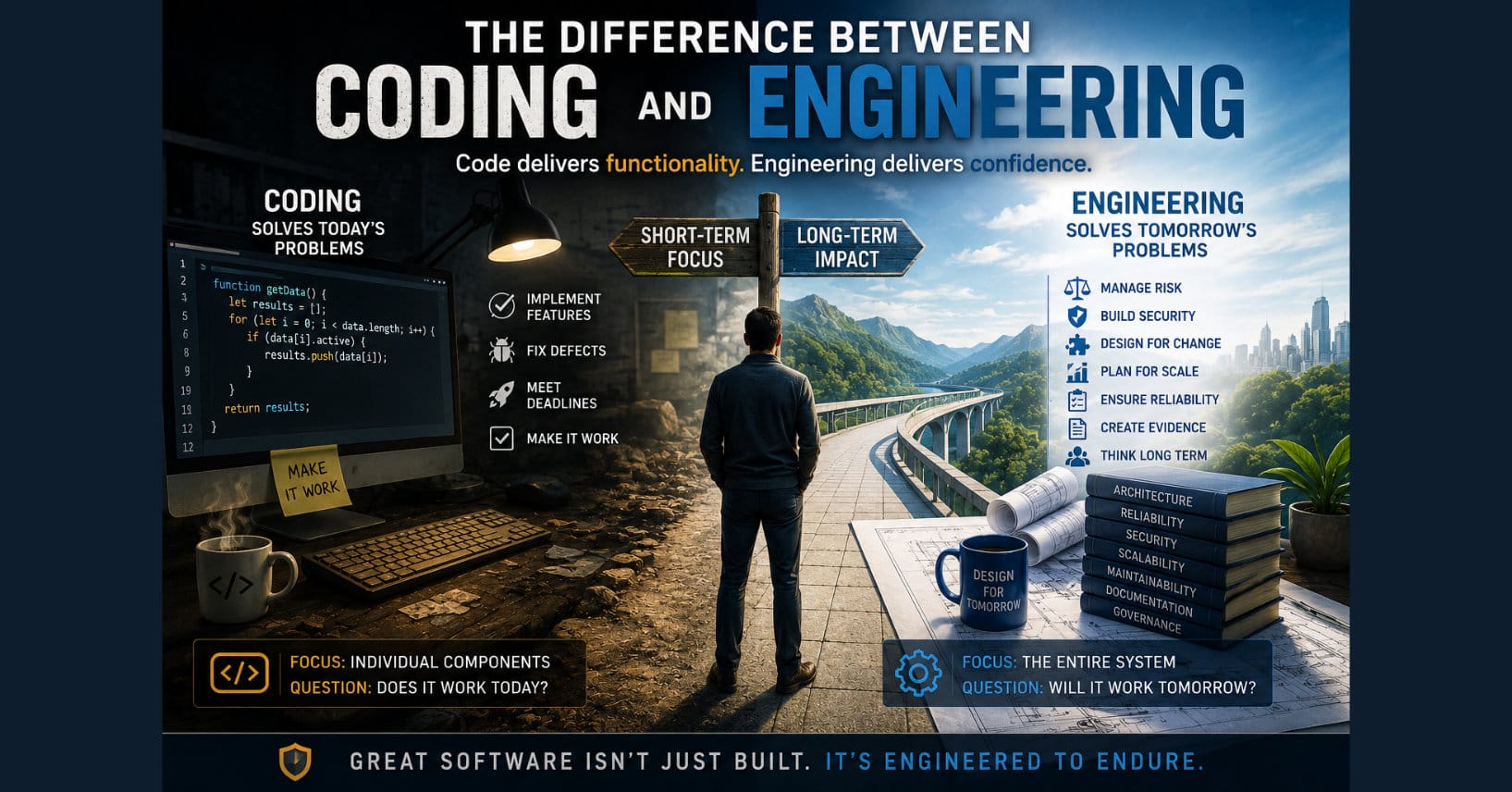
Writing code is an essential technical skill, but enterprise software engineering requires a broader perspective. This article explores the distinction between implementing features and engineering systems that remain reliable, secure, scalable, and maintainable throughout their operational life. Learn why successful organizations measure engineering not by the amount of code produced, but by the confidence their systems inspire over time.
Executive Perspective
The software industry often uses the words coding, programming, development, and engineering interchangeably. While they are closely related, they are not synonymous.
Every software engineer writes code.
Not every person who writes code is practicing engineering.
This distinction is not about job titles, education, or professional credentials. It is about perspective.
Coding focuses on creating software that works.
Engineering focuses on creating software that continues to work—reliably, securely, maintainably, and predictably—long after the original implementation is complete.
Organizations rarely fail because they lacked talented programmers.
More often, they struggle because they lacked an engineering mindset capable of balancing immediate delivery with long-term sustainability.
Code Solves Today’s Problems
Writing code is one of the most valuable technical skills in modern business.
Without developers, ideas never become applications.
Business processes remain manual.
Automation never happens.
Innovation stalls.
Code transforms requirements into working software.
It produces features.
It fixes defects.
It automates tasks.
It enables organizations to operate more efficiently.
Those accomplishments should never be minimized.
Yet writing code answers only one question:
Does the software work today?
Engineering asks a much broader set of questions.
Engineering Solves Tomorrow’s Problems
Engineering extends beyond implementation.
It considers the entire operational life of a system.
Before writing a single line of code, engineers ask questions such as:
- Can this system scale?
- How will future developers understand it?
- What happens when a component fails?
- Can this design evolve as business requirements change?
- How will we investigate incidents?
- Can this system be secured and audited?
- What assumptions are we making today that may no longer be true in five years?
These questions often have little immediate effect on project demonstrations.
They have enormous influence on long-term success.
Engineering is the discipline of making decisions that reduce future uncertainty.
Features Are Only Part of the Product
Many organizations evaluate software teams by counting completed features.
Features certainly matter.
Customers purchase capabilities.
Executives fund business outcomes.
However, every feature introduces new responsibilities.
It must be:
- Maintained
- Tested
- Secured
- Documented
- Supported
- Integrated
- Monitored
- Eventually replaced
From an engineering perspective, shipping a feature is not the end of the work.
It is the beginning of an operational commitment.
Every new capability becomes part of the organization’s long-term technology portfolio.
Engineers Design Systems
Developers naturally focus on the components they are building.
Engineers must understand how those components interact.
One class designs a service.
An engineer designs the relationships between services.
One developer optimizes a database query.
An engineer evaluates the data model supporting every future query.
One programmer writes authentication logic.
An engineer establishes trust boundaries across the entire platform.
Individual components matter.
System behavior matters more.
Enterprise software succeeds because the entire system functions predictably under changing business conditions.
Engineering Requires Trade-Offs
Perhaps the greatest difference between coding and engineering is that engineering rarely offers perfect answers.
Every design decision involves compromise.
Performance versus maintainability.
Flexibility versus simplicity.
Development speed versus architectural discipline.
Cost versus resilience.
Standardization versus optimization.
Engineering requires balancing competing priorities while understanding the consequences of each decision.
There is no architecture without trade-offs.
There is only informed decision-making.
Success Is Measured Differently
Coding success is often measured by completion.
Did the feature ship?
Did the tests pass?
Did the defect disappear?
Engineering success is measured over time.
Can the application still evolve?
Can new developers contribute confidently?
Can incidents be investigated?
Can security controls adapt to emerging threats?
Can the organization continue operating when unexpected events occur?
These questions may not be answered until years after deployment.
That is why engineering is fundamentally a long-term discipline.
Engineering Produces Confidence
Business leaders rarely evaluate software quality by reading source code.
Instead, they observe outcomes.
Can they trust the reports?
Can customers depend on the application?
Can the organization recover from outages?
Can auditors reconstruct important events?
Can new capabilities be introduced without destabilizing existing operations?
Confidence becomes the true product of engineering.
Reliable software creates confidence.
Predictable software creates confidence.
Well-documented software creates confidence.
Well-governed software creates confidence.
Engineering produces far more than executable code.
It produces organizational trust.
Great Engineers Think Beyond Technology
Technology changes continuously.
Programming languages rise and fall.
Frameworks become obsolete.
Cloud platforms evolve.
Artificial intelligence transforms development workflows.
Engineering principles remain remarkably stable.
Clear requirements.
Thoughtful architecture.
Reliable testing.
Meaningful documentation.
Intentional governance.
Operational resilience.
The technologies supporting these principles will change.
The principles themselves endure.
That is why experienced engineers invest more time learning how to think than learning the newest framework.
From Developers to Enterprise Engineers
The transition from software developer to enterprise software engineer occurs gradually.
It begins when questions change.
Instead of asking:
“How do I implement this feature?”
Enterprise engineers ask:
- Why does this feature exist?
- What business problem does it solve?
- What risks does it introduce?
- How will it affect the rest of the system?
- What evidence should it produce?
- How will future engineers maintain it?
- What happens if this assumption proves incorrect?
Those questions expand the engineer’s perspective from implementation to stewardship.
Enterprise engineering is ultimately the responsibility of caring for systems throughout their entire operational life.
Looking Ahead
Engineering begins long before code is written.
The quality of a system is determined just as much by its requirements as by its implementation.
The next article explores why software has a life cycle whether organizations choose to manage it or not—and why the System Development Life Cycle remains one of the most important engineering disciplines in enterprise software.
Engineering Principle
Code delivers functionality. Engineering delivers confidence.