Digital Transformation Series | Article 8 of 8
Digital Transformation: Redesigning the Enterprise for Continuous Change
Summary
Digital transformation is often described as a journey from a current state to a defined future state. But when technology, markets, regulation, customer expectations, and competitive conditions continuously change, that future state is only temporary.
The Transformable Enterprise concludes the eight-part Digital Transformation series by arguing that the real objective is not a permanently transformed organization, but an enterprise designed to keep changing without requiring extraordinary disruption.
The article brings together the series’ core concepts: capability-driven transformation, adaptable operating models, bounded autonomy, architectural optionality, information fitness, persistent software delivery, decision-oriented governance, meaningful transformation measurement, and organizational learning. It also introduces the cost of change as a strategic metric and examines how AI is testing whether enterprises can absorb major technological shifts.
The durable competitive advantage is not possession of today’s technology. It is the organizational ability to absorb tomorrow’s.
For years, organizations have talked about digital transformation as a journey.
There is a current state.
There is a future state.
Between them sits the transformation program.
Leadership defines the destination.
Consultants develop the roadmap.
Technology teams modernize systems.
Processes are redesigned.
New capabilities are introduced.
Eventually, the enterprise reaches the future state and transformation is complete.
That model made sense when technological change occurred slowly enough for organizations to believe a relatively stable destination existed.
That assumption is becoming increasingly difficult to defend.
Artificial intelligence is changing software development, knowledge work, customer interaction, analytics, automation, and decision-making.
Cloud platforms continue introducing new capabilities.
Cybersecurity requirements evolve.
Business models change.
Customer expectations move.
Regulation expands.
New competitors emerge.
Acquisitions reshape technology portfolios.
Technologies that appeared strategic five years ago become constraints.
The future state keeps moving.
This changes the objective of digital transformation.
The enterprise does not need to become transformed.
It needs to become transformable.
The Future State Is Temporary
Every transformation roadmap contains an implicit assumption about the future.
This is what our applications will look like.
This is how our operating model will work.
This is the platform we will standardize on.
This is how customers will interact with us.
This is how employees will work.
This is how information will move.
Some of those assumptions will be correct.
Others will not survive contact with reality.
The problem is not imperfect forecasting.
No enterprise can predict technology, markets, regulation, competition, and customer behavior with sufficient precision to design a permanent future state.
The problem is designing the enterprise as though the forecast were permanent.
A rigid future-state architecture can become tomorrow’s legacy environment.
A highly optimized operating model can become tomorrow’s organizational constraint.
A strategic platform can become tomorrow’s vendor dependency.
Transformation therefore needs to produce more than a target state.
It needs to produce the ability to move beyond that state.
Transformation Is Becoming a Permanent Enterprise Condition
The word transformation traditionally implies a transition.
Something changes from one form into another.
That suggests an endpoint.
But digital enterprises increasingly operate under continuous technological change.
There may no longer be a meaningful post-transformation period.
When the cloud migration ends, AI adoption begins.
When the ERP modernization finishes, customer expectations change.
When the data platform stabilizes, a new acquisition arrives.
When the operating model is redesigned, new regulatory requirements appear.
When one legacy platform is retired, another approaches end of life.
Transformation becomes less like crossing a bridge and more like maintaining the ability to navigate.
This does not mean enterprises should live in permanent organizational disruption.
Quite the opposite.
The purpose of becoming transformable is to reduce the disruption required for change.
Change should become part of normal enterprise operation rather than an exceptional event requiring a massive program every few years.
The Transformable Enterprise Has a Different Design Goal
Traditional enterprise design often emphasizes optimization.
Standardize.
Consolidate.
Reduce cost.
Eliminate variation.
Maximize utilization.
Create efficiency.
Those objectives remain important.
But optimization has a hidden risk.
Highly optimized systems can become brittle.
A process designed perfectly for today’s conditions may perform poorly when conditions change.
An architecture optimized around one vendor may reduce today’s costs while limiting tomorrow’s choices.
A workforce organized around narrow specialization may operate efficiently until the underlying work changes.
A tightly standardized technology environment may reduce complexity while making experimentation difficult.
The transformable enterprise balances efficiency with adaptability.
It asks not only:
How efficiently can we operate today?
But also:
How economically can we change tomorrow?
That second question changes architecture, governance, software delivery, information design, organizational structure, and investment priorities.
Capability Becomes the Unit of Transformation
The first article in this series argued that digital transformation is not a technology program.
Technology is an enabler.
The object of transformation is enterprise capability.
That idea becomes even more important in a transformable enterprise.
Instead of organizing transformation around technologies:
Move to cloud.
Deploy AI.
Implement ERP.
Adopt automation.
Modernize applications.
The enterprise organizes change around capabilities:
Improve customer onboarding.
Accelerate product launch.
Increase decision speed.
Improve supply-chain visibility.
Strengthen software delivery.
Reduce operational friction.
Create trusted enterprise information.
Increase resilience.
Technologies will change.
Capabilities persist.
This provides a more durable foundation for transformation strategy.
The question becomes:
What must the enterprise become better able to do?
Technology decisions follow from that answer.
The Operating Model Must Support Change
Article 3 argued that transformation happens in the operating model, not the organization chart.
That becomes a defining characteristic of the transformable enterprise.
Work must be able to move across organizational boundaries without excessive coordination.
Decision authority must exist close enough to the work to prevent unnecessary delay.
Accountability must follow end-to-end capabilities rather than disappear between departments.
Teams need sufficient autonomy to act within clear enterprise boundaries.
Funding needs to support persistent capabilities rather than force every change into a temporary project.
Performance measures need to reward enterprise outcomes rather than local optimization.
This does not require constant restructuring.
A transformable operating model should reduce the need for restructuring.
If every strategic shift requires redrawing the organization chart, the enterprise may be encoding too much behavior into formal structure.
The better model creates stable structures within which capabilities can evolve.
Bounded Autonomy Creates Scalable Change
Earlier in this series, I introduced the concept of bounded autonomy.
It is particularly important here.
Complete centralization creates consistency but can slow local decisions.
Complete decentralization creates speed but can produce duplication, fragmentation, and risk.
The transformable enterprise needs both enterprise coherence and local adaptability.
Teams should be able to make many decisions independently within clearly defined boundaries.
Those boundaries may include:
Security requirements.
Data standards.
Architectural principles.
Regulatory controls.
Approved platforms.
Identity models.
Risk tolerances.
Interoperability requirements.
Within those boundaries, teams should not need permission for every routine decision.
This changes governance.
Governance stops being primarily an approval mechanism.
It becomes a system for establishing the conditions under which distributed decisions can be made safely.
That is a much more scalable model for continuous transformation.
Architecture Must Preserve Options
Article 4 examined architecture as the constraint nobody sees.
In a transformable enterprise, architecture has another responsibility.
It must preserve optionality.
Modular systems.
Clear interfaces.
Accessible APIs.
Reusable platforms.
Loosely coupled services.
Automated infrastructure.
Observable systems.
Replaceable components.
These are not simply technical preferences.
They determine how many strategic choices remain available.
Can the enterprise replace a vendor?
Can it introduce a new channel?
Can it integrate an acquisition?
Can it adopt a new AI capability?
Can it modify one business capability without destabilizing several others?
Can it experiment without placing core operations at risk?
Architecture does not need to predict which choices leadership will make.
It needs to avoid unnecessarily removing those choices.
This is architectural optionality.
And in an uncertain technology environment, optionality has strategic value.
Information Must Outlive Applications
Article 5 argued that data frequently becomes the transformation bottleneck.
The transformable enterprise treats information differently.
Applications are temporary.
Enterprise information persists.
Customer relationships survive CRM replacements.
Employee histories survive HR platforms.
Products survive manufacturing systems.
Contracts survive document repositories.
Financial relationships survive accounting platforms.
If information remains tightly bound to applications, every technology change becomes an information reconstruction project.
The transformable enterprise therefore designs information around durable business concepts rather than temporary software implementations.
Definitions become explicit.
Ownership becomes clear.
Authoritative sources are understood.
Lineage becomes traceable.
Relationships can be navigated.
Information can move safely across applications and organizational boundaries.
This creates information fitness: information that is sufficiently defined, trustworthy, accessible, connected, and usable for the capabilities depending on it.
That becomes increasingly important as AI expands the number of systems capable of consuming enterprise information.
Software Delivery Must Become Continuous
Article 6 argued that transformation requires a different software delivery model.
That is because the transformable enterprise cannot wait for a new project every time software needs to evolve.
Persistent product teams maintain ownership.
Platform engineering removes repeated technical work.
Automation reduces delivery friction.
DevOps integrates development and operational responsibility.
DevSecOps integrates security into the delivery system.
Continuous delivery reduces the cost and risk of individual changes.
Observability shortens feedback loops.
Technical debt is managed as a delivery constraint rather than ignored as an engineering concern.
The result is more than faster software development.
It is a shorter distance between enterprise intent and operational capability.
That distance matters strategically.
A company that can safely turn an idea into production software in days has options that a company requiring nine months does not.
Software delivery becomes part of enterprise adaptability.
Governance Must Accelerate Good Decisions
Governance is sometimes treated as the natural enemy of speed.
That is usually a design problem.
Poor governance creates committees, approvals, escalation paths, and delays without necessarily improving decisions.
Weak governance removes controls but leaves accountability unclear.
The transformable enterprise needs neither extreme.
It needs governance designed around decision quality.
Who has authority?
What evidence is required?
What boundaries apply?
Which decisions can be made locally?
Which decisions require enterprise coordination?
When must risk be escalated?
How are decisions recorded?
How do we learn whether the decision produced the intended result?
Good governance should reduce uncertainty about how decisions are made.
That can increase speed.
When teams know their authority, understand the boundaries, have access to trusted information, and can demonstrate their reasoning, many decisions no longer require escalation.
The organization becomes faster because governance becomes clearer.
AI Will Test Whether the Enterprise Is Actually Transformable
Artificial intelligence provides an unusually powerful test of enterprise adaptability.
Organizations are rapidly discovering that adopting AI requires much more than selecting a model.
AI touches:
Information architecture.
Data governance.
Cybersecurity.
Identity.
Software development.
Process design.
Decision authority.
Legal risk.
Vendor management.
Workforce design.
Customer experience.
Governance.
An enterprise that can integrate AI safely and productively without creating an entirely separate organizational structure has probably developed significant transformation capability.
An enterprise that must create dozens of manual exceptions, duplicate data pipelines, new approval layers, and isolated pilot environments may discover that AI is exposing existing rigidity.
This pattern will repeat.
Today’s stress test is AI.
Tomorrow’s may be something else.
The specific technology matters less than the enterprise’s ability to absorb it.
Learning Speed Becomes a Competitive Capability
Transformability is not only about changing systems quickly.
It is also about learning quickly.
Transformation initiatives are built on assumptions.
Customers will use this capability.
This process will reduce cost.
This architecture will scale.
This automation will improve productivity.
This AI system will improve decisions.
Some assumptions will be wrong.
The advantage belongs not to the enterprise that never makes incorrect assumptions, but to the one that discovers them quickly and adjusts at low cost.
That requires short feedback loops.
Small changes.
Observable outcomes.
Customer feedback.
Operational telemetry.
Experimentation.
Decision review.
Teams capable of changing direction.
Architecture capable of tolerating that change.
A transformable enterprise reduces the cost of being wrong.
That is strategically important because uncertainty is increasing.
The Cost of Change Is a Strategic Metric
Enterprises carefully measure the cost of operations.
They should also understand the cost of change.
What does it cost to launch a new product?
Modify a core process?
Integrate an acquisition?
Change a pricing model?
Introduce a new data source?
Adopt a new technology?
Replace a vendor?
Implement a regulatory requirement?
Deploy a software feature?
If routine change is consistently expensive, the enterprise is accumulating structural rigidity.
The causes may differ.
Architecture.
Data fragmentation.
Organizational dependencies.
Approval structures.
Technical debt.
Procurement.
Manual testing.
Funding mechanisms.
Skills.
The transformable enterprise deliberately reduces these costs over time.
This gives us another way to think about transformation ROI.
A transformation investment creates value not only through the capability it delivers today.
It can also create value by reducing the cost of tomorrow’s changes.
Adaptability Is Not the Same as Constant Change
There is an important distinction here.
A transformable enterprise is not an enterprise that changes everything constantly.
Constant organizational churn can be destructive.
Employees need stability.
Platforms need time to mature.
Standards create value.
Processes require consistency.
Customers expect reliability.
Adaptability means the capacity to change when change creates value.
It does not mean exercising that capacity unnecessarily.
A well-designed bridge does not move continuously.
It is designed to absorb movement when conditions require it.
The same principle applies to the enterprise.
The goal is structural flexibility, not perpetual disruption.
Transformation Becomes Portfolio Management
Once transformation becomes continuous, leadership also needs to reconsider how change is governed.
A single transformation roadmap becomes less useful when opportunities and constraints evolve continuously.
The enterprise instead manages a portfolio of capabilities.
Some require investment.
Some require modernization.
Some need simplification.
Some should be retired.
Some require experimentation.
Some should remain stable.
Capital moves according to strategic value, evidence, risk, and changing conditions.
This is different from launching one massive transformation program every five years.
The organization develops a permanent mechanism for allocating investment toward enterprise change.
Transformation becomes part of strategy execution.
Not an exception to it.
The Transformability Test
Leadership teams can assess their enterprise with a straightforward set of questions.
Operating Model
Can work move across organizational boundaries without excessive coordination?
Decision-Making
Can appropriate decisions be made quickly within clearly defined authority?
Architecture
Can major components change without destabilizing unrelated systems?
Information
Can trusted information move to the people, applications, automation, and AI capabilities that need it?
Software Delivery
Can ideas become safe production capabilities quickly?
Governance
Do controls enable distributed decisions or create unnecessary queues?
Learning
Can the organization test assumptions and adjust without enormous sunk costs?
Complexity
Does each major transformation remove unnecessary systems, processes, and dependencies?
Optionality
Are today’s technology decisions preserving tomorrow’s choices?
Change Cost
Is the cost of implementing the next change declining?
No enterprise will answer all of these perfectly.
That is not the objective.
The questions reveal where rigidity is accumulating.
The Transformation Paradox
There is a paradox at the center of digital transformation.
The most successful transformation may eventually make large transformation programs less necessary.
Architecture becomes easier to change.
Information becomes easier to use.
Teams become more autonomous.
Software delivery becomes continuous.
Decision-making becomes faster.
Platforms become reusable.
Governance becomes clearer.
Legacy complexity declines.
Change becomes normal.
The enterprise no longer waits until accumulated constraints become severe enough to justify another massive transformation initiative.
It continuously addresses them.
That may be the clearest evidence that transformation succeeded.
The organization stops needing to declare that it is transforming.
It simply becomes capable of change.
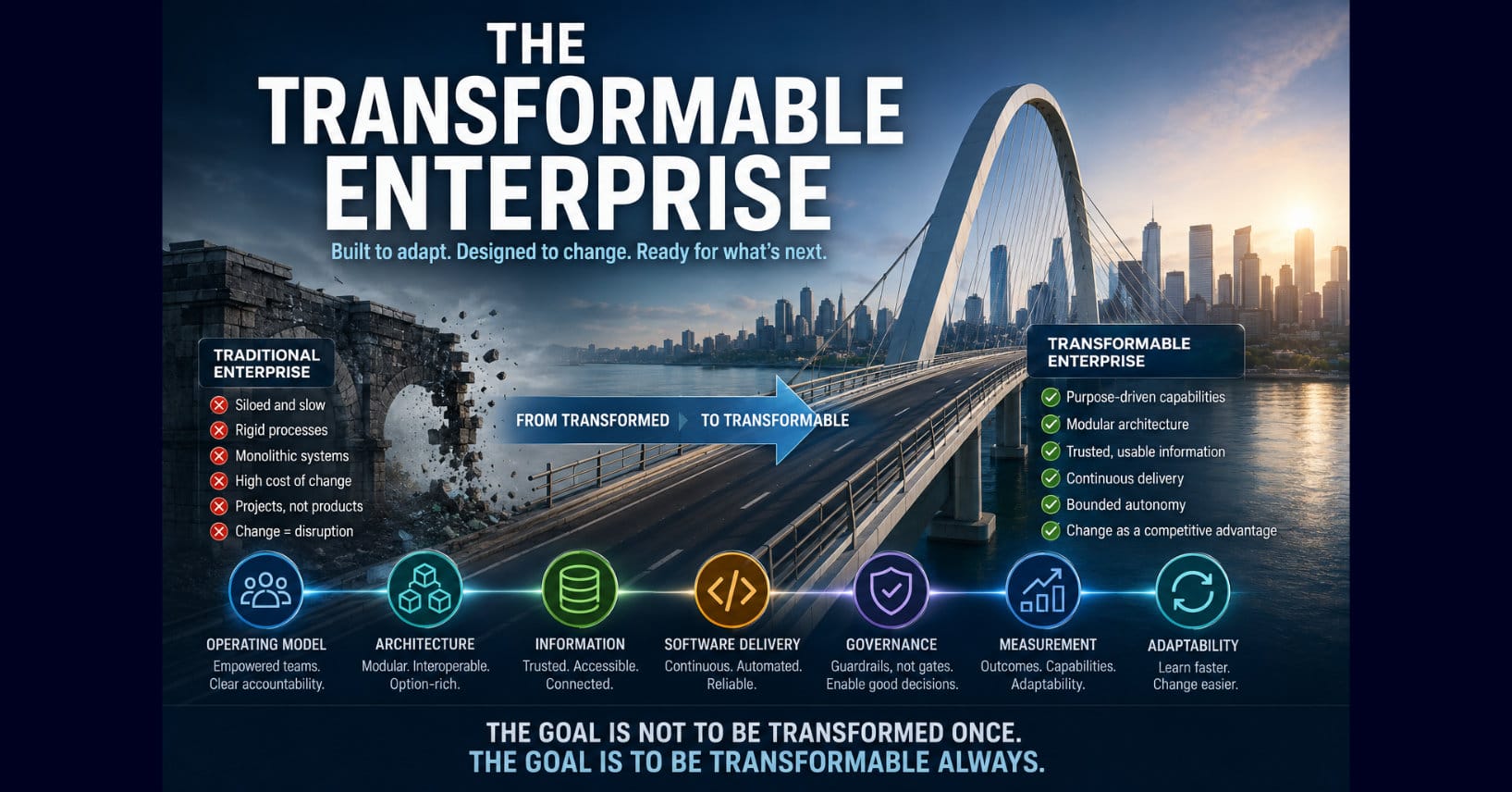
From Transformed to Transformable
Across this series, we have moved through eight ideas.
Digital transformation is not a technology program.
Transformation activity can become transformation theater.
The operating model matters more than the organization chart.
Architecture can quietly constrain what strategy is able to accomplish.
Data becomes a bottleneck when enterprise information remains fragmented.
Continuous transformation requires a different software delivery model.
Transformation metrics must distinguish activity from genuine enterprise change.
And ultimately, the objective is not a transformed enterprise.
It is a transformable one.
These ideas point toward a different way of thinking about digital transformation.
Transformation is not primarily about implementing technology.
It is about redesigning the enterprise so that technology-enabled change becomes easier to absorb.
Cloud will evolve.
AI will evolve.
Enterprise software will evolve.
Customer expectations will evolve.
Regulation will evolve.
The technologies five years from now will not be the technologies we are discussing today.
The durable advantage is therefore not possession of today’s technology.
It is the organizational ability to absorb tomorrow’s.
Executive Question
If a technology emerged tomorrow that fundamentally changed our industry, how quickly could our enterprise absorb it without launching another multiyear transformation program?
That question brings the entire series together.
The answer depends on the operating model.
The architecture.
The information.
The software delivery system.
The governance model.
The decision structure.
The organization’s ability to learn.
And the accumulated cost of previous decisions.
Those conditions determine whether change becomes an opportunity or another crisis.
The future will continue moving.
The enterprise must be designed to move with it.
That is the transformable enterprise.
Series Conclusion
Digital Transformation: Redesigning the Enterprise for Continuous Change
This eight-article series began with a simple proposition:
Digital transformation is not a technology program.
It ends with a broader one:
The ultimate purpose of digital transformation is to build an enterprise that no longer requires extraordinary effort every time technology changes.
That is the shift from transformed to transformable.
And increasingly, that may be the enterprise capability that matters most.