Digital Transformation Series | Article 6 of 8
Digital Transformation: Redesigning the Enterprise for Continuous Change
Summary
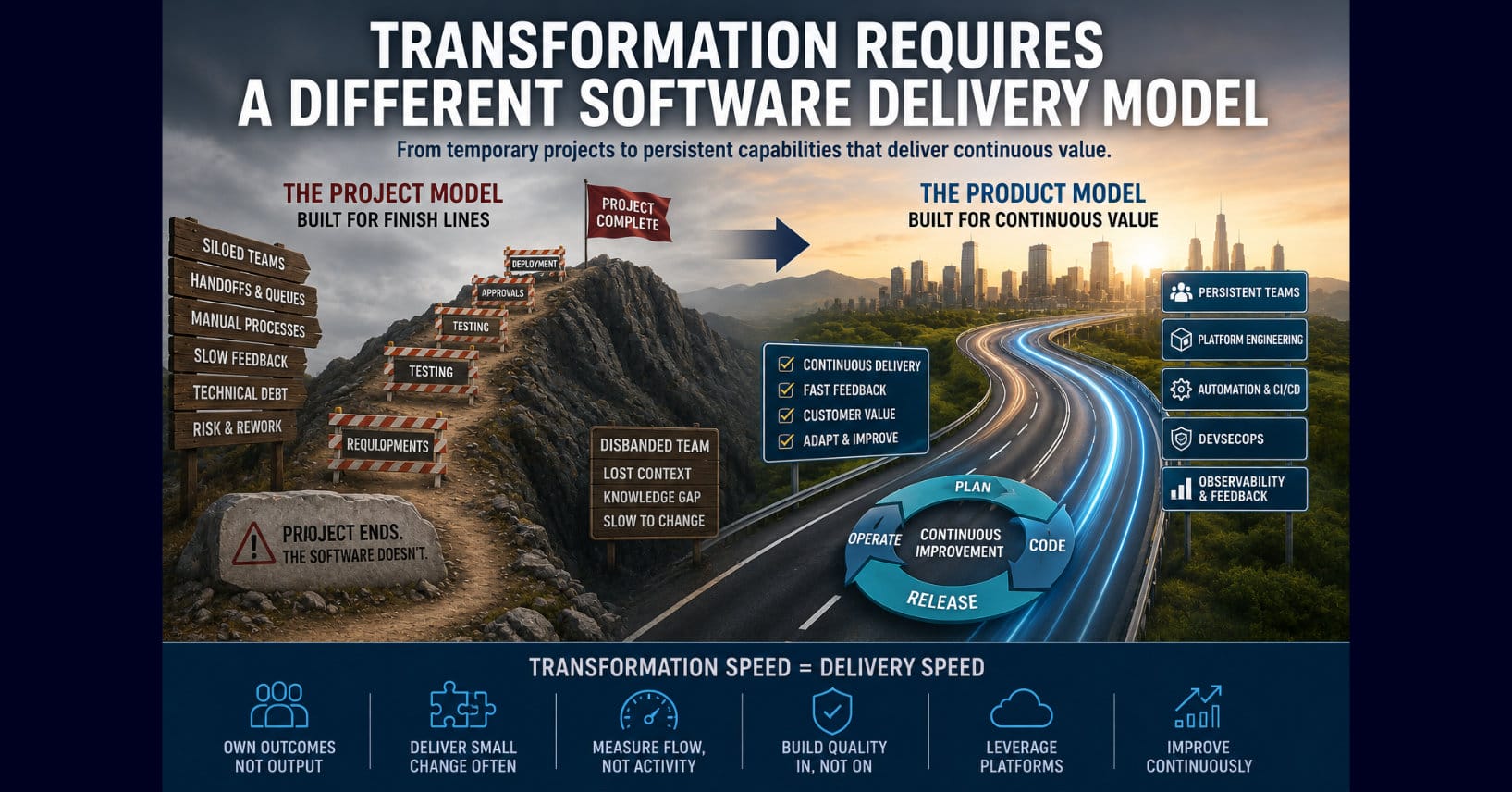
Enterprise software increasingly represents a persistent business capability, yet many organizations continue funding and managing it as a succession of temporary projects. The project may end, but the software—and the need to continuously evolve it—does not.
Transformation Requires a Different Software Delivery Model examines why continuous digital transformation requires a shift from project completion toward persistent product ownership and continuous value delivery. It explores product-oriented operating models, platform engineering, DevOps and DevSecOps, automation, technical debt, capability-based funding, procurement, flow metrics, and AI-assisted software development.
The article argues that software delivery is no longer merely an IT process. In a digitally dependent enterprise, it is a strategic capability that determines how quickly ideas, customer needs, regulatory requirements, and emerging technologies can become operational reality.
A company decides to build a new digital capability.
The project is approved.
Funding is allocated.
A project manager is assigned.
A team is assembled.
Requirements are gathered.
Architecture is designed.
Software is developed.
Testing occurs.
The application goes live.
The project is declared successful.
The team disbands.
The project manager moves to another initiative.
Developers are reassigned.
Consultants leave.
The remaining application is transferred to an operations or maintenance team.
Then customers begin using it.
Requirements change.
Security vulnerabilities appear.
Dependencies evolve.
Cloud platforms introduce new capabilities.
Business priorities shift.
Technical debt accumulates.
Competitors introduce new features.
Artificial intelligence changes what the software could potentially do.
And the enterprise discovers something that should have been obvious from the beginning.
The project ended.
The software did not.
This mismatch sits at the center of one of digital transformation’s most persistent problems.
Organizations increasingly depend on software as a continuously evolving enterprise capability while continuing to fund, organize, and manage software as a sequence of temporary projects.
Continuous transformation requires a different model.
The Project Model Solved a Different Problem
Projects are not inherently bad.
They are extremely useful management structures when work has a defined objective, identifiable beginning, expected completion, and temporary resource requirements.
Construct a building.
Relocate an office.
Implement a regulatory change.
Consolidate a facility.
Projects provide scope, budgets, schedules, accountability, and closure.
Enterprise software does not behave quite so neatly.
A digital product may have a launch date, but its useful life begins rather than ends at launch.
An API does not stop evolving when the implementation project closes.
A customer portal does not become complete when version 1.0 enters production.
A data platform does not reach a permanent finished state.
An internal workflow application continues changing as the business changes.
Software is not simply something the enterprise builds.
Increasingly, software is part of how the enterprise operates.
Treating persistent capabilities as temporary projects creates structural tension between the lifecycle of the work and the management model surrounding it.
Project Completion Is Not Capability Completion
Traditional project governance naturally optimizes toward completion.
Did we deliver the agreed scope?
Did we meet the schedule?
Did we remain within budget?
Did the system pass acceptance testing?
Did we go live?
Those are reasonable questions.
But digital transformation requires additional questions.
Is the capability improving?
Are customers using it successfully?
Is the software becoming easier or harder to change?
Are operational problems declining?
Is technical debt being managed?
Can the team respond quickly to new requirements?
Are security and reliability improving continuously?
Does the capability still support the business outcome that justified the investment?
A project can succeed while the resulting capability deteriorates.
That is because project success and product success are not the same thing.
The project measures delivery.
The product measures sustained value.
The Handoff Is a Warning Sign
One of the most revealing words in enterprise software delivery is handoff.
Development hands the system to testing.
Testing hands it to operations.
The project team hands it to support.
Architecture hands standards to engineering.
Security hands findings back to development.
Business analysts hand requirements to technology.
Each handoff creates a boundary.
Boundaries create queues.
Queues create delay.
They also weaken accountability.
The team that builds the software may not operate it.
The team that operates it may not understand why it was designed a particular way.
The people who defined requirements may not see how customers actually use the finished capability.
The team fixing production incidents may have little influence over architectural decisions creating those incidents.
Information degrades as it moves between groups.
A continuously transforming enterprise needs fewer handoffs and more persistent ownership.
The objective is not to eliminate specialization.
It is to organize specialists around outcomes rather than forcing work to travel continuously between organizational silos.
Product Thinking Changes the Unit of Management
A product-oriented delivery model changes the fundamental unit of management.
Instead of funding a temporary project to deliver a system, the enterprise funds a persistent capability and the team responsible for evolving it.
That team may include product management, software engineering, design, quality engineering, operations, security, data expertise, and other skills depending on the capability.
The exact organizational structure will vary.
The principle is more important than the labels:
Responsibility persists for as long as the capability matters.
The team does not simply deliver software.
It owns outcomes.
That changes behavior.
Maintainability matters because the team will maintain what it builds.
Reliability matters because the team experiences operational consequences.
Automation matters because repetitive manual work consumes the team’s own capacity.
Technical debt matters because the team will encounter it again.
Customer feedback matters because the product continues evolving.
Architecture becomes a long-term concern rather than a project deliverable.
This is one reason product thinking can improve software quality without making quality a separate initiative.
Persistent ownership changes incentives.
Products Are Not Just Customer-Facing Applications
Product operating models are sometimes misunderstood as appropriate only for digital businesses or customer-facing applications.
That is too narrow.
An enterprise capability can be treated as a product even when its consumers are internal.
Identity services can be a product.
Developer platforms can be products.
Data platforms can be products.
Integration capabilities can be products.
Observability platforms can be products.
Internal workflow capabilities can be products.
The important characteristic is not whether the capability generates external revenue.
It is whether it has persistent users, delivers ongoing value, requires continuous evolution, and benefits from clear ownership.
Thinking this way changes the relationship between enterprise technology and the rest of the organization.
Internal technology capabilities stop being merely infrastructure that someone maintains.
They become services deliberately designed for consumers.
Platform Engineering Changes the Economics of Delivery
Persistent product teams alone are not enough.
If every team must independently solve infrastructure, identity, security, deployment, monitoring, integration, and developer tooling, autonomy becomes expensive.
This is where platform engineering becomes strategically important.
A good internal platform turns common technical requirements into reusable capabilities.
A product team should not need to design a deployment pipeline from scratch.
It should not need to invent a logging architecture.
It should not need to manually request routine infrastructure.
It should not need to rediscover how authentication works.
It should not need to negotiate basic security controls for every application.
Those capabilities can be provided through platforms.
This creates a powerful transformation effect.
The enterprise moves complexity away from every individual delivery team and solves it once in a reusable way.
That reduces duplication.
It improves consistency.
It shortens delivery cycles.
It allows product teams to spend more time on differentiated business capabilities.
Platform engineering is therefore not simply an infrastructure improvement.
It changes the economics of enterprise software development.
DevOps Was Never Supposed to Be a Toolchain
DevOps is another idea that has sometimes been reduced to technology.
CI/CD platforms.
Infrastructure as code.
Containers.
Monitoring tools.
Automation.
Those capabilities are important.
But the deeper idea behind DevOps is organizational.
Development and operations cannot optimize independently when they are responsible for the same software system.
Developers cannot maximize delivery speed while operations absorbs instability.
Operations cannot maximize stability by making change prohibitively difficult.
The two objectives must be reconciled inside the delivery system.
This is why DevOps emphasizes shared responsibility, automation, feedback, observability, and continuous improvement.
The same principle increasingly extends to security.
DevSecOps should not mean adding another security tool to the pipeline.
It should mean designing security into the software delivery capability rather than treating security as an external inspection performed near the end.
Transformation requires these disciplines because continuous change cannot depend on repeated manual coordination among separate organizational functions.
Automation Is the Foundation of Delivery Speed
Organizations sometimes try to accelerate software delivery by asking teams to work faster.
That approach has obvious limits.
Sustainable delivery speed comes primarily from removing delay and reducing the cost of change.
Automation plays a central role.
Automated builds.
Automated tests.
Automated security checks.
Automated infrastructure provisioning.
Automated deployments.
Automated policy enforcement.
Automated rollback.
Automated observability.
Each removes a category of manual coordination from routine delivery.
The result is not merely faster development.
It is a different operating capability.
A team that can safely deploy a small change in minutes behaves differently from a team that must coordinate a quarterly release.
Smaller changes reduce risk.
Faster feedback improves quality.
Problems can be identified earlier.
Experiments become less expensive.
Business priorities can change without invalidating six months of project planning.
Software delivery speed therefore affects more than technology performance.
It affects strategic responsiveness.
Release Frequency Is an Organizational Property
When an enterprise takes three months to release software, the immediate assumption may be that development is slow.
Often, development is only one part of the timeline.
A feature may require:
Two weeks of development.
Then architecture review.
Then integration testing.
Then security testing.
Then environment provisioning.
Then change approval.
Then release scheduling.
Then coordination with dependent applications.
Then a production window.
The code may have been finished for weeks before the customer receives it.
Release frequency is therefore not simply an engineering metric.
It is a property of the operating model.
Architecture, governance, infrastructure, testing, security, organizational dependencies, and decision rights all contribute.
This connects directly to the earlier articles in this series.
Transformation cannot be separated into isolated business, organizational, architectural, data, and software problems.
They form one system.
Technical Debt Is a Delivery Tax
Project models create another structural problem.
Projects are rewarded for delivering scope within budget and schedule.
Investments that improve long-term maintainability can appear to compete with delivery objectives.
Refactoring.
Test automation.
Dependency upgrades.
Architecture improvements.
Documentation.
Platform improvements.
Observability.
Removing obsolete code.
Each consumes current resources while producing benefits that may appear after the project closes.
The rational project decision can therefore be to defer them.
The rational product decision may be very different.
A persistent team experiences the future cost of today’s shortcuts.
Technical debt becomes visible as reduced delivery capacity.
Every future feature costs more.
Testing takes longer.
Failures become more frequent.
Dependencies become harder to change.
Developers spend increasing amounts of time understanding old decisions.
Technical debt is therefore not simply an engineering-quality issue.
It is a delivery tax.
The enterprise pays it every time it tries to change the software.
Funding Models Can Defeat Product Models
Organizations sometimes adopt product terminology while retaining project economics.
Teams are renamed product teams.
Product managers are appointed.
Backlogs replace project plans.
But funding still arrives through annual projects tied to predefined scope.
This creates an operating contradiction.
A persistent product team needs the ability to respond to evidence.
Customer behavior changes.
Priorities change.
Technical constraints appear.
New opportunities emerge.
Some planned features turn out to have little value.
A project funding model asks the team to predict the solution before the learning occurs.
A product funding model allocates investment toward an enduring capability and evaluates whether that investment is producing outcomes.
This does not eliminate financial discipline.
It changes what is being funded.
Instead of repeatedly asking:
Should we approve another project for this system?
Leadership asks:
How much should we invest in this capability, and what outcomes should that investment produce?
That is a different management conversation.
Procurement Can Become Part of the Delivery Architecture
Large enterprises also need to consider procurement.
Software delivery increasingly depends on external services.
Cloud platforms.
SaaS applications.
APIs.
Development tools.
AI models.
Data providers.
Specialized engineering partners.
If obtaining or changing these services requires months of procurement activity, software delivery cannot move faster than procurement permits.
This does not mean abandoning commercial controls.
It means recognizing procurement as part of the delivery system.
Standard contract structures, preapproved service categories, reusable security assessments, architectural standards, and established vendor-management patterns can reduce repetitive work.
Transformation requires examining the entire path from idea to production.
Any recurring queue on that path is part of the delivery model.
AI Is Changing Software Delivery Again
Artificial intelligence is now changing the economics of software engineering itself.
AI-assisted development can generate code, tests, documentation, migration scripts, prototypes, and technical explanations at extraordinary speed.
That creates substantial opportunity.
It also creates an interesting problem.
If coding becomes faster while architecture reviews, testing environments, security approvals, integration dependencies, procurement, release governance, and deployment processes remain slow, the bottleneck simply moves.
Developers may produce software faster than the enterprise can absorb it.
This reinforces an important transformation principle:
Optimizing one stage of a constrained system does not necessarily improve the performance of the system.
AI can accelerate engineering work.
The enterprise still needs a delivery model capable of converting that acceleration into production value.
In some organizations, AI may make existing delivery bottlenecks more obvious rather than eliminating them.
Measure Flow, Not Just Output
Traditional software metrics often emphasize output.
Features delivered.
Story points completed.
Projects finished.
Tickets closed.
Those metrics describe activity.
A transformation-oriented delivery model needs to understand flow.
How long does an idea take to reach production?
How much of that time is active work?
How much is waiting?
How frequently can software be deployed?
How often do changes fail?
How quickly can service be restored?
How long does it take developers to obtain a working environment?
How much time is spent resolving dependencies?
How much engineering capacity goes toward maintaining existing complexity?
These measures reveal the software delivery system.
They also expose where transformation investment may produce the greatest leverage.
The objective is not maximum developer activity.
It is reliable flow of value from idea to operation.
The Software Delivery System Is an Enterprise Capability
This may be the most important conceptual shift.
Software delivery should not be viewed merely as an IT process.
In a digitally dependent enterprise, software delivery is an enterprise capability.
It determines how quickly strategy can become functionality.
How rapidly customer feedback can become improvement.
How quickly regulatory changes can be implemented.
How fast operational problems can be corrected.
How readily new technologies can be adopted.
How inexpensively experiments can be conducted.
How safely the enterprise can change.
Organizations that treat software delivery as a back-office technical function may therefore underestimate one of their most important strategic capabilities.
A company that can reliably convert an idea into production software in days has strategic options that a company requiring nine months does not.
That difference may not appear on the balance sheet.
It appears in what the enterprise is capable of doing.
From Projects to Persistent Capability
The transition does not require eliminating every project.
Projects will remain appropriate for some work.
Large migrations may require project structures.
Regulatory deadlines may require coordinated programs.
Acquisitions may require temporary integration initiatives.
Major infrastructure changes may require dedicated projects.
The mistake is using the project as the default lifecycle for software that must continue evolving after the project ends.
A more sustainable model combines:
Persistent product ownership for enduring business capabilities.
Platform teams for reusable technical capabilities.
Automated delivery pipelines for routine software change.
Integrated operational responsibility so teams experience the consequences of what they build.
Continuous security and quality rather than late-stage inspection.
Capability-based funding where appropriate.
Flow metrics that expose delay across the delivery system.
Together, these create a software delivery model designed for continuous change.
Transformation Speed Cannot Exceed Delivery Speed
Digital transformation ultimately depends on changing how the enterprise operates.
Increasingly, those changes require software.
A new customer experience requires software.
A redesigned process requires software.
New automation requires software.
A new data capability requires software.
AI integration requires software.
New business models increasingly require software.
If the enterprise can make strategic decisions faster than it can implement them, software delivery becomes the transformation bottleneck.
That is why the delivery model matters.
The objective is not simply to make developers more productive.
It is to shorten the distance between enterprise intent and operational capability.
Executive Question
How long does it take our enterprise to turn a good idea into safe, working production software—and where does most of that time actually go?
Do not look only at development time.
Look at waiting.
Approvals.
Dependencies.
Environments.
Testing.
Procurement.
Security.
Integration.
Release coordination.
That is where the delivery model reveals itself.
And if transformation requires continuous change, improving that system may be one of the highest-leverage investments the enterprise can make.
Coming Next
Article 7: Measuring Transformation Without Fooling Yourself
Cloud workloads migrated. Applications modernized. Agile teams established. AI pilots launched. Automation projects completed.
Transformation programs rarely suffer from a shortage of metrics.
The problem is determining whether those metrics demonstrate that the enterprise actually changed.
In Article 7, we will move beyond implementation measures and examine how leaders can measure transformation through enterprise capabilities, flow, decision speed, operational friction, software delivery, customer outcomes, and the organization’s growing ability to change itself.