Digital Transformation Series | Article 2 of 8
Digital Transformation: Redesigning the Enterprise for Continuous Change
Summary
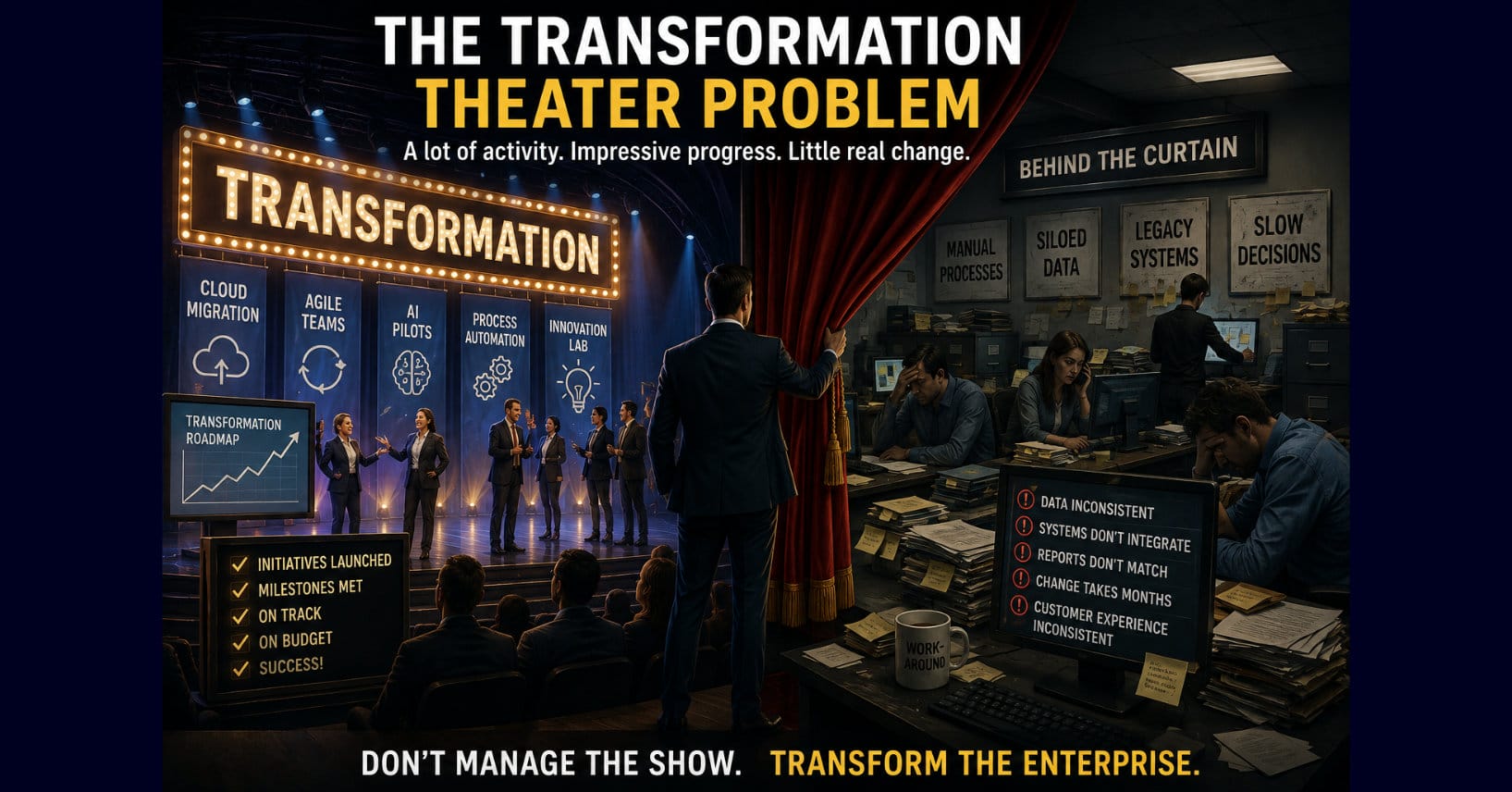
Transformation offices, cloud migrations, Agile teams, AI pilots, automation initiatives, and innovation labs can create convincing evidence that an enterprise is transforming. Yet beneath the dashboards and milestones, legacy systems, fragmented data, manual processes, slow decisions, and organizational friction may remain largely unchanged.
The Transformation Theater Problem examines the gap between visible transformation activity and measurable improvements in enterprise capability. It introduces the distinction between activity, output, and capability; explores the pilot paradox; and explains how cloud, Agile, AI, and automation initiatives can appear successful without producing meaningful operational change.
The article argues that leaders should measure transformation by what the enterprise can now do differently, what legacy complexity has been eliminated, and whether the organization has become easier to change.
Walk through almost any large enterprise undergoing digital transformation and the evidence appears everywhere.
There is a transformation office.
There are cloud migration programs.
There are Agile teams.
There are innovation labs.
There are automation initiatives.
There are AI pilots.
There are executive dashboards filled with milestones, percentages, and status indicators.
There may be hundreds of people working on dozens of initiatives, supported by substantial technology investments and an impressive collection of vendors and consultants.
By almost every visible measure, transformation is happening.
Except the enterprise itself may not be changing very much.
Decisions still require the same approvals.
Customers still encounter the same friction.
Employees still move information manually between systems.
New products still take months to launch.
Software releases still require extensive coordination.
Business units still maintain conflicting versions of the same information.
Legacy systems still constrain strategic decisions.
And spreadsheets continue performing work that supposedly transformed enterprise platforms were meant to eliminate.
This is the Transformation Theater Problem: an organization creates convincing evidence of transformation activity without producing corresponding changes in enterprise capability.
The danger is not simply wasted money.
Transformation theater can convince leadership that the organization is becoming more adaptable when the underlying enterprise is becoming more complicated.
Activity Is Easy to Measure
Transformation programs naturally generate activity.
Projects start.
Teams form.
Platforms are purchased.
Applications migrate.
Workshops occur.
Consultants deliver presentations.
Employees receive training.
Pilots launch.
Dashboards turn green.
All of these activities are measurable.
That makes them attractive management indicators.
Executives can ask how many applications have migrated to the cloud and receive a percentage.
They can ask how many teams have adopted Agile methods and receive a number.
They can ask how many processes have been automated and receive a chart.
They can ask how many AI use cases are underway and receive a portfolio.
The problem is that these measures tell leadership what the transformation program is doing.
They do not necessarily reveal what the enterprise is becoming.
An organization can complete 100 percent of its planned transformation initiatives and still fail to create the capabilities those initiatives were supposed to produce.
That is the difference between measuring implementation and measuring transformation.
When the Transformation Program Becomes the Product
Large transformation programs develop their own organizational gravity.
They acquire budgets, governance structures, reporting mechanisms, leadership teams, consultants, methodologies, and internal communications.
Eventually, managing the transformation can become an enterprise activity in its own right.
The program begins producing artifacts that demonstrate progress:
Roadmaps.
Maturity assessments.
Operating models.
Transformation scorecards.
Quarterly updates.
Capability maps.
Architecture diagrams.
Program dashboards.
None of those artifacts is inherently problematic. Many are necessary.
The problem begins when producing evidence that the transformation program is progressing becomes more important than determining whether the enterprise is actually improving.
At that point, the transformation program itself has quietly become the product.
This is especially dangerous in multiyear programs because organizational incentives begin aligning around program continuity.
People are assigned roles.
Budgets depend on continued funding.
Consulting engagements expand.
Executive reputations become associated with success.
Public commitments may have been made.
Stopping or fundamentally redirecting the program becomes politically difficult even when the original assumptions no longer hold.
Transformation can then continue because transformation is underway.
The Pilot Paradox
Innovation programs are particularly vulnerable to transformation theater.
A pilot demonstrates that something can work.
That is useful.
But enterprises frequently confuse technical feasibility with operational transformation.
Consider artificial intelligence.
An organization launches twenty AI pilots.
Several demonstrate impressive capabilities.
Executives see demonstrations.
Employees become enthusiastic.
The organization announces an AI strategy.
A year later, perhaps two of those pilots have become operational capabilities used consistently across the enterprise.
What happened?
The technology worked.
The enterprise could not absorb it.
Production deployment exposed problems the pilot did not need to solve:
Who owns the capability?
Which systems must it integrate with?
Is the underlying data reliable?
How will employees incorporate it into existing workflows?
Who supports it?
How will its performance be monitored?
What happens when it fails?
Which existing process will be retired?
How does the organization scale it beyond the original team?
A pilot can avoid many of those questions.
An enterprise capability cannot.
This creates the pilot paradox: organizations can become increasingly sophisticated at demonstrating innovation while remaining surprisingly poor at operationalizing it.
The result is an impressive innovation portfolio with limited enterprise impact.
Agile Can Become Theater Too
Agile transformation provides another example.
Organizations may train thousands of employees.
Teams adopt Scrum.
Job titles change.
Daily standups appear.
Backlogs replace project plans.
Jira dashboards multiply.
The organization declares itself Agile.
Yet software may still require months to reach production.
Funding may still be allocated annually around projects.
Architecture decisions may still require centralized approvals.
Security reviews may occur late in delivery.
Infrastructure provisioning may still take weeks.
Teams may remain dependent on multiple external groups before releasing anything.
In that environment, Agile terminology has changed more quickly than the operating system of the enterprise.
The organization has adopted Agile practices without necessarily becoming more agile.
The distinction is critical.
Doing Agile is an implementation choice. Being able to respond rapidly to change is an enterprise capability.
Transformation should be measured by the latter.
Cloud Migration Can Hide the Same Problem
Cloud programs can create similar illusions.
Suppose an enterprise reports that 75 percent of its application portfolio has migrated to the cloud.
That sounds transformational.
But what does it mean?
If those applications remain tightly coupled, difficult to deploy, poorly documented, expensive to modify, dependent on manual infrastructure processes, and constrained by legacy integration patterns, the enterprise may have moved technical debt from one hosting environment to another.
Cloud adoption created new possibilities.
The operating model determined whether those possibilities became capabilities.
This is why transformation cannot be evaluated solely by technology adoption.
The relevant question is not:
How much technology changed?
It is:
How much organizational capability changed because of the technology?
The Dashboard Problem
Executives depend on dashboards because large transformation portfolios cannot be managed through anecdote.
But dashboards influence behavior.
What leadership measures becomes what programs optimize.
If the dashboard emphasizes applications migrated, teams trained, milestones completed, projects delivered, pilots launched, and budget consumed, those are the outcomes the organization will pursue.
A transformation dashboard can therefore be entirely accurate while presenting a misleading picture of transformation.
Every indicator can be green.
Every milestone can be achieved.
Every workstream can report progress.
And the enterprise can remain slow, fragmented, expensive, and difficult to change.
The dashboard is not necessarily wrong.
It is answering the wrong question.
Measure the Enterprise, Not Just the Program
A better transformation measurement model separates three things:
Activity
What work are we performing?
Examples include applications migrated, employees trained, APIs created, processes automated, and AI pilots launched.
Output
What did the work produce?
Examples include a new customer platform, a cloud environment, an automated workflow, a data platform, or a redesigned application.
Capability
What can the enterprise now do differently?
Examples include launching a product in six weeks instead of nine months, onboarding customers in minutes instead of days, releasing software daily instead of quarterly, or identifying supply disruptions before customers are affected.
Activity matters.
Outputs matter.
But transformation ultimately exists at the capability level.
That distinction provides leadership with a simple diagnostic tool.
For every major transformation initiative, ask:
What enterprise capability is this initiative supposed to create or materially improve?
Then ask:
How will we know that capability actually changed?
If those questions cannot be answered clearly, the initiative may be producing technology rather than transformation.
Transformation Theater Often Begins With Good Intentions
Transformation theater is rarely the result of deliberate deception.
More often, it emerges from reasonable management behavior.
Leaders need measurable progress.
Boards need updates.
Program managers need milestones.
Technology teams need delivery targets.
Vendors need implementation plans.
Finance needs budgets.
Employees need defined responsibilities.
The easiest things to measure are therefore the things the organization begins managing.
Over time, proxies for transformation become substitutes for transformation.
Cloud adoption becomes a proxy for scalability.
Agile adoption becomes a proxy for speed.
Automation becomes a proxy for efficiency.
AI adoption becomes a proxy for innovation.
Application modernization becomes a proxy for adaptability.
But proxies can diverge from the capabilities they were intended to represent.
An organization can have extensive cloud adoption and remain difficult to scale.
It can have hundreds of Agile teams and remain slow.
It can automate inefficient processes and simply execute bad processes faster.
It can deploy AI widely without materially improving decisions.
It can modernize applications while preserving the architectural dependencies that made change difficult in the first place.
Technology adoption and enterprise capability are related.
They are not equivalent.
The Hardest Transformation Decision May Be What to Stop
Transformation programs tend to emphasize creation.
Build the platform.
Launch the initiative.
Deploy the system.
Establish the team.
Introduce the capability.
But genuine transformation frequently requires subtraction.
Retire the old application.
Eliminate the duplicate process.
Remove an approval.
Stop generating the spreadsheet.
Decommission the redundant database.
Dissolve the temporary workaround.
Consolidate the competing platform.
End the manual reconciliation process.
Without subtraction, transformation can increase organizational complexity.
The enterprise adds cloud platforms without retiring legacy infrastructure.
It adds collaboration tools without eliminating old ones.
It adds APIs while preserving point-to-point integrations.
It adds AI assistants while retaining the workflows the assistants were supposed to improve.
It adds transformation structures on top of existing organizational structures.
Eventually, the transformed enterprise contains everything the old enterprise had—plus the transformation.
That is not transformation.
It is accumulation.
Follow the Friction
One of the best ways to distinguish genuine transformation from transformation theater is to look beyond the transformation portfolio and examine everyday work.
Where are employees waiting?
Where are customers repeating information?
Where are managers reconciling conflicting reports?
Where are developers waiting for environments or approvals?
Where are employees copying information between systems?
Where are spreadsheets compensating for missing capabilities?
Where does a routine change require coordination among several departments?
Where do employees say, “That is just how the system works”?
Those points of friction reveal the actual operating model.
They also reveal whether transformation has reached it.
An executive presentation may describe an integrated digital enterprise.
A customer service representative switching among seven applications to answer one question tells a different story.
Both observations can be technically true.
Only one describes how the enterprise actually operates.
Transformation Should Make the Enterprise Easier to Change
There is another test that deserves more attention.
A transformation initiative should not merely improve the enterprise’s current state.
It should improve the enterprise’s ability to change again.
Suppose a new platform reduces operating costs but makes future modifications more difficult.
Suppose an automation program creates hundreds of fragile dependencies that nobody fully understands.
Suppose a cloud migration reduces infrastructure costs but leaves applications more tightly coupled to proprietary services.
Suppose a new enterprise platform standardizes processes but makes business-model experimentation prohibitively expensive.
Those initiatives may produce short-term benefits while reducing long-term adaptability.
That matters because digital transformation is occurring in an environment where technological change is accelerating.
The enterprise that optimizes perfectly for today’s operating model may be poorly prepared for tomorrow’s.
Transformation therefore needs another measure:
Did this investment increase or decrease our capacity for future change?
That question shifts attention from immediate implementation toward architectural and organizational optionality.
From Transformation Program to Transformation Capability
The objective should not be to eliminate transformation programs.
Large enterprises will continue needing coordinated initiatives to accomplish substantial change.
The objective is to prevent the program from becoming confused with the outcome.
A transformation program is temporary.
Transformation capability should persist.
When the program ends, the enterprise should be demonstrably better at changing itself.
Its architecture should be easier to evolve.
Its information should move more freely.
Its software delivery system should respond more quickly.
Its decision structures should create less unnecessary delay.
Its teams should possess greater autonomy within clearly defined boundaries.
Its platforms should enable capabilities that previously required custom development.
Its operating model should absorb new technologies without requiring another organizational crisis.
That is what remains after the transformation banners come down.
The Transformation Theater Test
Leadership teams can expose transformation theater with five straightforward questions:
- What enterprise capability is each major transformation initiative intended to change?
- What measurable evidence demonstrates that the capability has actually improved?
- Which old processes, systems, dependencies, or organizational mechanisms disappeared because of the transformation?
- Where does operational friction remain despite completed transformation initiatives?
- Is the enterprise now easier to change than it was before the program began?
Those questions move the discussion away from transformation activity and toward transformation consequences.
They can also produce uncomfortable answers.
That is precisely why they are useful.
Executive Question
If we stopped reporting transformation activities and measured only changes in enterprise capability, how much transformation would we still be able to demonstrate?
The answer may reveal the difference between a transformation program that looks successful and an enterprise that has actually changed.
Coming Next
Article 3: Transform the Operating Model, Not the Org Chart
Organizations frequently respond to transformation by restructuring teams, creating new executive roles, and moving reporting lines.
But changing who reports to whom does not necessarily change how the enterprise operates.
In Article 3, we will examine the operating model beneath the organization chart—decision rights, workflows, information flows, accountability, capabilities, and organizational interfaces—and why that is where genuine transformation occurs.