Enterprise Software Engineering Series—Article 1
Many organizations equate enterprise software with large companies or massive user bases, but that definition misses the point. Enterprise software is determined by the business impact of its success—or failure. This article establishes the foundational principles of enterprise software engineering, explaining why sustainability, scalability, security, governance, and maintainability matter more than technology choices. It also introduces the philosophy that will guide the entire Enterprise Software Engineering series: software is a long-term business asset that must be intentionally designed to endure.
Executive Perspective
The phrase enterprise software is one of the most frequently used—and least clearly defined—terms in technology. It appears in marketing materials, software demonstrations, architecture discussions, and consulting proposals, yet its meaning often changes depending on who is using it.
Many assume enterprise software is simply software used by large organizations. Others believe it refers to applications with thousands of users or multimillion-dollar budgets. Neither definition captures what truly distinguishes enterprise systems from every other application.
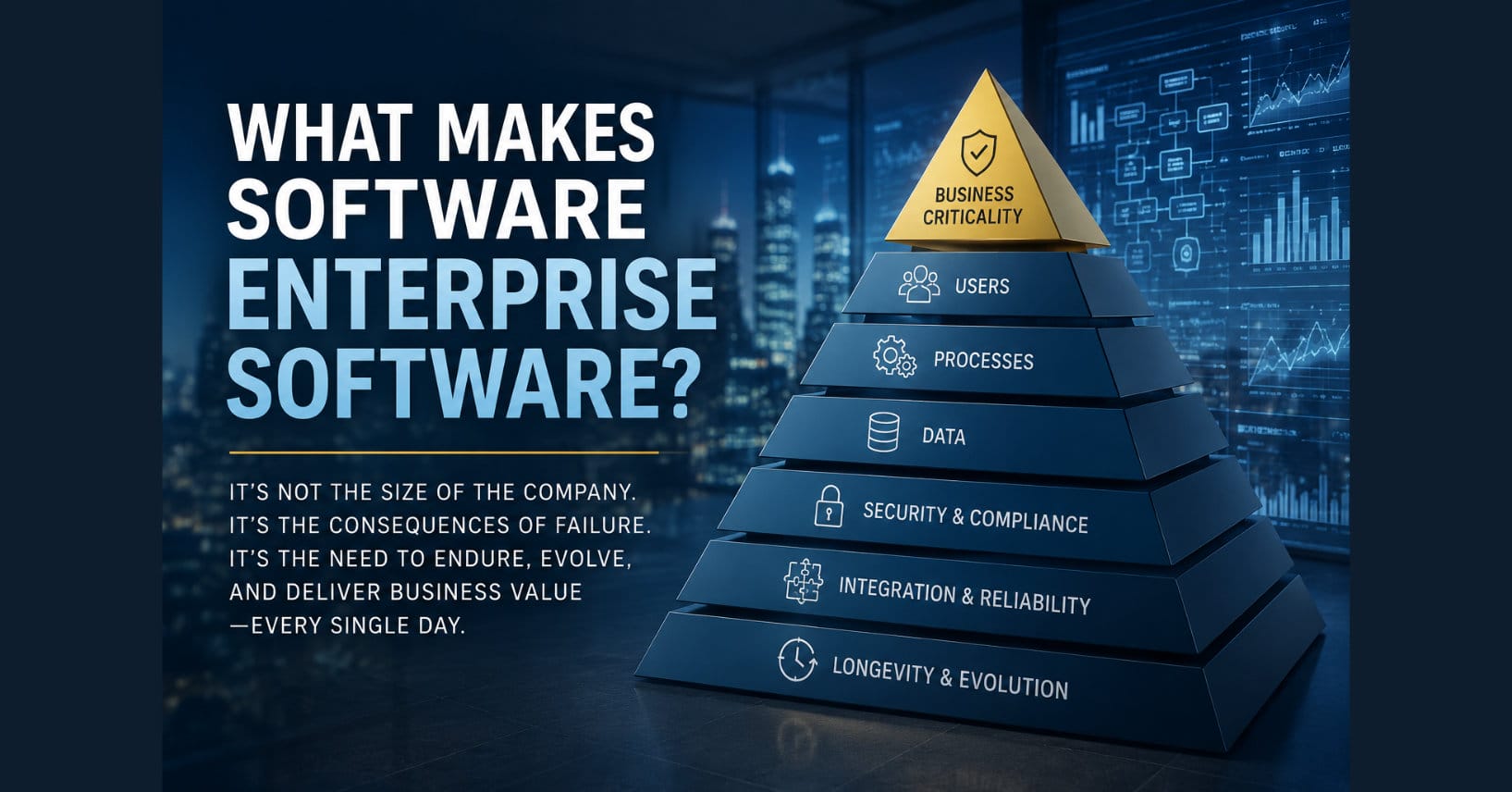
Enterprise software is not defined by the size of the company that owns it. It is defined by the consequences of its failure.
A custom inventory system supporting twenty employees may be far more “enterprise” than a consumer application serving millions of casual users if the inability to access that inventory system prevents shipments, delays revenue recognition, or exposes the organization to regulatory penalties.
This distinction matters because organizations frequently underestimate the engineering discipline required to build systems that become critical to their operations. Applications often begin life as departmental tools or proof-of-concept projects. Over time they accumulate users, business rules, integrations, reports, compliance requirements, and operational dependencies until they become indispensable. Unfortunately, software rarely announces the day it becomes enterprise software.
Organizations discover it only after an outage.
Enterprise Is About Consequence
The defining characteristic of enterprise software is business criticality.
Ask a simple question:
What happens if this application becomes unavailable for twenty-four hours?
If the answer includes any of the following, you are likely dealing with enterprise software:
- Revenue stops.
- Employees cannot perform their jobs.
- Customers lose access to services.
- Regulatory obligations are missed.
- Operational decisions become impossible.
- Leadership loses visibility into critical business data.
- Reputation suffers.
- Legal exposure increases.
None of these outcomes depend on programming language, database platform, or hosting environment. They depend entirely on how important the application has become to the organization.
Enterprise software exists wherever operational continuity depends upon technology.
Size Is a Poor Measurement
One of the biggest misconceptions in our industry is that enterprise software is synonymous with scale.
Scale certainly introduces complexity, but complexity alone does not define enterprise engineering.
Consider two examples.
The first application serves two million anonymous users browsing publicly available content. If the system experiences an outage, users may become frustrated, but little permanent business damage occurs.
The second application is used by twelve employees processing organ transplant coordination, emergency dispatch, financial settlements, or cybersecurity incident response.
Which application demands greater engineering discipline?
In many cases, the smaller system.
When every transaction carries operational, financial, or legal consequences, reliability becomes more important than popularity.
Enterprise software is measured by business impact—not user count.
Enterprise Software Has a Longer Life Than Its Original Developers
Consumer applications often optimize for rapid innovation.
Enterprise software must optimize for sustainability.
Many business systems remain operational for ten, fifteen, or even twenty years. During that time they experience:
- Multiple development teams
- Leadership turnover
- Vendor changes
- Database growth
- Regulatory changes
- Security threats
- Infrastructure migrations
- Business process evolution
The engineers who originally designed the application may no longer work for the organization.
The software, however, remains.
This reality fundamentally changes engineering priorities.
Writing elegant code is valuable. Designing software that strangers can successfully maintain a decade later is far more valuable.
Sustainable software engineering begins with the assumption that future engineers will inherit every decision made today.
Enterprise Software Is Built Around Business Processes
Many development projects begin by discussing screens, reports, or features.
Enterprise engineering begins somewhere else.
It begins with understanding how the organization creates value.
Software exists to support business processes—not the other way around.
Before architects discuss frameworks or databases, they should understand questions such as:
- How does work move through the organization?
- Which decisions require human judgment?
- Which processes are subject to regulation?
- What evidence must be preserved?
- What information drives executive decisions?
- Which failures create unacceptable business risk?
Technology should implement business capability rather than define it.
Organizations that reverse this relationship often spend years adapting their operations to software limitations instead of designing software that supports their mission.
Enterprise Software Must Evolve
No enterprise remains static.
Markets change.
Customers change.
Laws change.
Technology changes.
The software must change as well.
Architecture therefore becomes less about predicting the future than preparing for it.
Successful enterprise systems anticipate modification by emphasizing:
- Clear architectural boundaries
- Modular design
- Well-defined interfaces
- Stable data models
- Documented business rules
- Extensible integration strategies
The objective is not to eliminate change.
The objective is to make change less expensive.
Engineering Beyond Development
Many organizations think software projects conclude when deployment succeeds.
Enterprise engineering recognizes deployment as the beginning of a much longer operational journey.
Once software enters production, organizations inherit responsibilities that continue throughout the application’s lifetime:
- Performance monitoring
- Security management
- Incident response
- Capacity planning
- Documentation maintenance
- Compliance reporting
- Disaster recovery
- Technical debt management
Every deployment represents the start of a long-term operational commitment.
Software that cannot be maintained eventually becomes software that cannot be trusted.
Characteristics of Enterprise Software
Although enterprise systems differ across industries, they typically share common characteristics.
Reliability
The organization expects predictable operation under normal and abnormal conditions.
Maintainability
Future engineers can understand, modify, and extend the system without introducing unnecessary risk.
Scalability
Growth in users, transactions, or data volumes can be accommodated without fundamental redesign.
Security
Confidentiality, integrity, and availability are treated as architectural requirements rather than optional features.
Auditability
Important actions can be reconstructed through logs, evidence, and historical records.
Integration
The application cooperates with other business systems through stable interfaces.
Governance
Changes follow repeatable engineering and organizational processes.
Longevity
The architecture anticipates years—not months—of operational use.
Notice that none of these characteristics mention programming languages, cloud providers, frameworks, or development methodologies.
These are engineering qualities.
Not technology choices.
Enterprise Engineering Is a Mindset
The transition from software development to enterprise software engineering occurs when engineers begin asking different questions.
Instead of asking:
“Can we build this?”
Enterprise engineers ask:
- Can we support this?
- Can we secure this?
- Can we evolve this?
- Can we recover this?
- Can we explain this?
- Can we defend this?
- Can we operate this ten years from now?
Those questions shape every architectural decision that follows.
Looking Ahead
If enterprise software is defined by business consequence rather than technical complexity, then architecture becomes far more than diagramming components or selecting technologies.
Architecture becomes the discipline of reducing future organizational risk.
The next article explores that idea in depth by examining why every architectural decision is ultimately a business decision—and why architecture is, at its core, an exercise in risk management.
Engineering Principle
Enterprise software is defined by the consequences of its failure, not by the technologies used to build it.