AI Strategy Series | Article 16 of 20
Building the Intelligent Enterprise
Summary
Artificial intelligence is fundamentally changing the economics of enterprise intelligence. Capabilities that once required scarce expertise, substantial labor, and considerable time are becoming increasingly accessible through commercially available AI systems. As the cost of producing information, analysis, recommendations, and technical solutions declines, organizations must reconsider what creates sustainable competitive advantage.
In Article 16 of the AI Strategy Series, Building the Intelligent Enterprise, Victor M. Font Jr. examines how the commoditization of intelligence is shifting enterprise value away from information production and toward the organizational capabilities necessary to convert intelligence into measurable business outcomes.
The article distinguishes five layers of enterprise intelligence: information production, analysis and interpretation, contextual judgment, authorized decision-making, and operational execution. While AI can accelerate activities across these layers, the ability to validate recommendations, exercise legitimate authority, and coordinate execution remains essential.
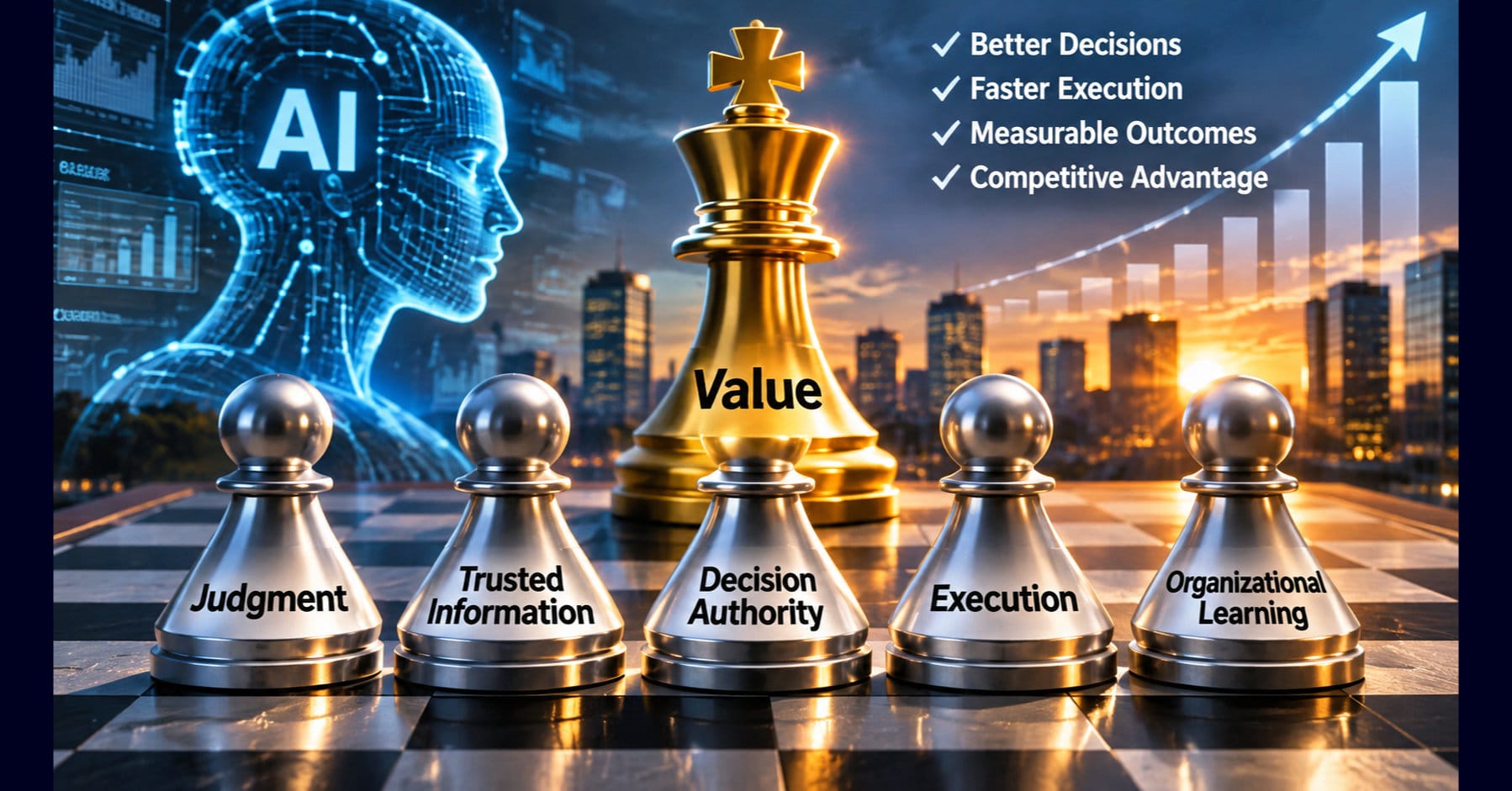
Five capabilities emerge as increasingly valuable: contextual judgment, trusted information and evidence, decision authority and governance, integrated execution, and organizational learning.
The Enterprise Value Migration Model illustrates how competitive differentiation is shifting from access to specialized knowledge and sophisticated tools toward authoritative information, accountable decisions, integrated operating models, and evidence-based adaptation.
The article also examines why proprietary data does not automatically establish a competitive advantage, why professional expertise remains essential, and how trustworthy AI operations can improve economic performance.
For CEOs, CIOs, and boards of directors, the strategic imperative extends beyond AI adoption. Organizations must identify which existing advantages are becoming commoditized, strengthen their distinctive capabilities, and redesign their operating models to convert increasingly abundant intelligence into sustainable economic value.
The central conclusion is that competitive advantage will increasingly depend not on possessing intelligence, but on the enterprise’s ability to turn that intelligence into trustworthy decisions, coordinated execution, organizational learning, and measurable results.
For most of modern business history, intelligence has been expensive.
Organizations invested heavily in acquiring information, developing expertise, producing analysis, and employing professionals capable of interpreting complex business conditions.
The ability to gather information, recognize patterns, develop recommendations, and communicate conclusions represented a meaningful competitive advantage.
Companies built entire organizational structures around these capabilities.
Management consulting firms monetized specialized analysis.
Financial institutions invested in research departments.
Technology companies employed architects, engineers, and analysts to solve problems that required substantial technical knowledge.
Corporate leadership depended on layers of management to collect information, interpret performance, and coordinate decisions.
Intelligence was valuable partly because producing it required scarce expertise, significant labor, and considerable time.
Artificial intelligence is changing that economic equation.
A capability that once required hours of professional analysis can increasingly be produced in minutes.
Information that previously demanded specialized research can be synthesized rapidly.
Software, business documents, financial scenarios, architectural alternatives, and strategic recommendations can be generated at dramatically lower marginal costs.
The implications extend well beyond productivity.
When intelligence becomes inexpensive and widely accessible, possessing intelligence is no longer sufficient to establish competitive advantage.
The strategic question changes.
If every organization can access increasingly capable AI systems, what differentiates one enterprise from another?
If competitors can generate similar analyses, recommendations, software, and strategic options, where does sustainable economic value reside?
And if the cost of producing an answer approaches zero, what becomes valuable about deciding which answer to trust, which action to authorize, and which outcome to pursue?
These questions reach the foundations of enterprise strategy.
The next competitive advantage may not come from having more intelligence.
It may come from possessing the organizational capabilities necessary to turn abundant intelligence into superior decisions, coordinated execution, and sustained economic results.
The Economics of Scarcity Are Changing
Economic value is influenced by scarcity.
When a capability is difficult to obtain, expensive to reproduce, or available to only a limited number of competitors, organizations possessing that capability may enjoy an advantage.
Historically, many forms of business intelligence met those conditions.
Specialized analytical expertise was scarce.
Complex research required substantial labor.
Software development demanded technical knowledge and sustained engineering effort.
Strategic planning depended on experienced professionals capable of evaluating incomplete information.
The resulting scarcity created economic value.
AI is reducing the cost of producing many of these outputs.
This does not mean expertise has become unnecessary or that all intelligence is equally reliable.
It means the economic conditions surrounding certain forms of knowledge work are changing.
An enterprise that previously differentiated itself through the speed or volume of routine analysis may discover that competitors can now achieve comparable results using commercially available AI systems.
A company that once relied on its ability to produce extensive documentation may find that document generation has become a commodity.
An organization whose competitive position depended primarily on access to specialized analytical tools may find those capabilities increasingly embedded in ordinary business software.
The value of the capability does not disappear.
But its ability to differentiate the enterprise may decline.
This distinction is essential.
A capability can remain operationally valuable while losing its strategic scarcity.
Email remains indispensable to many organizations.
Its widespread availability does not make access to email a sustainable competitive advantage.
Cloud infrastructure is strategically important.
But merely using cloud computing rarely distinguishes an enterprise from competitors with access to similar services.
AI may follow a comparable pattern across substantial portions of knowledge work.
The technology becomes increasingly necessary for competitive participation while becoming less sufficient for competitive differentiation.
Intelligence Is Not a Single Economic Commodity
Before declaring intelligence inexpensive, we must distinguish among different forms of intelligence.
AI is not reducing the cost of every cognitive capability equally.
Generating a plausible explanation is different from establishing that the explanation is correct.
Producing a strategic recommendation is different from determining whether the recommendation is appropriate for a particular organization.
Writing software is different from delivering a reliable, secure, maintainable production system.
Summarizing a regulatory requirement is different from interpreting its application to a specific enterprise under legal and operational uncertainty.
These distinctions matter because AI can reduce the cost of producing an output without proportionally reducing the cost of verifying, implementing, or accepting responsibility for it.
Consider five economic layers.
Five Layers of Enterprise Intelligence
| Layer | Enterprise Capability | Effect of Increasingly Accessible AI |
|---|---|---|
| Information production | Gathering, summarizing, and generating information | Lower cost and greater availability |
| Analysis and interpretation | Identifying patterns, evaluating alternatives, developing recommendations | Faster analysis, with continuing validation requirements |
| Contextual judgment | Determining what conclusions mean for a specific organization | Remains dependent on context, expertise, and accountability |
| Authorized decision-making | Selecting actions within legitimate business authority | Requires explicit decision rights and governance |
| Operational execution | Translating decisions into coordinated business outcomes | Depends on processes, systems, people, controls, and resources |
AI can contribute to every layer.
However, the economic value of those contributions differs.
The cost of generating an analysis may decline rapidly.
The cost of establishing whether that analysis is trustworthy may decline more slowly.
The cost of obtaining organizational agreement may remain substantial.
And the cost of executing a decision across fragmented enterprise systems may remain largely unchanged unless the operating model is redesigned.
This creates an important strategic asymmetry.
AI can make recommendations abundant while leaving the capacity to act on them constrained.
That asymmetry is where many future competitive advantages will emerge.
The New Scarcity: Turning Intelligence Into Action
Imagine two competing manufacturers.
Both use advanced AI systems.
Both can analyze supplier performance, forecast demand, identify production constraints, and recommend inventory adjustments.
Both receive similar recommendations about reducing excess inventory while maintaining customer service levels.
The first manufacturer operates through fragmented departments.
Procurement controls supplier relationships.
Operations controls production schedules.
Finance controls working capital targets.
Sales controls customer commitments.
Each function has different incentives, approval procedures, and performance measures.
The AI recommendation is technically sound.
But implementing it requires extensive negotiation across organizational boundaries.
The second manufacturer has established an integrated operating model.
A designated business owner is accountable for end-to-end inventory performance.
Decision rights are explicit.
Information is shared across functions.
Escalation thresholds are defined.
Operational systems support coordinated execution.
The same AI recommendation can be evaluated, authorized, and implemented much faster.
Which organization gains the advantage?
Not necessarily the one with the more sophisticated AI model.
The advantage belongs to the organization better equipped to convert intelligence into coordinated action.
This is a critical change in the economics of enterprise competition.
When analytical capabilities become widely available, the ability to act effectively on those capabilities becomes more valuable.
Execution has always mattered.
AI makes its importance more visible by reducing the scarcity of the analysis that precedes it.
Why Better Answers Do Not Automatically Produce Better Decisions
Enterprise leaders frequently assume that better information leads to better decisions.
The relationship is not automatic.
A decision involves more than analytical quality.
It requires selecting among alternatives under conditions of uncertainty, competing objectives, resource constraints, and accountability.
An AI system may recommend closing an underperforming facility.
Its analysis may accurately identify operating costs, demand patterns, and projected financial benefits.
But the decision may also involve workforce obligations, contractual commitments, community relationships, regulatory requirements, and long-term strategic considerations.
These factors cannot necessarily be reduced to a single optimization objective.
Similarly, AI may identify an opportunity to accelerate a product launch.
But management must determine whether the organization is prepared to accept the resulting operational, security, financial, and reputational risks.
The quality of the recommendation matters.
So does the legitimacy of the decision.
A decision must be made by an authorized party, using appropriate evidence, within established constraints, with accountability for its consequences.
That is why professional judgment remains strategically important.
Not because humans will always outperform AI at analysis.
But because enterprise decisions involve obligations that cannot simply be delegated to a system without an appropriate governance framework.
The value of judgment increases when the volume of available recommendations exceeds the organization’s capacity to evaluate and execute them.
The enterprise needs people and systems capable of distinguishing between what is analytically attractive, operationally feasible, legally permissible, and strategically appropriate.
Trustworthy Information Becomes More Valuable as Generated Information Becomes Abundant
AI can generate extraordinary volumes of information.
But increasing the supply of information does not necessarily increase its reliability.
In fact, abundant generated content can make it more difficult to distinguish authoritative information from plausible but unsupported assertions.
An enterprise may have thousands of documents describing its operations.
Some are current.
Others are obsolete.
Some reflect approved policies.
Others contain informal recommendations.
Some represent authoritative business records.
Others are drafts, interpretations, or historical artifacts.
An AI system can retrieve and synthesize information from these sources.
But unless the enterprise establishes information authority, the resulting answer may combine incompatible or outdated material.
The problem becomes more consequential when AI moves beyond generating answers and begins executing actions.
An autonomous agent relying on incorrect supplier information may initiate an inappropriate transaction.
An agent using outdated access policies may recommend unauthorized permissions.
An AI-assisted financial process may produce a plausible analysis using data that lacks the necessary reconciliation or approval.
These failures are not simply model-quality problems.
They are information governance problems.
The Information Value Shift
| Traditional Emphasis | Emerging Strategic Emphasis |
|---|---|
| Volume of available information | Reliability and authority of information |
| Speed of information retrieval | Provenance and contextual relevance |
| Access to analytical tools | Ability to validate analytical outputs |
| Documentation completeness | Evidence of decisions and actions |
| Data accumulation | Governed information that supports execution |
| Knowledge availability | Knowledge that can be trusted and acted upon |
As information generation becomes less expensive, the relative importance of trustworthy information may increase.
This creates a strategic opportunity for organizations that have invested in data governance, information architecture, provenance, and decision evidence.
Their advantage is not simply possessing more data.
It is possessing information whose meaning, authority, quality, and permitted uses are understood.
That distinction becomes particularly important in agentic environments.
An agent cannot responsibly exercise delegated authority if the information supporting its actions is unreliable or its authorization boundaries are unclear.
The intelligent enterprise must therefore treat trusted information as operational infrastructure.
Proprietary Data Is Valuable Only When It Changes the Outcome
One response to the commoditization of AI capabilities is to argue that proprietary data will become the primary source of competitive advantage.
There is merit in that argument.
Organizations possess customer relationships, transaction histories, operational records, domain knowledge, and business context that competitors cannot readily reproduce.
These assets can improve the relevance and effectiveness of AI applications.
But proprietary data does not automatically create a competitive advantage.
A company may possess decades of historical information that is poorly governed, inconsistent, inaccessible, or irrelevant to current business decisions.
Another organization may possess less data but maintain superior information quality, clearer authority, and better integration with operational processes.
The second organization may generate greater economic value from its information assets.
The strategic value of proprietary data depends on several conditions:
- The data must be relevant to a valuable business decision or capability.
- Its quality and provenance must be sufficiently reliable.
- The enterprise must have legitimate authority to use it.
- It must be accessible through appropriate architecture.
- It must improve outcomes that matter economically.
- Competitors must face meaningful difficulty reproducing the resulting advantage.
The final condition is particularly important.
If proprietary data produces only a modest improvement that competitors can achieve through alternative sources or better execution, its strategic value may be limited.
The competitive advantage comes from the complete capability.
Data is one component.
The ability to govern, interpret, and operationalize that data is another.
This distinction will be examined more fully in Article 17, Your Proprietary Data Is Not Automatically an AI Moat.
The Five Capabilities That Become More Valuable
As AI reduces the cost of producing many forms of intelligence, five enterprise capabilities deserve greater strategic attention.
1. Contextual Judgment
AI can identify patterns and evaluate alternatives.
But enterprise leaders must determine which alternatives align with organizational objectives, constraints, obligations, and risk tolerance.
Contextual judgment includes understanding what the organization is trying to accomplish and recognizing when an apparently optimal recommendation is inappropriate.
It also includes knowing when available evidence is insufficient.
A mature organization does not reward employees merely for accepting AI-generated recommendations.
It develops professionals capable of challenging assumptions, identifying missing evidence, and exercising sound judgment under uncertainty.
2. Trusted Information and Evidence
When information is abundant, its reliability becomes a differentiator.
Organizations need authoritative data, defensible provenance, explicit ownership, and evidence connecting decisions to their underlying information.
This capability supports more than accurate AI outputs.
It enables accountability.
The enterprise must be able to establish what information was used, which rules applied, who or what acted, and why an action was authorized.
That evidence becomes essential when AI participates directly in business execution.
3. Decision Authority and Governance
AI can recommend actions faster than traditional organizational structures can authorize them.
Without explicit decision rights, this creates bottlenecks or unauthorized execution.
Competitive advantage increasingly depends on the ability to define which decisions may be automated, which require human authorization, and which must remain under direct professional control.
The organization must also establish intervention mechanisms, escalation requirements, and accountability for outcomes.
Governance is not merely a constraint on AI.
Properly designed, it enables the enterprise to act faster within clearly defined boundaries.
4. Integrated Execution Capability
An organization that cannot coordinate its systems, processes, and business functions will struggle to convert AI recommendations into results.
Integrated execution requires coherent enterprise architecture, interoperable systems, well-defined processes, and accountable business ownership.
It also requires organizational structures that support end-to-end outcomes rather than departmental optimization.
This capability becomes increasingly valuable as AI exposes opportunities that traditional operating models cannot readily capture.
5. Organizational Learning
The first four capabilities help an organization make and execute decisions.
The fifth determines whether it becomes better at doing so over time.
Organizational learning requires systematic feedback from decisions, actions, outcomes, and failures.
The enterprise must understand which AI-enabled interventions worked, which assumptions proved incorrect, and which operating practices should change.
This is not simply model retraining.
It is the organization’s ability to improve its decision processes, governance, workflows, and allocation of resources.
An enterprise that learns faster can convert similar AI capabilities into progressively better outcomes.
That learning capability may become one of the most durable sources of differentiation.
The Enterprise Value Migration Model
These five capabilities suggest a broader shift in where economic value resides.
Historically, organizations often differentiated themselves through their ability to acquire expertise and produce information.
AI is reducing the scarcity of those capabilities.
The emerging opportunity is to develop enterprise systems that transform inexpensive intelligence into trustworthy, authorized, and economically productive action.
Enterprise Value Migration
| Dimension | Historically Valuable Capability | Increasingly Valuable Capability |
|---|---|---|
| Knowledge | Access to specialized information | Contextual interpretation and judgment |
| Analysis | Ability to produce recommendations | Ability to evaluate and prioritize recommendations |
| Data | Possession of information assets | Governed, authoritative, operationally useful information |
| Decisions | Speed of management analysis | Clarity of decision rights and accountability |
| Operations | Functional efficiency | End-to-end execution capability |
| Technology | Access to sophisticated tools | Architecture that integrates intelligence into operations |
| Learning | Accumulated institutional experience | Rapid, evidence-based organizational adaptation |
This model does not imply that traditional capabilities become worthless.
They remain necessary.
But the relative sources of differentiation may change.
The enterprise that merely produces more analysis may not outperform competitors.
The enterprise that consistently converts analysis into better decisions and execution has a stronger opportunity to do so.
The Competitive Advantage of Saying No
When intelligence becomes inexpensive, organizations may face an unexpected strategic problem.
They can generate more opportunities than they can responsibly pursue.
AI can identify potential markets, propose products, recommend operational improvements, generate software concepts, and develop investment scenarios at unprecedented speed.
The resulting volume of possibilities can overwhelm management capacity.
The scarce resource becomes not the ability to identify options, but the ability to select among them.
This elevates strategic discipline.
An enterprise must distinguish between opportunities that are technically feasible and those that justify investment.
It must recognize when additional analysis no longer improves decision quality.
It must establish criteria for declining initiatives that do not align with strategic priorities.
And it must be willing to discontinue investments whose original assumptions no longer hold.
This connects directly to Article 1, Your AI Strategy Is Not an AI Roadmap.
A strategy is defined partly by what an organization deliberately chooses not to pursue.
When AI makes opportunity generation inexpensive, that discipline becomes more important.
The ability to say no becomes more valuable when the cost of proposing another initiative approaches zero.
Organizations that confuse abundant possibilities with strategic opportunity may spread their resources across too many initiatives.
Those that concentrate capital, talent, and managerial attention on a smaller number of consequential business constraints may achieve better outcomes.
Why Enterprise Architecture Becomes More Important, Not Less
A common assumption is that increasingly capable AI will reduce the need for traditional enterprise architecture.
If AI can generate code, integrate systems, and recommend technical designs, why maintain extensive architectural disciplines?
The answer lies in the distinction between producing a technical solution and ensuring that the solution fits the enterprise.
AI can generate an integration.
But the enterprise must determine whether that integration respects information authority, security boundaries, operational dependencies, and architectural standards.
AI can propose a new application.
But leadership must decide whether the application duplicates existing capabilities, introduces unacceptable vendor dependencies, or creates additional technical debt.
AI can recommend automating a workflow.
But enterprise architecture must establish how that workflow interacts with systems of record, decision authority, identity controls, and downstream processes.
The growing availability of technical solutions can increase architectural complexity if organizations lack disciplined governance.
More software does not necessarily produce a more coherent enterprise.
More integrations do not necessarily create interoperability.
More AI agents do not necessarily improve operating performance.
Enterprise architecture becomes valuable because it provides the structural discipline necessary to integrate abundant technological capabilities into a coherent operating environment.
The architect’s role evolves.
Less emphasis may be required on manually producing routine technical artifacts.
Greater emphasis will be placed on evaluating alternatives, defining constraints, managing dependencies, and ensuring that technology decisions support enterprise outcomes.
When implementation becomes easier, architectural coherence becomes more important.
The Risk of Commoditized Expertise
The declining cost of certain forms of intelligence creates another challenge.
Organizations may confuse inexpensive analytical output with the elimination of professional expertise.
If AI can produce financial analyses, architectural designs, legal summaries, or clinical documentation, management may conclude that fewer experienced professionals are necessary.
That conclusion can be premature.
Professional expertise includes capabilities that are not fully represented by the production of documents or recommendations.
Experienced professionals recognize unusual conditions.
They understand the limitations of available evidence.
They identify conflicts between competing objectives.
They exercise judgment when established procedures are insufficient.
They recognize when an apparently reasonable recommendation could produce harmful consequences.
And they accept responsibility within professional and organizational frameworks.
AI can assist these activities.
But replacing the visible output of expertise does not necessarily replace the expertise required to evaluate that output.
This is particularly important for workforce development.
As discussed in Article 14, The AI Skills Gap Is Not What Most Companies Think It Is, organizations risk weakening the professional development pathways through which future experts acquire judgment.
If AI performs the foundational analytical work traditionally assigned to junior professionals, enterprises must deliberately create alternative methods for developing expertise.
Otherwise, organizations may become increasingly dependent on AI while reducing their internal capacity to challenge it.
That would be a strategically dangerous outcome.
The value of expertise may shift from routine production toward evaluation, supervision, and accountable judgment.
But that expertise must still be developed.
The Economics of Trust
Trust is often discussed as an ethical or reputational concern.
In an AI-enabled enterprise, it also has direct economic implications.
A system whose outputs cannot be trusted requires additional review.
A process whose decisions cannot be explained creates operational friction.
An autonomous agent whose authority is unclear requires more restrictive supervision.
A business that cannot demonstrate the reliability of its AI-enabled operations may face higher assurance costs, slower adoption, and greater resistance from customers or regulators.
Trustworthy operation can therefore influence the economics of AI deployment.
Consider two organizations implementing similar AI capabilities.
One requires extensive manual validation because information quality, decision authority, and evidence retention are poorly defined.
The other has established reliable information sources, explicit authorization rules, automated controls, and verifiable decision records.
The second organization may be able to operate with fewer unnecessary interventions while maintaining appropriate assurance.
Its advantage does not come from eliminating governance.
It comes from embedding governance into the operating architecture.
This is an important distinction.
Controls that exist only as documents may increase administrative burden without improving operational confidence.
Controls that are technically enforced, continuously monitored, and supported by reliable evidence can enable more efficient execution.
The strategic value of trust is therefore connected to the enterprise’s ability to demonstrate that its systems operate within authorized boundaries.
Trust should not be treated as an unmeasurable aspiration.
It should be supported by observable operational performance and defensible evidence.
The Next Competitive Moat May Be Organizational
Traditional competitive strategy frequently emphasizes proprietary technology, intellectual property, scale, brand, network effects, and access to scarce resources.
These sources of advantage remain relevant.
AI does not eliminate them.
But widespread access to capable AI systems changes the relative importance of organizational execution.
Two enterprises may purchase the same AI platform.
They may use similar models.
They may have access to comparable cloud infrastructure.
Yet their economic results may differ substantially.
Why?
Because their organizations differ.
One has clear decision authority.
The other has fragmented accountability.
One maintains authoritative information.
The other relies on inconsistent data.
One can redesign business processes across functional boundaries.
The other preserves departmental silos.
One measures realized economic outcomes.
The other reports adoption and theoretical productivity.
One learns systematically from operational evidence.
The other repeats the same mistakes across successive technology initiatives.
These differences are difficult to eliminate simply by purchasing better software.
They reflect organizational capabilities developed through sustained leadership, governance, architecture, and operational discipline.
Such capabilities can be difficult for competitors to reproduce because they depend on interconnected systems, management practices, institutional knowledge, and organizational behavior.
This suggests a potentially important source of competitive advantage.
The enterprise’s operating model may become a more durable differentiator than its access to artificial intelligence.
That does not mean every organization should pursue the same operating model.
Competitive advantage depends on alignment with business strategy, market conditions, customer needs, and organizational capabilities.
But it does mean that AI investment decisions should increasingly address how the enterprise operates, not merely what technology it possesses.
Measuring Value in an Intelligence-Abundant Enterprise
If competitive advantage shifts toward judgment, trusted information, execution, and learning, management needs corresponding performance measures.
Traditional AI dashboards emphasize utilization and output.
An intelligence-abundant enterprise should evaluate whether it is becoming better at making and executing consequential decisions.
Measuring the New Sources of Value
| Strategic Capability | Illustrative Measures |
|---|---|
| Decision quality | Decision accuracy, reversals, escalation appropriateness, outcome variance |
| Information trustworthiness | Data quality, provenance completeness, authoritative-source coverage |
| Decision authority | Unauthorized action rates, delegation compliance, intervention effectiveness |
| Execution capability | End-to-end cycle time, cross-functional throughput, outcome realization |
| Organizational learning | Time to incorporate lessons, recurrence of known failures, improvement across repeated decisions |
| Economic performance | Incremental contribution margin, avoided costs, return on invested capital |
| Strategic adaptability | Time to respond to material changes, resource reallocation effectiveness, discontinued underperforming initiatives |
These measures require careful interpretation.
A low number of escalations, for example, does not necessarily indicate effective autonomous operation.
It may indicate that the organization is failing to identify situations requiring human intervention.
Likewise, faster decisions are not inherently better if they produce more errors or unacceptable risks.
The objective is not to maximize speed or automation.
It is to improve the quality, effectiveness, and economic consequences of enterprise decisions.
Measurement must therefore combine performance, assurance, and realized outcomes.
What the CEO Must Reconsider
The CEO’s responsibility is not simply to ensure that the organization adopts AI.
It is to determine how AI changes the enterprise’s competitive position.
That requires answering several strategic questions.
Which capabilities currently differentiate the organization?
Which of those capabilities are becoming more widely available through AI?
Which business constraints will remain difficult to overcome even when intelligence is abundant?
Where does the organization possess distinctive information, relationships, operating capabilities, or institutional knowledge?
What organizational changes would allow AI to create an advantage competitors cannot easily reproduce?
And where should the enterprise deliberately avoid competing because AI is reducing the economic value of previously differentiated offerings?
These are not primarily technology questions.
They concern the future economics of the business.
A CEO who treats AI solely as a productivity initiative may overlook the possibility that the organization’s existing sources of competitive advantage are changing.
A CEO who treats AI as a strategic restructuring force can evaluate which capabilities deserve continued investment and which may become commoditized.
What the CIO Must Reconsider
The CIO must also rethink the meaning of technology advantage.
Historically, organizations could sometimes differentiate themselves through superior access to computing capabilities, specialized software, or proprietary technical implementations.
Those opportunities still exist.
But increasingly accessible AI reduces some barriers to obtaining sophisticated technology.
The CIO’s strategic contribution therefore shifts toward integrating AI into the enterprise’s distinctive operating capabilities.
That includes:
- Establishing authoritative information architecture.
- Designing secure and interoperable AI-enabled systems.
- Defining technical enforcement of delegated authority.
- Supporting reliable human-agent workflows.
- Preserving evidence of decisions and execution.
- Managing vendor dependencies and architectural portability.
- Measuring the complete economics of AI-enabled services.
- Enabling rapid adaptation without uncontrolled complexity.
The CIO must help the enterprise avoid confusing technological sophistication with competitive advantage.
A more capable model is not automatically a better business investment.
A larger collection of AI agents is not automatically a more intelligent enterprise.
The value comes from how the technology improves the organization’s ability to operate, decide, adapt, and compete.
What the Board Must Understand
Boards should recognize that AI may change not only operational performance but also the durability of existing competitive advantages.
An organization whose business model depends on expensive information production may face increasing competitive pressure.
A company whose advantage depends on proprietary relationships, trusted information, operational infrastructure, or difficult-to-reproduce execution capabilities may experience a different set of opportunities and risks.
Directors should therefore examine AI through the lens of strategic positioning.
Management should be prepared to explain which existing capabilities may become commoditized, which new capabilities require investment, and how the organization intends to sustain differentiation.
Boards should also distinguish between AI adoption and strategic advantage.
A company may be technologically current without being competitively differentiated.
It may deploy advanced AI systems while remaining constrained by fragmented processes, weak governance, and poor execution.
The board’s responsibility is to oversee whether management is building capabilities that support sustainable enterprise value.
That requires more than approving AI budgets.
It requires understanding how the economics of the business may change as intelligence becomes more accessible.
The Boardroom Question
If our competitors can purchase access to the same AI capabilities we use, what prevents them from reproducing the business value we expect those capabilities to create?
If management cannot identify a defensible answer, the enterprise may be investing in competitive parity rather than competitive advantage.
The Executive Imperative
Enterprise leaders should begin evaluating AI strategy through the changing economics of scarcity.
That requires eight deliberate actions.
First, identify which existing capabilities are becoming commoditized. Determine where AI is reducing the scarcity of knowledge, analysis, technical production, or information services that previously supported differentiation.
Second, distinguish operational necessity from strategic advantage. Recognize that adopting AI may be necessary to remain competitive without necessarily creating a durable advantage.
Third, identify the enterprise’s scarce complementary capabilities. Evaluate contextual judgment, trusted information, decision authority, integrated execution, customer relationships, and organizational learning.
Fourth, strengthen information authority. Ensure AI-enabled decisions rely on governed, relevant, and defensible information.
Fifth, redesign decision rights and accountability. Establish who can authorize actions, which decisions may be delegated, and how interventions occur.
Sixth, invest in end-to-end execution. Reduce the organizational and architectural constraints that prevent valuable recommendations from becoming business outcomes.
Seventh, develop professional judgment and organizational learning. Preserve the human capabilities necessary to evaluate AI outputs and improve enterprise performance over time.
Eighth, measure competitive and economic outcomes. Evaluate whether AI investments improve differentiation, adaptability, operating performance, and realized financial value.
These actions shift AI strategy from acquiring intelligence toward building an enterprise capable of using intelligence more effectively than its competitors.
Conclusion: The Value Is Moving Beyond the Answer
Artificial intelligence is changing the economics of knowledge work.
Capabilities that once required scarce expertise, substantial labor, and significant time are becoming more accessible.
This creates enormous opportunities for productivity, innovation, and business transformation.
But it also changes the foundations of competitive advantage.
When many organizations can generate similar analyses, recommendations, documents, and technical solutions, the ability to produce those outputs becomes less distinctive.
The value begins moving toward capabilities that remain difficult to reproduce.
Contextual judgment.
Trustworthy information.
Legitimate decision authority.
Coordinated execution.
Organizational learning.
These capabilities determine whether inexpensive intelligence produces better business outcomes or merely increases the volume of information and recommendations circulating through an unchanged enterprise.
The organizations that succeed will not necessarily be those with the most sophisticated AI models.
They will be those that build operating environments capable of converting intelligence into decisions, decisions into action, and action into sustained economic value.
That requires enterprise architecture, governance, leadership, and organizational design to operate as an integrated strategic discipline.
AI may make intelligence cheaper.
It does not make judgment, accountability, execution, or competitive differentiation automatic.
When intelligence becomes abundant, the scarce resource is the enterprise’s ability to turn it into something valuable.
References
Barney, Jay B. “Firm Resources and Sustained Competitive Advantage.” Journal of Management 17, no. 1 (1991): 99–120. https://doi.org/10.1177/014920639101700108.
Brynjolfsson, Erik, Daniel Rock, and Chad Syverson. “Artificial Intelligence and the Modern Productivity Paradox: A Clash of Expectations and Statistics.” In The Economics of Artificial Intelligence: An Agenda, edited by Ajay Agrawal, Joshua Gans, and Avi Goldfarb, 23–57. Chicago: University of Chicago Press, 2019.
Davenport, Thomas H., and Nitin Mittal. All-in on AI: How Smart Companies Win Big with Artificial Intelligence. Boston: Harvard Business Review Press, 2023.
International Organization for Standardization and International Electrotechnical Commission. ISO/IEC 42001:2023: Information Technology—Artificial Intelligence—Management System. Geneva: ISO, 2023.
National Institute of Standards and Technology. Artificial Intelligence Risk Management Framework (AI RMF 1.0). NIST AI 100-1. Gaithersburg, MD: NIST, 2023. https://doi.org/10.6028/NIST.AI.100-1.
Porter, Michael E. Competitive Advantage: Creating and Sustaining Superior Performance. New York: Free Press, 1985.
Teece, David J., Gary Pisano, and Amy Shuen. “Dynamic Capabilities and Strategic Management.” Strategic Management Journal 18, no. 7 (1997): 509–33.
Coming Next
Article 17: Your Proprietary Data Is Not Automatically an AI Moat
Enterprise leaders increasingly describe proprietary data as their primary defense against AI commoditization.
But possessing information that competitors cannot access does not automatically produce sustainable competitive advantage.
The next article examines the conditions under which proprietary data becomes a genuine strategic asset—and why information quality, authority, exclusivity, operational integration, and the ability to convert data into measurable outcomes matter more than data ownership alone.