Enterprise Requirements Series—Article 4
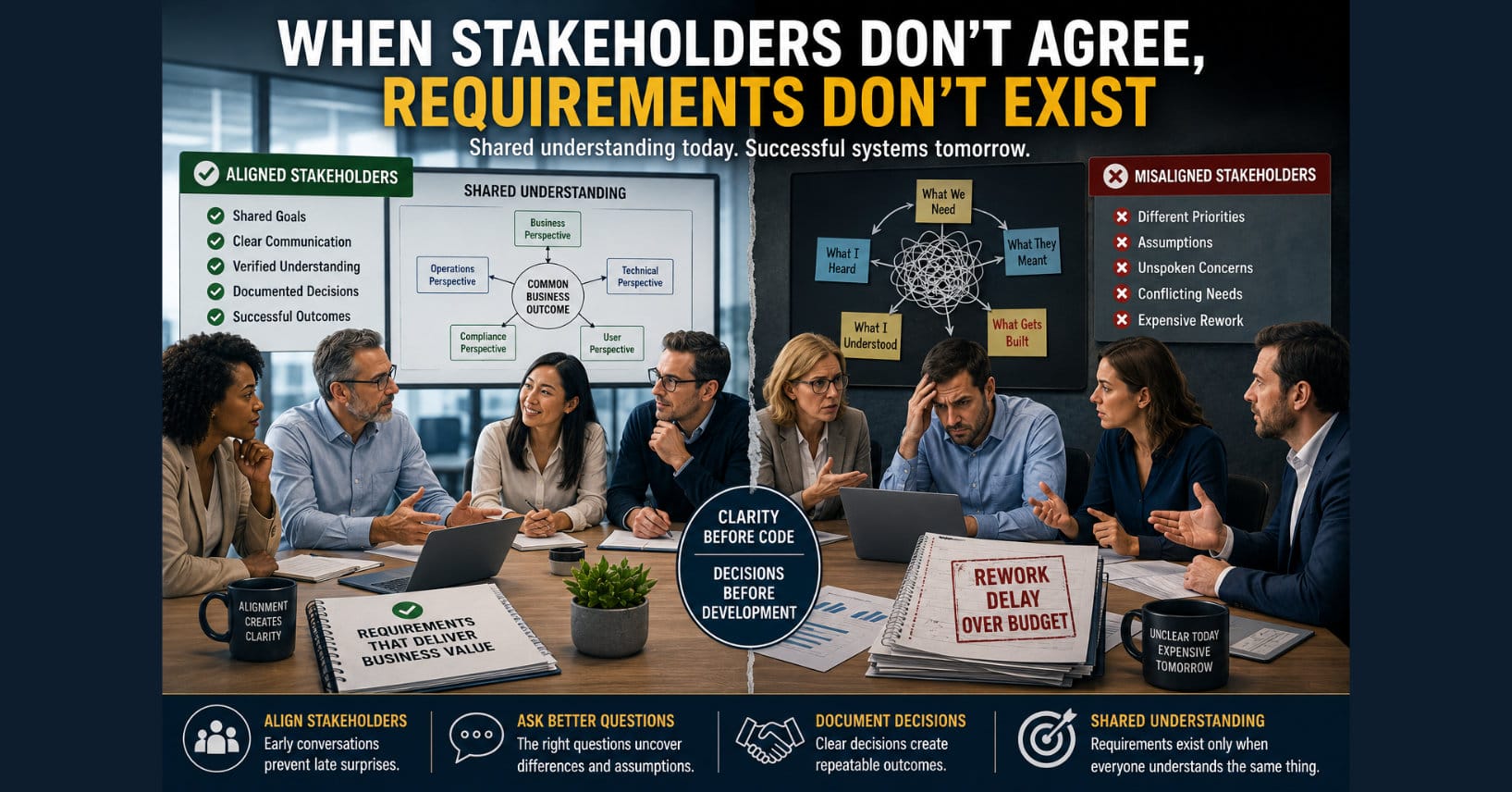
This article explains why requirements engineering is fundamentally about achieving shared understanding among stakeholders—not simply documenting what was discussed in meetings. It explores how differing perspectives, hidden assumptions, conflicting priorities, and unresolved business decisions create ambiguous requirements that eventually become technical defects, costly rework, and project failure. The article argues that successful requirements are engineered through collaboration, negotiation, and leadership.
Building Better Software by Engineering Better Decisions
Few moments are more encouraging in a project than hearing someone say:
“I think we’re all on the same page.”
Unfortunately, that statement has preceded some of the most expensive software failures in history.
Meetings end.
Everyone nods.
Action items are assigned.
Development begins.
Months later, stakeholders insist the software isn’t what they asked for.
Developers respond that it is exactly what the requirements specified.
Both sides may be telling the truth.
The problem is that agreement was assumed, not verified.
Agreement Is Not Understanding
People naturally interpret information through the lens of their own experience.
An executive hears business outcomes.
A finance manager hears policy.
An operations manager hears workflow.
A compliance officer hears regulation.
An architect hears system behavior.
A developer hears implementation.
Each participant leaves the meeting convinced everyone agreed.
In reality, each person agreed with their own interpretation.
Requirements do not exist because people attended the same meeting.
Requirements exist when everyone shares the same understanding.
Silence Is Not Consensus
One of the greatest mistakes in requirements discovery is assuming that silence means agreement.
Many stakeholders remain quiet because:
- They believe someone else will ask the question.
- They assume their concerns are already understood.
- They are unfamiliar with the technical discussion.
- They do not want to challenge leadership.
- They have not yet considered the operational impact.
The absence of disagreement is not evidence of alignment.
It is often evidence that important conversations never occurred.
Every Stakeholder Sees a Different System
Imagine an organization implementing a new purchasing system.
The Chief Financial Officer wants stronger financial controls.
Department managers want faster approvals.
Employees want a simpler interface.
Internal audit wants complete traceability.
Information security wants stronger access controls.
Legal wants regulatory compliance.
Operations wants minimal disruption.
Information technology wants maintainability.
Every stakeholder is correct.
Every stakeholder is describing a different definition of success.
Requirements engineering is the discipline of reconciling those perspectives before development begins.
Requirements Are Negotiated Decisions
Many organizations treat requirements gathering as an interview.
The analyst asks questions.
Stakeholders provide answers.
Requirements are documented.
That approach rarely succeeds on complex projects.
Enterprise requirements are negotiated decisions.
Conflicting priorities must be identified.
Business rules must be reconciled.
Trade-offs must be documented.
Risks must be accepted consciously.
Requirements are not collected.
They are engineered.
Questions Reveal Alignment
Experienced business analysts know that good requirements emerge from good questions.
Instead of asking:
“What do you need?”
Ask:
“What business problem are we solving?”
“What happens if this requirement is omitted?”
“Who disagrees with this approach?”
“What assumptions are we making?”
“What would cause this project to fail even if every feature worked?”
Questions expose differences that meetings often conceal.
Those differences are not obstacles.
They are opportunities to improve the solution before development begins.
Shared Understanding Must Be Demonstrated
One of the most effective ways to validate requirements is to ask stakeholders to explain them back in their own words.
If five stakeholders describe the same requirement five different ways, the requirement is not ready for implementation.
Shared understanding should be demonstrated—not assumed.
Techniques such as process models, decision tables, use cases, prototypes, workflow diagrams, and acceptance criteria all help verify that everyone envisions the same outcome.
Documentation is important.
Verification is essential.
Developers Should Never Resolve Business Disagreements
One of the most common causes of expensive rework occurs when unresolved business questions are left for developers to answer.
Should approval require one manager or two?
Which department owns the data?
Which policy takes precedence?
What happens when exceptions occur?
These are business decisions.
Developers should implement those decisions.
They should never be expected to invent them.
Every unanswered business question eventually becomes a technical assumption.
Technical assumptions frequently become production defects.
Alignment Is a Leadership Responsibility
Successful organizations recognize that stakeholder alignment is not merely a project management activity.
It is executive leadership.
Leaders establish priorities.
Leaders resolve conflicts.
Leaders define acceptable risk.
Leaders determine business objectives.
Requirements engineering provides the structure that transforms those decisions into implementable specifications.
Without leadership alignment, even exceptional development teams cannot consistently deliver successful systems.
Looking Ahead
Projects rarely fail because stakeholders disagree.
They fail because disagreements remain hidden until implementation exposes them.
The earlier differences are discovered, the less expensive they are to resolve.
Requirements engineering succeeds when it creates a shared understanding that survives design, development, testing, deployment, and future enhancement.
The objective is not unanimous agreement.
It is a documented understanding that everyone accepts before the first line of code is written.
Requirements Reality
Consensus is not measured by agreement in meetings. It is measured by agreement in the requirements.
Coming Next
Article 5—Developers Don’t Build Bad Software—Bad Requirements Do
When projects fail, developers often receive the blame. Next, we’ll examine why the real problem usually begins much earlier—with the quality of the requirements organizations provide.