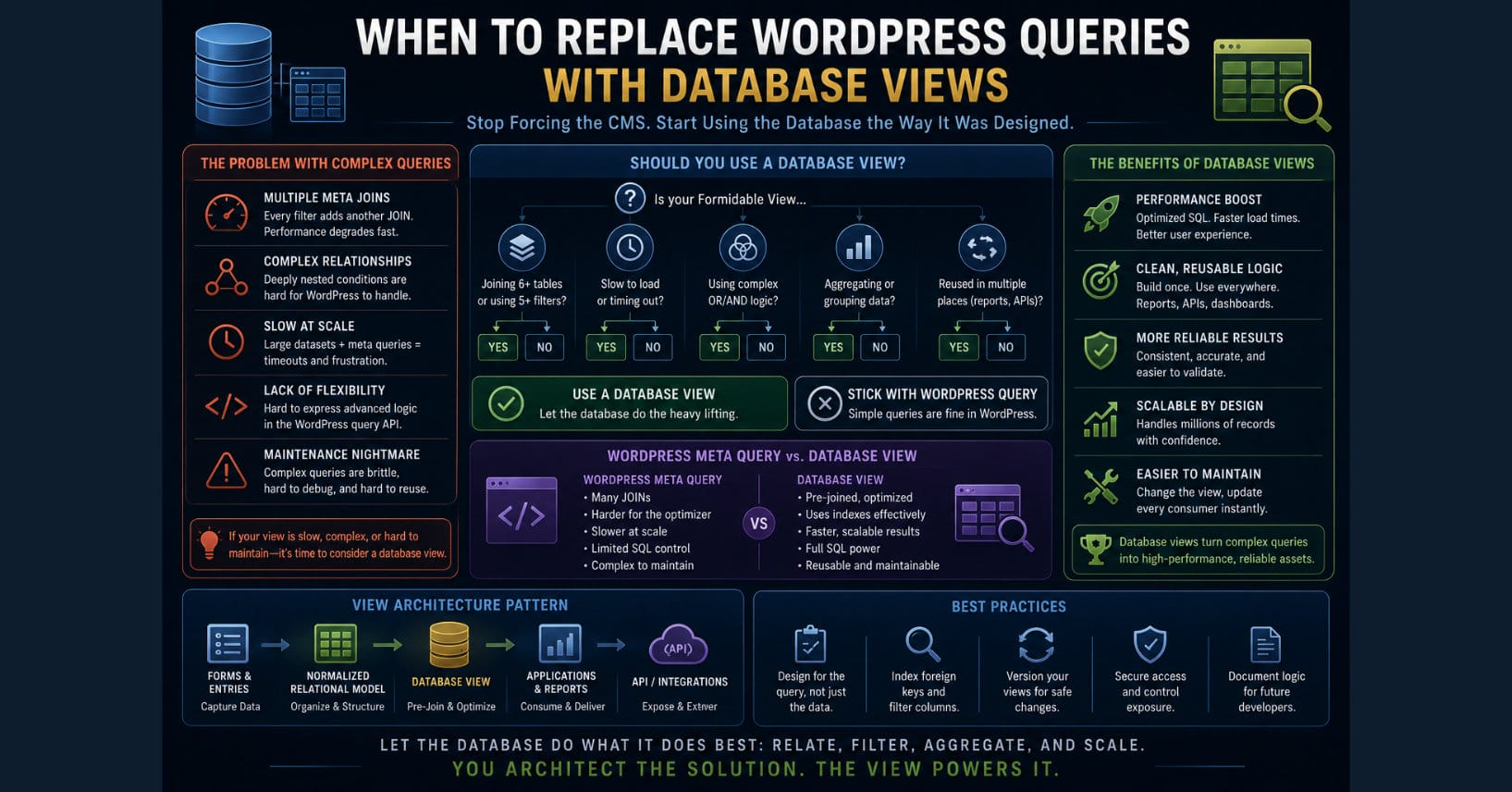
Enterprise WordPress Series—Article 3
As enterprise WordPress applications grow, complex queries become increasingly difficult to maintain and optimize. This article explores how database Views centralize business logic, simplify reporting, improve performance, and create a clean architectural boundary between application code and relational data.
Most WordPress performance discussions focus on the application.
Caching plugins.
PHP optimization.
Object caching.
Content delivery networks.
Those are all valuable techniques, but they often ignore the component best equipped to solve complex data problems:
The database engine itself.
Relational database systems have spent decades optimizing joins, aggregations, indexes, and query execution plans. Yet many WordPress applications continue asking PHP to solve problems the database could solve more efficiently.
Enterprise architects know when to stop rewriting application code and start leveraging database views.
Executive Brief
Database Views provide an abstraction layer between complex relational data and application code.
Rather than repeatedly constructing expensive joins inside WordPress—or forcing plugins to rebuild increasingly complicated queries—a View allows the database engine to expose a clean, reusable virtual table.
The application becomes simpler.
Reporting becomes faster.
Architecture becomes more maintainable.
What Is a Database View?
A database View is a stored SQL query.
To the application, it behaves like a table.
Behind the scenes, however, the database executes the underlying query and returns the results as if they were ordinary rows.
Applications no longer need to understand how dozens of tables relate to one another.
They simply query the View.
The database performs the heavy lifting.
Why This Matters for WordPress
WordPress excels at managing content and user interactions.
It was never intended to become an analytical reporting engine.
As enterprise applications grow, developers often encounter increasingly sophisticated requirements:
- Executive dashboards
- Compliance reporting
- Risk summaries
- Cross-department analytics
- Historical trends
- Operational scorecards
- Multi-dimensional filtering
Meeting these requirements by continually expanding application queries eventually becomes difficult to maintain.
A View centralizes that complexity.
One Query Instead of Twenty
Imagine an executive dashboard displaying:
- Organization
- Department
- Asset
- Assessment status
- Open findings
- Risk score
- Evidence count
- Last review date
Without a View, every report may reconstruct the same joins.
Every new developer writes another version.
Every optimization must be repeated.
Instead, a View encapsulates the relationships once.
Every application consumes the same business definition.
Consistency improves immediately.
Database Views Are Business Objects
Enterprise architects rarely think of Views as SQL.
They think of them as business concepts.
Examples include:
- Active Assessments
- Open Risks
- Compliance Status
- Executive Dashboard
- Audit Evidence
- Vendor Exposure
- Incident Timeline
These become reusable business assets rather than isolated queries embedded throughout the application.
Separating Business Logic from Application Logic
One of the greatest benefits of Views is architectural separation.
Application code should answer questions such as:
- Who can access this information?
- How should it be presented?
- Which workflow follows?
The database should answer questions such as:
- Which records qualify?
- How are entities related?
- Which calculations define compliance?
- What constitutes an open finding?
Keeping these responsibilities separate makes both systems easier to evolve.
Working with Formidable Forms
Formidable Forms stores structured business data exceptionally well.
However, enterprise reporting frequently requires combining information across multiple forms, relationships, calculations, and historical records.
Instead of asking every Formidable View to reconstruct these relationships, a database View can expose the desired result as a single dataset.
Formidable Views then consume that dataset just as they would any other source.
The application becomes significantly simpler.
Beyond Metadata
In the previous article, we discussed the limitations of metadata for highly relational workloads.
Database Views provide one of the cleanest solutions.
Metadata remains the authoritative source.
Relational tables preserve business relationships.
Views expose information optimized for reporting.
Each layer has a clear responsibility.
Performance Is Only One Benefit
Developers often discover Views because of performance.
They continue using them because of maintainability.
Imagine changing the definition of “High Risk.”
Without Views, that logic may exist in:
- dashboard queries
- reports
- widgets
- APIs
- scheduled jobs
- exports
With a View, the business rule changes once.
Every consumer immediately benefits.
That is architectural leverage.
Security Advantages
Views also provide an opportunity to control information exposure.
Applications may only require a subset of available data.
A View can expose:
- selected columns
- calculated values
- aggregated information
- filtered datasets
The application never needs direct access to every underlying table.
This aligns well with the principle of least privilege and simplifies downstream integrations.
When Should You Introduce Views?
Not every project needs them.
Simple websites rarely benefit.
Enterprise systems frequently do.
Indicators include:
- Multiple reports repeating identical joins.
- Increasingly complex SQL generated by plugins.
- Dashboards becoming difficult to maintain.
- Performance degrading as data volumes increase.
- Business rules duplicated throughout the application.
- APIs returning data assembled from numerous sources.
When these patterns emerge, Views deserve serious consideration.
Looking Ahead
Database Views organize information.
Operational Data Stores optimize information.
Although the two concepts are related, they solve different architectural problems.
In the next article, we’ll examine how Operational Data Stores provide a reporting layer specifically designed for enterprise analytics while leaving operational systems untouched.
Understanding that distinction is one of the keys to building WordPress applications that continue performing well as they grow from thousands of records to millions.
Enterprise Takeaway
Enterprise developers eventually discover that the most scalable application is often the one that delegates work to the component best equipped to perform it.
Database Views are not merely a SQL convenience.
They are an architectural boundary that separates business knowledge from application code, improves maintainability, reduces duplication, and allows WordPress to leverage the full capabilities of the relational database engine beneath it.