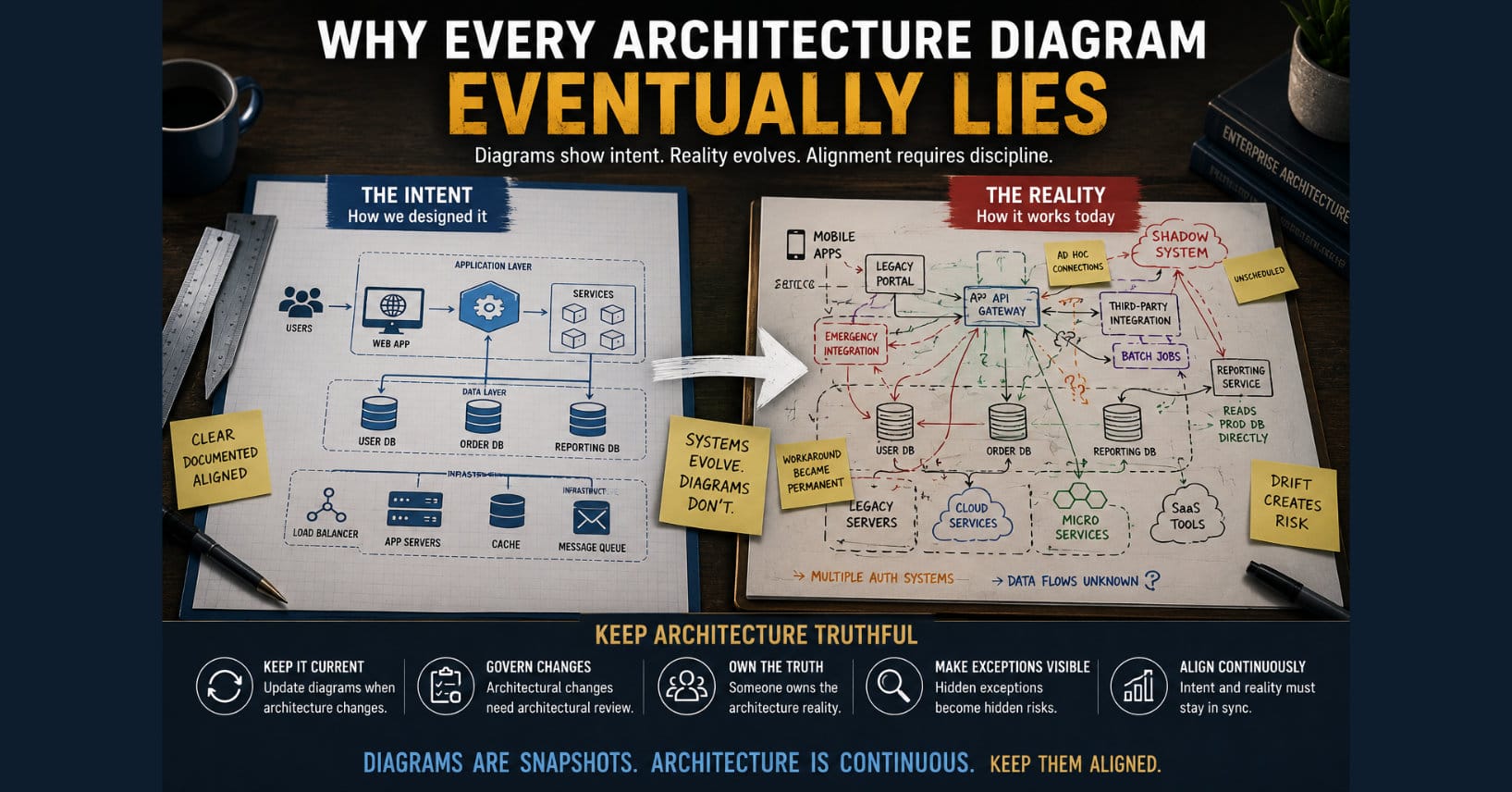
Enterprise Architecture Series—Article 7
Every architecture diagram eventually becomes outdated as enterprise systems evolve. This article explains why diagrams should be treated as living operational assets rather than static project deliverables. Learn how architectural governance, continuous documentation, and change management keep design intent aligned with production reality and preserve trust in enterprise architecture.
Executive Brief
Architecture diagrams are among the most valuable artifacts an enterprise architect produces.
They communicate system boundaries.
They illustrate relationships.
They document design intent.
They help engineers understand how individual components contribute to the larger enterprise.
They are also guaranteed to become inaccurate.
Not because architects are careless.
Because systems evolve faster than documentation.
Every production deployment, emergency change, integration, optimization, and business initiative gradually moves the implemented architecture away from the documented architecture.
Eventually, every architecture diagram tells two stories.
One describes how the system was intended to work.
The other—hidden inside production—describes how it actually works.
Successful organizations recognize this reality and govern architecture accordingly.
The Business Problem
Documentation creates confidence.
Accurate documentation creates informed decisions.
Outdated documentation creates risk.
Many organizations invest significant effort producing architecture diagrams during project planning.
Context diagrams.
Application diagrams.
Infrastructure diagrams.
Integration diagrams.
Deployment diagrams.
Everyone agrees they are important.
Unfortunately, once implementation begins, maintaining them becomes someone else’s responsibility.
Projects deliver new features.
Infrastructure changes.
Services are decomposed.
Cloud platforms evolve.
Temporary workarounds become permanent.
Emergency integrations bypass architectural standards.
Months later, a new architect opens the enterprise architecture repository.
The diagrams are beautifully organized.
They simply no longer represent production.
Teams begin making architectural decisions using obsolete information.
The documentation has become more dangerous than having no documentation at all.
The Architectural Principle
Architecture diagrams are snapshots.
Architecture is continuous.
Confusing the two creates organizational risk.
The purpose of an architecture diagram is not to permanently describe a system.
Its purpose is to communicate the current architectural understanding.
That understanding must evolve alongside the implementation.
Architectural governance therefore requires more than documentation.
It requires synchronization.
Every meaningful architectural change should trigger a review of the documentation that explains it.
Otherwise, the architecture repository gradually becomes a historical archive instead of an operational resource.
Good architects document intent.
Great architects continuously reconcile intent with reality.
Enterprise Example
A manufacturing company modernizes its enterprise resource planning environment.
The initial architecture clearly defines service boundaries, API integrations, data ownership, and security zones.
The diagrams become the foundation for development.
Over the next four years, dozens of projects expand the platform.
Several emergency integrations bypass APIs.
A cloud migration introduces new infrastructure.
Reporting services begin reading production databases directly.
Identity management evolves independently.
Multiple architectural exceptions are approved during accelerated delivery schedules.
Each change solves an immediate business problem.
Few updates are reflected in the architectural documentation.
When a cybersecurity assessment begins, engineers discover conflicting versions of the enterprise architecture.
The diagrams show one environment.
Production reveals another.
The greatest risk is no longer technical debt.
It is architectural uncertainty.
Common Mistakes
Many organizations treat documentation as a project deliverable rather than an operational asset.
Others assume diagrams must capture every implementation detail, making them too complex to maintain.
Some organizations create documentation only during major initiatives.
Years pass before it is reviewed again.
Another common mistake is separating architecture governance from change management.
If production changes without architectural review, documentation inevitably drifts.
The objective is not perfect documentation.
The objective is trustworthy documentation.
Architecture Insight
An inaccurate architecture diagram is not merely outdated.
It actively influences future decisions based on assumptions that are no longer true.
Architecture becomes dangerous when confidence exceeds accuracy.
Questions Architects Should Ask
Whenever significant changes occur, consider:
- Does this change alter the architectural intent?
- Should existing diagrams be updated?
- Are new dependencies being introduced?
- Have architectural exceptions been documented?
- Can another architect understand the current production environment?
- Would this documentation support an audit or incident investigation?
Architect’s Checklist
Healthy architectural documentation demonstrates these characteristics:
- Diagrams reflect the current production architecture.
- Architectural changes are incorporated into governance processes.
- Documentation emphasizes business capabilities over implementation minutiae.
- Exceptions are visible rather than hidden.
- Architecture repositories have clear ownership.
- Diagrams support operational decisions, not historical curiosity.
- Documentation is trusted because it is continuously maintained.
Conclusion
Every architecture diagram eventually becomes inaccurate.
That is not failure.
It is evidence that the organization continues to evolve.
Failure occurs when documentation stops evolving while the enterprise continues changing.
Enterprise architecture is not the practice of drawing diagrams.
It is the discipline of preserving a shared understanding of increasingly complex systems.
The value of a diagram is never measured by how impressive it looks.
It is measured by whether engineers, architects, auditors, and business leaders can confidently make decisions because they trust what it represents.
The best architecture diagrams are not the ones that never change.
They are the ones that change as faithfully as the systems they describe.