Enterprise Requirements Series—Article 17
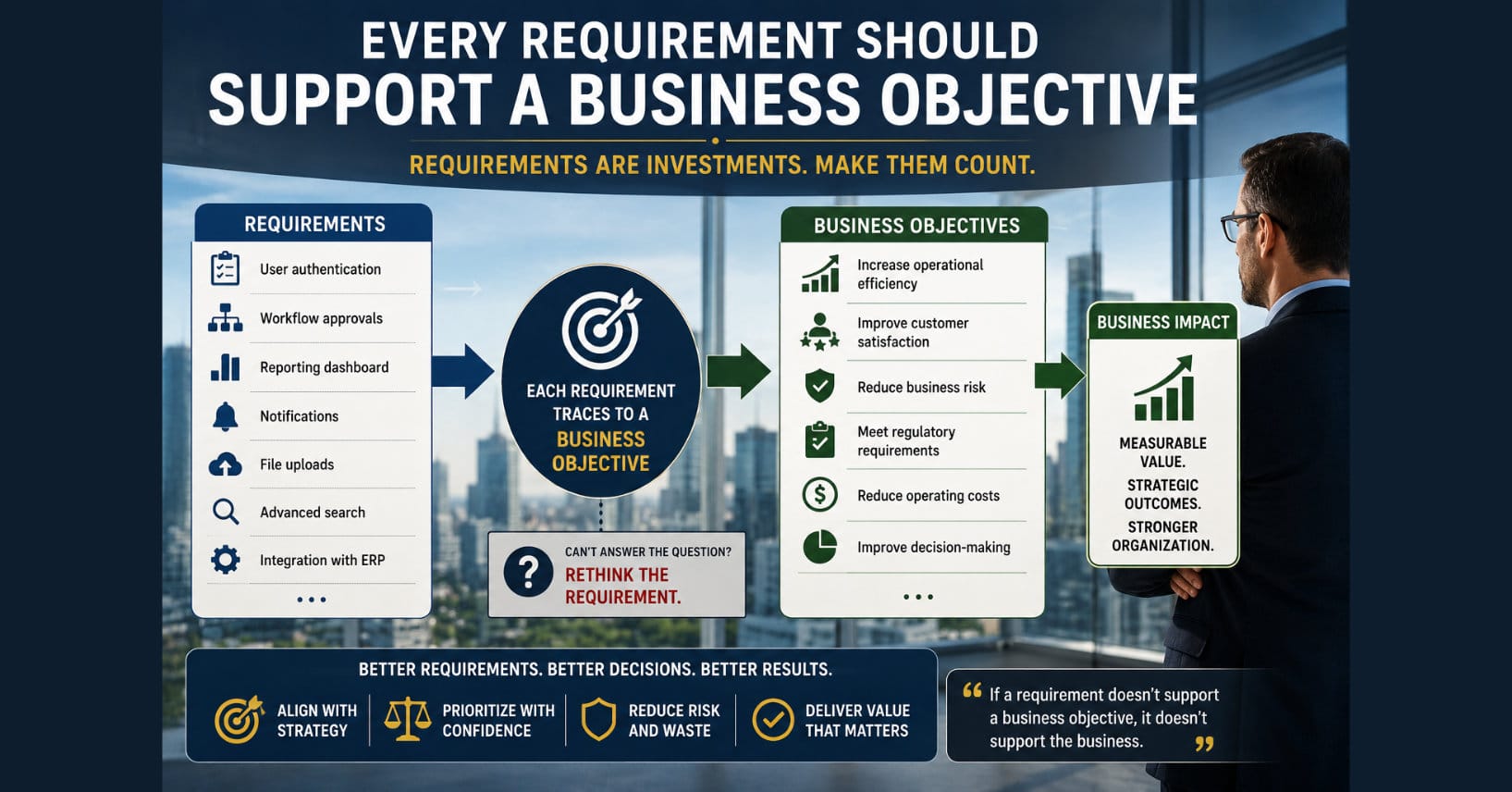
This article explains why every software requirement should support a clearly defined business objective. It reframes requirements as investment decisions and shows how objective-driven requirements improve prioritization, stakeholder alignment, enterprise architecture, governance, and measurable business value.
Building Better Software by Engineering Better Decisions
Every software requirement has a cost.
It consumes budget.
It consumes time.
It consumes development effort.
It consumes testing resources.
It consumes operational support.
It consumes organizational attention.
Given those costs, every requirement should answer one simple question:
What business objective does this support?
If that question cannot be answered, the requirement probably should not exist.
Requirements Are Investments
Organizations often treat requirements as lists of requested functionality.
A better perspective is to view them as investment decisions.
Every approved requirement competes for limited resources.
Approving one requirement often means postponing another.
That makes prioritization a business decision—not merely a technical one.
Before approving any requirement, leadership should understand the business value it is expected to create.
Business Objectives Provide Purpose
Business objectives define why an organization undertakes a project in the first place.
Examples include:
- Increase operational efficiency.
- Improve customer satisfaction.
- Reduce business risk.
- Strengthen cybersecurity.
- Meet regulatory requirements.
- Reduce operating costs.
- Increase revenue.
- Improve decision-making.
Requirements should exist only because they help achieve one or more of these objectives.
Otherwise, they become activity without purpose.
Features Are Easy to Request
Anyone can ask for:
- Another report.
- Another dashboard.
- Another workflow.
- Another notification.
- Another approval step.
Those requests may be reasonable.
They are not automatically valuable.
A more useful question is:
Which business objective improves if we implement this requirement?
That single question often changes the entire conversation.
Traceability Begins with Business Objectives
Requirements traceability is frequently discussed in terms of testing and implementation.
Its most important relationship may actually be upward.
Every requirement should trace directly to:
- A strategic objective.
- A business goal.
- A regulatory obligation.
- A contractual commitment.
- A documented business need.
When that connection exists, prioritization becomes much easier.
When it does not, organizations struggle to explain why the requirement was approved in the first place.
Objectives Help Resolve Conflict
Stakeholders rarely disagree because they dislike each other.
They disagree because they optimize for different outcomes.
Operations may prioritize efficiency.
Finance may prioritize cost.
Compliance may prioritize regulatory obligations.
Security may prioritize risk reduction.
Sales may prioritize customer experience.
Business objectives provide a common framework for resolving those competing priorities.
Requirements that clearly support agreed-upon objectives become easier to evaluate objectively.
Every Requirement Should Earn Its Place
Requirements should never survive simply because someone requested them.
Every requirement should justify its existence.
Questions worth asking include:
- Which objective does this support?
- How will success be measured?
- What happens if we do not implement it?
- Which risks are reduced?
- Which capabilities improve?
- What business value is expected?
If convincing answers cannot be provided, the requirement deserves additional scrutiny.
Objectives Improve Architecture
Architecture becomes significantly more effective when it is guided by business objectives rather than isolated features.
For example:
If the objective is operational resilience, architecture may emphasize redundancy.
If the objective is regulatory compliance, architecture may emphasize auditability.
If the objective is customer responsiveness, architecture may emphasize scalability and performance.
Requirements provide direction.
Objectives provide purpose.
Architecture provides structure.
Together they create intentional systems rather than accidental ones.
Business Objectives Enable Better Governance
Executive governance depends upon understanding value.
Leaders should be able to answer:
Why are we funding this requirement?
What strategic objective does it support?
How will we know whether the investment succeeded?
Requirements connected to business objectives make those answers clear.
Requirements disconnected from business objectives create governance without accountability.
Looking Ahead
Requirements engineering is ultimately about helping organizations make better decisions.
That begins by ensuring every requirement has a reason to exist.
Business objectives provide that reason.
They transform requirements from collections of requested features into deliberate investments aligned with organizational strategy.
When every requirement supports a business objective, prioritization becomes clearer.
Architecture becomes more intentional.
Governance becomes more effective.
Software becomes more valuable.
That is the true purpose of requirements engineering.
Requirements Reality
Requirements should never compete for attention. They should compete for business value.
Coming Next
Article 18—Measuring Requirements Quality Before Development Begins
Before development starts, how do you know whether your requirements are actually good? Next, we’ll examine the nine characteristics of high-quality requirements and why evaluating them early is one of the best investments a project can make.