Enterprise WordPress Series—Article 1
WordPress has evolved far beyond its origins as a blogging platform. This article explores how enterprise architects leverage WordPress as an application platform for structured data, workflow automation, APIs, governance, and operational business systems. It introduces the architectural concepts that form the foundation of the Enterprise WordPress series.
For years, WordPress has carried a reputation it no longer deserves.
Ask most IT professionals what WordPress is, and the answer is almost always the same:
“A blogging platform.”
Some will upgrade that assessment to “a content management system.”
Neither description is wrong.
Neither description is complete.
Today’s WordPress powers everything from Fortune 500 marketing sites to government portals, healthcare systems, learning management platforms, and complex line-of-business applications. Yet many organizations continue treating it like little more than a website.
That mindset causes companies to overlook one of the most mature and extensible application frameworks available.
Executive Brief
Enterprise software is not defined by the technology it uses. It is defined by the business problems it solves.
When paired with modern development practices, WordPress becomes an application platform capable of supporting structured data, complex workflows, governance controls, REST APIs, operational reporting, and enterprise integrations.
The organizations extracting the greatest value from WordPress are no longer building websites.
They are building business systems.
The Historical Misunderstanding
WordPress earned its popularity through publishing.
Its architecture, however, evolved into something much larger.
Today WordPress provides:
- User authentication
- Role-based security
- Database abstraction
- REST APIs
- Scheduling
- Background processing
- Plugin architecture
- Theme separation
- Media management
- Internationalization
- Configuration management
- Object caching
- Hook-based extensibility
Those are application platform capabilities—not blogging features.
Developers often spend months recreating these capabilities inside custom frameworks while WordPress already provides them as mature, production-tested services.
The Missing Layer
Many organizations stop after installing WordPress.
Enterprise developers start there.
The real platform emerges when WordPress becomes the presentation and orchestration layer while the database becomes the operational engine.
Instead of asking:
“How do we build another page?”
Enterprise architects ask:
- What business process are we modeling?
- What evidence must we preserve?
- How should data flow through the organization?
- Which APIs expose the information?
- How do we scale reporting?
- What governance controls exist?
Those questions shift the conversation from websites to information systems.
Enterprise Applications Already Built on WordPress
Organizations routinely use WordPress to power:
- Regulatory compliance systems
- Case management platforms
- Membership systems
- Workflow automation
- Customer portals
- Operational dashboards
- Assessment platforms
- Learning management systems
- Evidence repositories
- Governance reporting
The front-end may resemble a website.
Behind the scenes sits a sophisticated business application.
The Power of Structured Data
The real transformation occurs when WordPress becomes a structured data platform.
Instead of storing information as pages and posts, applications begin storing:
- inspections
- incidents
- assessments
- inventories
- audit findings
- projects
- assets
- contracts
- cybersecurity controls
- governance evidence
Content becomes data.
Data becomes intelligence.
That distinction changes everything.
Formidable Forms Changes the Equation
This is where Formidable Forms becomes more than a form builder.
It becomes an enterprise data collection engine.
Every form represents a business object.
Every entry represents structured operational data.
Every relationship represents a business process.
Applications emerge naturally from these building blocks.
Rather than writing thousands of lines of CRUD code, developers define data structures and concentrate on business logic.
The development effort shifts away from infrastructure and toward solving organizational problems.
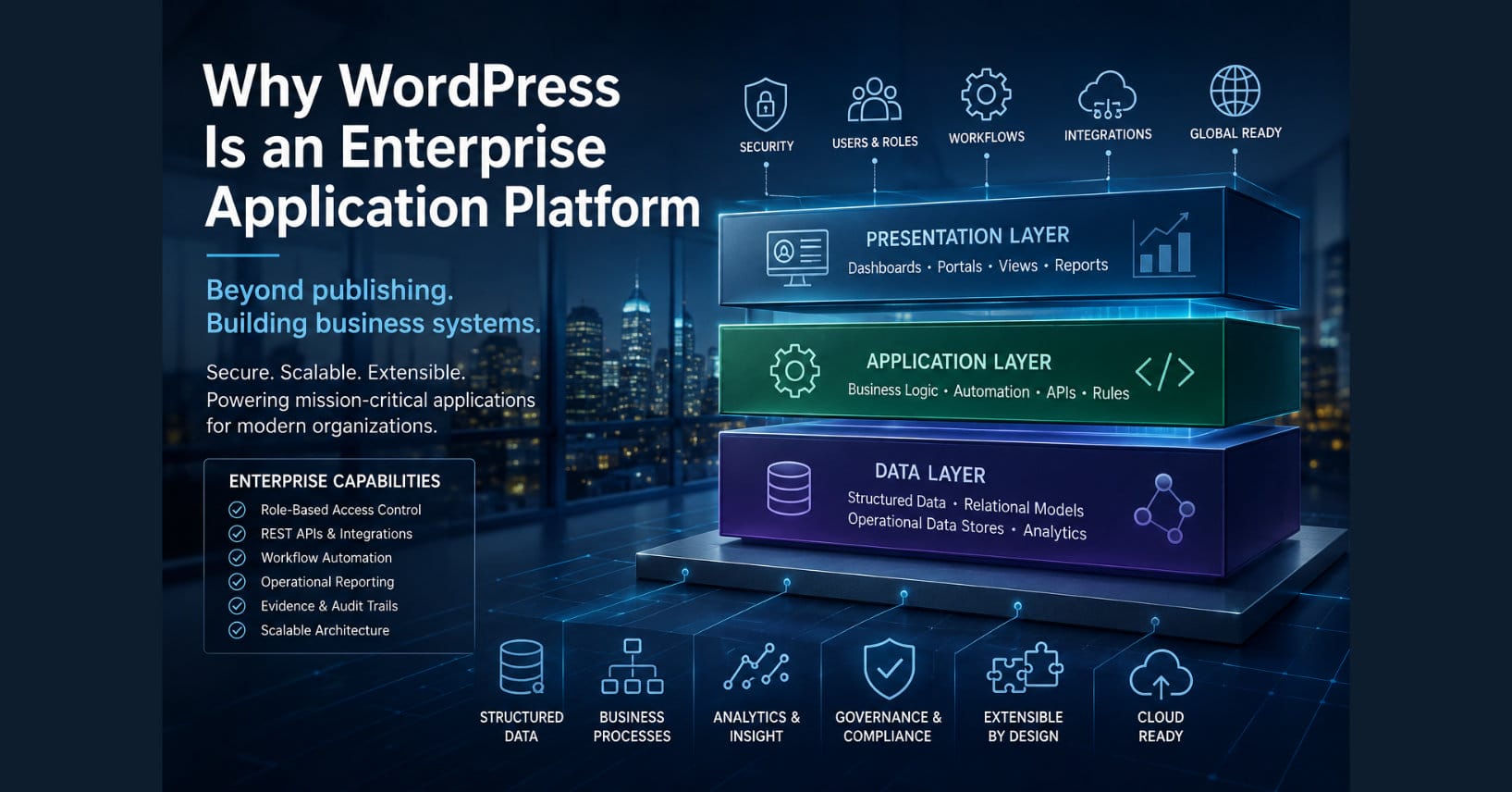
The Enterprise Architecture
An enterprise WordPress application typically separates responsibilities into distinct layers.
Presentation Layer
Pages, Views, dashboards, portals, and reports.
Application Layer
Business rules, workflows, permissions, APIs, automation, notifications, and integrations.
Data Layer
Relational models, operational data stores, database views, reporting structures, caching, and analytics.
This layered architecture allows each component to evolve independently while maintaining clean separation of concerns.
Beyond Metadata
Many developers eventually discover WordPress’s metadata architecture becomes the limiting factor for analytical workloads.
Metadata excels at flexibility.
It is not optimized for relational reporting.
Enterprise developers address this challenge by introducing relational models, SQL views, operational data stores, and optimized query strategies while continuing to leverage WordPress for authentication, administration, APIs, and content management.
Rather than abandoning WordPress, they extend it.
That philosophy underpins this entire series.
Looking Ahead
Over the coming articles, we’ll examine how enterprise developers rethink WordPress architecture.
We’ll discuss:
- Relational database design
- Operational Data Stores
- Database Views
- Evidence-driven applications
- Event sourcing
- Enterprise caching
- High-volume Formidable Forms deployments
- API-first architecture
- Scaling beyond one million records
Each topic builds upon a simple premise.
WordPress is no longer just a CMS.
Used correctly, it is a mature enterprise application platform capable of solving problems far beyond publishing.
Organizations that recognize this shift gain a significant advantage—not because they abandoned WordPress, but because they finally understood what it had become.
Enterprise Takeaway
The question is no longer whether WordPress can support enterprise applications.
The better question is whether architects are willing to design enterprise applications that fully leverage the platform’s strengths while compensating intelligently for its architectural limitations.
That is the difference between building websites and building enterprise systems.