Enterprise WordPress Series—Article 10
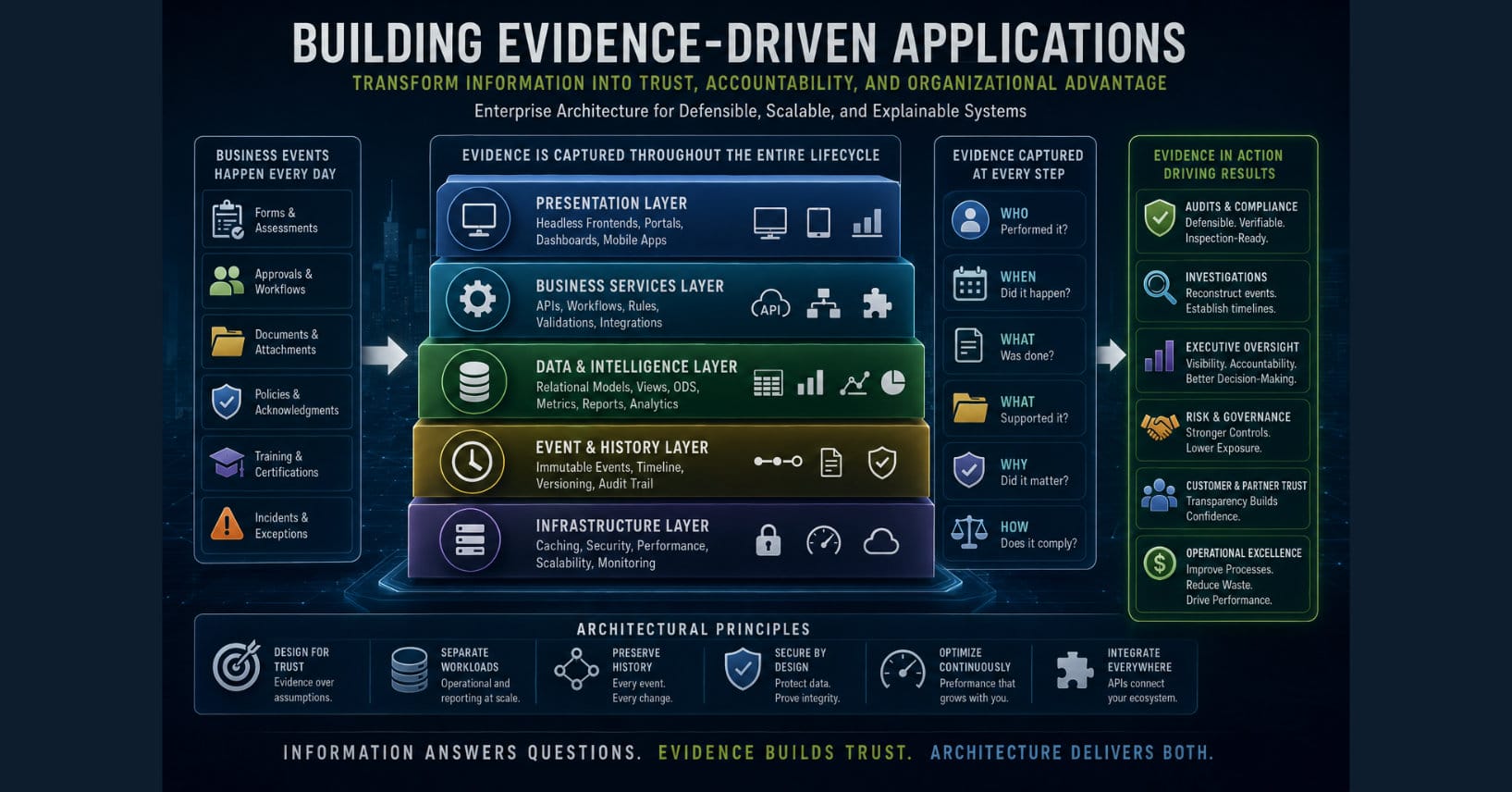
The next generation of enterprise applications won’t be measured solely by the information they manage—they’ll be measured by the evidence they preserve. This article concludes the Enterprise WordPress series by demonstrating how relational models, event sourcing, APIs, Operational Data Stores, and scalable architecture combine to create defensible, evidence-driven applications built on WordPress and Formidable Forms.
Most business applications answer questions.
Evidence-driven applications answer challenges.
That distinction is becoming increasingly important.
Organizations no longer need only systems that collect information.
They need systems capable of proving what happened, when it happened, who performed the action, what evidence supported the decision, and whether established processes were followed.
The application itself becomes part of the organization’s governance framework.
Enterprise WordPress applications are uniquely positioned to support this evolution.
Executive Brief
Evidence-driven applications are designed to preserve trustworthy business evidence throughout the lifecycle of every transaction.
Rather than treating evidence as an afterthought, enterprise architects intentionally capture structured data, business events, approvals, supporting documentation, and historical context as integral components of the application.
The result is software capable of supporting operational decisions, audits, investigations, regulatory compliance, and organizational accountability.
Information Is Not Evidence
Many organizations possess enormous amounts of data.
That does not mean they possess evidence.
Information tells us what exists.
Evidence demonstrates what occurred.
The distinction becomes critical during:
- Audits
- Investigations
- Litigation
- Regulatory reviews
- Insurance claims
- Governance assessments
- Executive oversight
Questions quickly change from:
“What does the database contain?”
to
“Can you prove this decision?”
Building on the Previous Architecture
Throughout this series we’ve introduced several architectural concepts.
Each contributes to evidence readiness.
Relational models organize business entities.
Database Views simplify reporting.
Operational Data Stores support operational intelligence.
Event sourcing preserves business history.
API-first design exposes consistent business services.
Headless architecture enables multiple consumers.
Enterprise caching improves performance.
Scalable architecture supports growth.
Together they create something larger than the sum of their parts.
An application capable of preserving trustworthy business evidence.
Evidence Is Created Continuously
Organizations often attempt to assemble evidence after an incident occurs.
That approach rarely succeeds.
Evidence should be generated naturally as work happens.
Each business event contributes another piece of the organizational record.
Examples include:
- Assessment submitted
- Reviewer assigned
- Evidence uploaded
- Approval granted
- Exception requested
- Exception approved
- Policy acknowledged
- Training completed
- Incident closed
Each event strengthens the historical record.
Trust Requires Context
A single database record rarely explains a business decision.
Evidence requires context.
Who initiated the action?
Which policy applied?
What supporting documentation existed?
Who approved the outcome?
When did the approval occur?
Which information influenced the decision?
Applications designed around evidence preserve those relationships automatically.
Evidence Is a Business Asset
Evidence serves far more than compliance.
Executives use it to evaluate governance.
Managers use it to improve processes.
Auditors use it to verify controls.
Investigators reconstruct timelines.
Insurers evaluate organizational maturity.
Customers gain confidence.
Investors reduce uncertainty.
Evidence becomes organizational capital.
WordPress Provides the Foundation
WordPress already supplies many of the services evidence-driven applications require.
Authentication.
Authorization.
Structured content.
Document management.
Workflow automation.
REST APIs.
User management.
Formidable Forms extends these capabilities by collecting structured business information while integrating naturally with enterprise workflows.
Architecture transforms those capabilities into evidence systems.
Designing for Defensibility
Evidence-driven architecture asks different design questions.
Instead of asking:
“Can users complete this workflow?”
Enterprise architects ask:
Can the workflow be reconstructed?
Can approvals be verified?
Can supporting documentation be located?
Can historical decisions be explained?
Can organizational oversight be demonstrated?
Those questions fundamentally reshape application design.
Artificial Intelligence Requires Evidence
Artificial intelligence increases—not decreases—the importance of evidence.
Organizations increasingly rely upon AI-assisted recommendations.
Leadership must still explain decisions.
Evidence demonstrates:
What information the AI received.
What recommendations were generated.
Which human approved the outcome.
Which policy governed the decision.
The future belongs to explainable systems.
Explainability requires evidence.
Beyond Compliance
The phrase “evidence-driven” often suggests regulation.
Its value extends much further.
Evidence improves:
- Operational intelligence
- Process improvement
- Organizational learning
- Business continuity
- Governance maturity
- Customer trust
- Executive decision-making
Applications become systems of organizational knowledge rather than repositories of isolated transactions.
Preparing for the Next Decade
Enterprise software continues evolving.
Artificial intelligence.
Increasing regulation.
Board oversight.
Cyber governance.
Supply chain transparency.
Digital accountability.
Each trend moves organizations toward greater expectations of defensible evidence.
Applications built today should anticipate those expectations rather than reacting to them later.
Bringing the Series Together
We began this series by asking whether WordPress is an enterprise application platform.
The answer has become increasingly clear.
Enterprise architecture is not determined by the framework.
It is determined by design.
WordPress provides the platform.
Relational models provide structure.
Views simplify complexity.
Operational Data Stores support reporting.
Event sourcing preserves history.
APIs expose business services.
Headless architecture enables flexibility.
Caching provides scalability.
Evidence transforms information into organizational trust.
Together they represent an enterprise application architecture capable of supporting organizations far beyond traditional websites.
Enterprise Takeaway
The next generation of enterprise applications will not be distinguished solely by the information they manage.
They will be distinguished by the evidence they preserve.
Organizations that intentionally design for defensibility today will be better prepared for tomorrow’s audits, investigations, governance reviews, regulatory requirements, and executive accountability.
Technology enables applications.
Evidence enables trust.
That is ultimately what enterprise architecture is designed to achieve.