Data Governance Series | Article 3 of 20
Governing the Information That Drives the Enterprise
Summary
Many organizations report high percentages of critical data assets with assigned owners, yet those owners often lack meaningful authority over the information they supposedly govern.
This article examines why data ownership without explicit decision rights is largely administrative labeling. It defines ownership as delegated governance authority and explores the decisions real data owners may need to make concerning business definitions, authoritative sources, data quality, permissible use, AI consumption, remediation, exceptions, and risk acceptance.
The article also distinguishes data ownership from stewardship, explains why authority requires clearly defined boundaries, and examines how AI is exposing weaknesses in traditional ownership models. Effective data governance requires more than assigning names in a catalog. It requires accountability, authority, boundaries, and evidence demonstrating that consequential governance decisions were actually made.
Many organizations can produce a list of their data owners.
That does not mean they have data ownership.
A governance program identifies critical data domains. Names are assigned. Responsibilities are documented. A data catalog displays an owner beside each important dataset.
The organization can now report that 95 percent of critical data assets have assigned owners.
The dashboard turns green.
Governance appears to be working.
Then a serious data problem emerges.
Two systems disagree about the same customer.
A business unit wants to use sensitive data for a new purpose.
An AI team wants to connect an enterprise assistant to a repository containing both authoritative and obsolete information.
A critical dataset repeatedly fails quality thresholds.
Someone needs to decide what happens next.
The designated data owner is consulted.
And the organization discovers something important:
The owner cannot actually decide.
The person may coordinate meetings, document definitions, escalate concerns, or recommend action. But the authority to designate an authoritative source, reject a proposed use, require remediation, approve an exception, or accept risk resides somewhere else—or nowhere clearly defined.
That is not ownership.
It is stewardship wearing an ownership label.
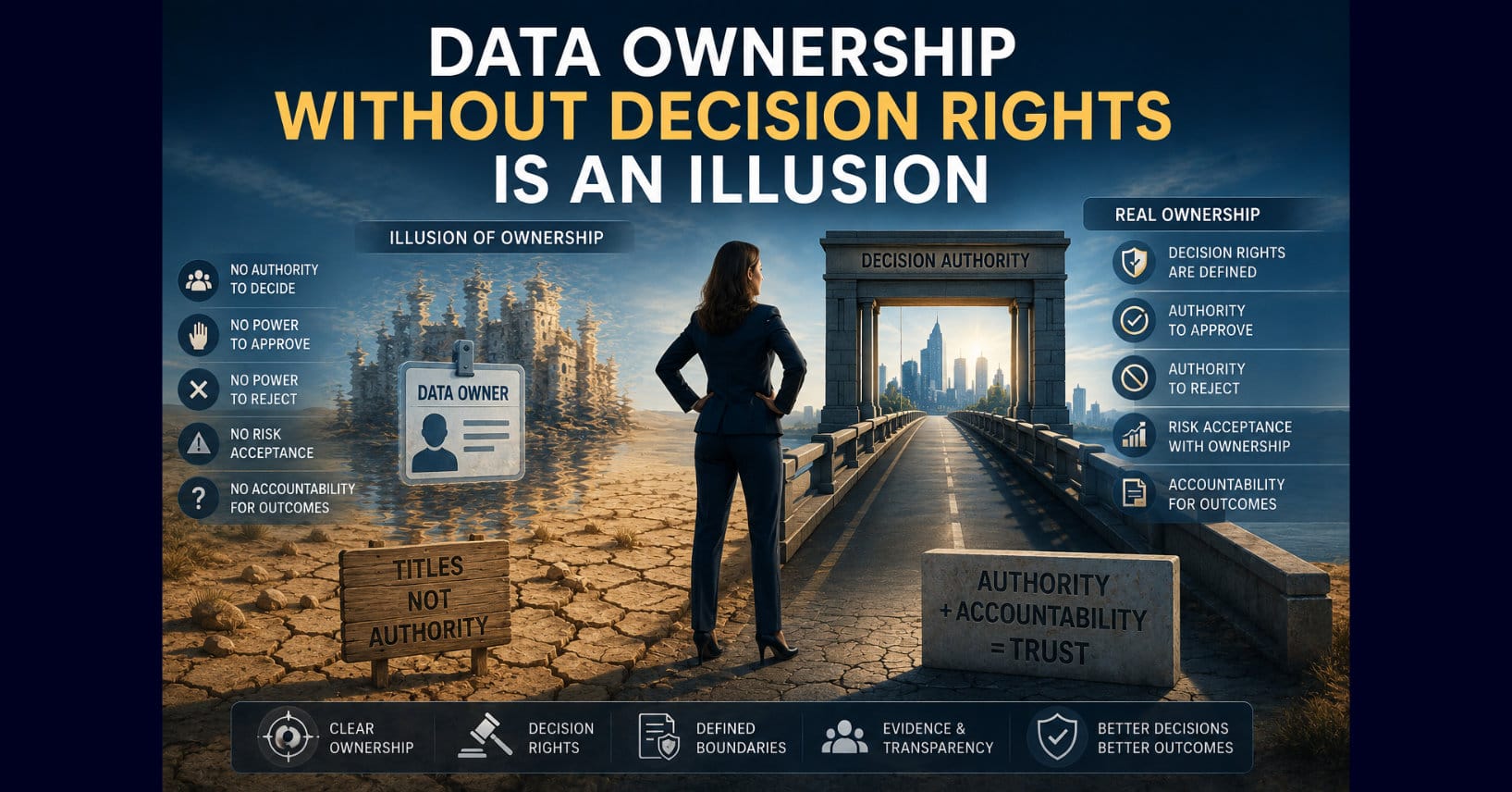
Data ownership without decision rights is an illusion.
Ownership Is a Governance Concept
The word “owner” creates expectations.
If someone owns a business asset, we generally assume that ownership conveys some degree of authority over that asset.
Enterprise data is more complicated.
A data owner does not possess corporate information as personal property. The organization owns or controls the information according to applicable legal, contractual, regulatory, and operational requirements.
The data owner’s role is therefore better understood as delegated governance authority.
The enterprise is effectively saying:
For this defined data domain, you are accountable for specified decisions concerning its meaning, quality, use, and risk.
That definition immediately changes the conversation.
Ownership is no longer about placing someone’s name next to a dataset.
It is about determining which decisions that person is authorized—and obligated—to make.
Without that authority, the title has little governance value.
The Catalog Test
A useful test is to open the organization’s data catalog and select a critical dataset.
Find the listed owner.
Then ask:
What decisions can this person make without seeking an undefined chain of additional approvals?
Can the owner determine which system is authoritative?
Can the owner approve the business definition?
Can the owner establish acceptable quality thresholds?
Can the owner reject a proposed use?
Can the owner require remediation?
Can the owner approve an exception?
Can the owner escalate unresolved risk?
Can the owner determine whether an AI system may consume the data?
Can the owner accept residual risk within defined limits?
If the answer repeatedly becomes:
“They would have to ask someone,”
then the organization should identify who that someone is.
That person—or governance body—may hold the actual decision authority.
This does not mean data owners should have unlimited power.
It means the organization should stop calling someone an owner when the governance model gives that person no meaningful authority.
Decision Rights Make Ownership Real
Decision rights define who has the authority to make specific categories of decisions.
For data governance, those rights may cover several dimensions.
Definition
Who determines what the data means?
Terms that appear obvious can produce significant disagreements.
What is a customer?
What constitutes active revenue?
When does an opportunity become a sale?
What qualifies as an incident?
What does “employee” include?
What counts as a completed transaction?
If multiple business units define the same concept differently, someone must determine whether those differences are legitimate or whether an enterprise definition is required.
Without decision authority over meaning, semantic conflict persists indefinitely.
Authoritative Source
Who decides which system or dataset should be treated as the source of record for a particular purpose?
Organizations frequently have multiple copies of the same information.
One may be operational.
Another may be analytically enriched.
Another may be synchronized from a vendor.
Another may contain manually corrected values.
Another may be optimized for AI retrieval.
All may contain legitimate data.
They are not necessarily equally authoritative.
Someone must have the authority to establish which source governs which use.
Quality
Who determines when data is good enough?
Perfect data is rarely achievable.
Governance therefore requires thresholds.
A customer mailing address may tolerate one level of error.
Financial reporting data may tolerate substantially less.
Data used for a safety-critical decision may require stronger controls still.
The data owner should not merely receive a quality dashboard.
Ownership should include authority to establish acceptable thresholds, require remediation when appropriate, and escalate unresolved deficiencies.
Permissible Use
Who decides whether data may be used for a new business purpose?
Access alone does not answer this question.
An employee may legitimately have access to a dataset while a proposed secondary use remains inappropriate, contractually restricted, legally problematic, or inconsistent with organizational policy.
The same issue increasingly arises with AI.
The fact that an AI platform technically can retrieve information does not mean it should.
Someone must have authority to determine whether the proposed use is consistent with the organization’s governance requirements.
Risk Acceptance
Who can say:
“We understand the deficiency, we understand the consequence, and we are proceeding anyway”?
This is one of the most important governance rights.
Organizations routinely operate with imperfect data.
The governance failure is not necessarily that imperfect data exists.
The failure occurs when consequential decisions rely upon known deficiencies without explicit risk acceptance.
A mature governance model establishes who may accept that risk, within what thresholds, for how long, and with what evidence.
Decision Rights Must Have Boundaries
Giving data owners real authority does not mean allowing them to override cybersecurity, privacy, legal, compliance, records-management, or regulatory obligations.
Ownership operates inside an enterprise governance system.
A customer-data owner should not be able to approve a use prohibited by privacy law.
A financial-data owner should not override accounting requirements.
A human-resources data owner should not independently authorize access inconsistent with employment law or corporate security controls.
An AI product owner should not bypass restrictions established by information security.
Governance therefore requires both authority and boundaries.
The organization’s model should define:
- what the data owner may decide independently;
- what requires consultation;
- what requires joint approval;
- what must be escalated;
- what the owner is prohibited from approving; and
- which authority prevails when governance domains conflict.
This is where many programs become vague.
They define roles but not jurisdiction.
That ambiguity becomes expensive when a real decision must be made quickly.
Data Owners and Data Stewards Are Not the Same
Another source of confusion is the relationship between ownership and stewardship.
The distinction should be clear.
A data owner holds defined decision authority and accountability.
A data steward performs or coordinates governance activities necessary to implement those decisions.
A steward may maintain metadata.
Monitor quality.
Coordinate issue resolution.
Document definitions.
Review lineage.
Facilitate access requests.
Maintain catalog information.
Track exceptions.
These activities are essential.
But performing them does not necessarily confer authority to make consequential governance decisions.
The distinction resembles other enterprise governance relationships.
A cybersecurity analyst may investigate risk, but a business executive may ultimately accept it.
A financial analyst may prepare forecasts, but an executive approves the investment.
A legal advisor may explain contractual exposure, but an authorized business leader decides whether to proceed.
Data governance needs the same clarity.
The steward helps governance operate.
The owner answers for defined governance decisions.
Beware the Owner Who Owns Everything
The opposite problem also occurs.
Some organizations assign an executive as the owner of an enormous data domain and assume the accountability problem is solved.
The CFO owns financial data.
The CHRO owns employee data.
The CMO owns customer data.
Simple.
Perhaps too simple.
Enterprise data crosses boundaries.
Customer information may be used by sales, finance, marketing, customer service, cybersecurity, legal, analytics, and AI systems.
Employee information may appear in HR platforms, identity systems, security tools, financial applications, learning platforms, collaboration systems, and third-party services.
One executive cannot realistically make every governance decision associated with every dataset in such a domain.
Effective ownership therefore needs delegation.
The executive owner may retain accountability for the domain while defined operational decision rights are delegated to appropriate subordinate owners, custodians, stewards, or governance bodies.
The critical requirement is traceability.
The organization should know where decision authority begins, where it is delegated, and where it returns for escalation.
Otherwise, executive ownership becomes ceremonial.
AI Makes Weak Ownership Visible
Artificial intelligence is rapidly stress-testing enterprise data ownership models.
Suppose an organization deploys an enterprise AI assistant using retrieval-augmented generation.
The implementation team asks:
Which repositories can we connect?
Security answers whether the system can access them.
That is necessary.
But it is not sufficient.
Someone must also answer:
Which content is authoritative?
Which information is outdated?
Which datasets contain restrictions on secondary use?
Which information should not be exposed through generative interfaces?
Which sources may be combined?
Which content requires additional context?
Which documents should be excluded?
Who approves those decisions?
These questions often reveal that the organization has custodians but not owners.
IT can grant access.
Security can enforce controls.
The AI team can configure retrieval.
But nobody has explicit authority to determine whether the information should be used in that context.
The technology reaches the decision boundary.
The governance model does not.
Ownership Should Follow the Data Lifecycle
Data ownership is sometimes treated as a static catalog attribute.
Real ownership is dynamic.
Data is created.
Collected.
Validated.
Transformed.
Combined.
Copied.
Shared.
Analyzed.
Archived.
Deleted.
And increasingly, retrieved by AI systems.
Authority may need to change across that lifecycle.
Raw operational data may be governed by one business domain.
A transformed analytical product may have another accountable owner.
A regulatory report derived from that information may introduce additional governance authorities.
An AI knowledge base may require explicit approval from multiple domains.
This does not mean every transformation requires a new owner.
It means ownership should reflect the actual governance requirements of the information as its context and consequence change.
The catalog should describe that governance reality.
It should not substitute for it.
A Practical Decision-Rights Matrix
Organizations do not need to make this unnecessarily complicated.
For each critical data domain, a decision-rights matrix can establish clarity.
For example:
| Governance Decision | Owner | Steward | Security | Privacy/Legal | Executive/Risk Authority |
|---|---|---|---|---|---|
| Define business meaning | Approves | Coordinates | Consulted | Consulted when required | Escalation |
| Designate authoritative source | Approves | Recommends | Consulted | Consulted when required | Escalation |
| Establish quality threshold | Approves | Monitors | Consulted | Consulted | Escalation |
| Approve standard business use | Approves | Documents | Consulted | Consulted | Escalation if high consequence |
| Approve sensitive AI use | Recommends | Documents | Required | Required | Approves when consequential |
| Accept material quality risk | Recommends | Documents | Consulted | Consulted | Approves |
| Approve retention exception | Consulted | Documents | Consulted | Required | Approves as required |
The exact matrix will vary by organization.
The important point is not the template.
It is that decision authority becomes explicit.
When an issue arises, people should not need to discover the governance model while trying to resolve the problem.
Ownership Requires Evidence
Once decision rights are defined, organizations should preserve evidence that those rights were exercised.
For consequential decisions, that evidence may include:
- the decision being considered;
- the accountable owner;
- the authority under which the decision was made;
- relevant data and evidence;
- consulted stakeholders;
- identified risks;
- alternatives considered;
- exceptions granted;
- required remediation;
- approval date;
- review date; and
- final disposition.
This is particularly important for risk acceptance.
If leadership knowingly proceeds using data with a material deficiency, the organization should be able to demonstrate who accepted that risk and why.
Without evidence, accountability becomes reconstructive.
People search email.
They review meeting notes.
They ask former employees.
They try to remember who approved what.
That is not a governance system.
It is organizational archaeology.
Measure Authority, Not Assignments
Data governance metrics should reflect this distinction.
Reporting that 98 percent of critical datasets have assigned owners sounds impressive.
But the more meaningful questions are:
What percentage of critical data domains have documented decision rights?
What percentage have authoritative sources formally designated?
What percentage have defined quality thresholds?
What percentage have explicit escalation paths?
What percentage of material exceptions have accountable approvals?
What percentage of consequential AI data uses have documented owner authorization?
What percentage of ownership decisions can be reconstructed from evidence?
These metrics measure whether ownership functions.
That is more useful than measuring whether an ownership field in the catalog contains a name.
From Ownership to Governance
Real data ownership requires four elements:
Accountability.
Someone answers for defined outcomes.
Authority.
That person possesses meaningful decision rights.
Boundaries.
The organization defines where that authority begins and ends.
Evidence.
The enterprise preserves a record demonstrating how consequential decisions were made.
Remove any one of those elements and ownership weakens.
Accountability without authority creates a scapegoat.
Authority without accountability creates uncontrolled discretion.
Authority without boundaries creates governance conflict.
Governance without evidence creates unverifiable claims.
Data ownership works only when these elements operate together.
Boardroom Takeaway
Executives should be skeptical of governance dashboards reporting the percentage of data assets with assigned owners.
An assigned owner is not necessarily an empowered owner.
For critical enterprise data, leadership should expect ownership to include explicit decision rights, defined jurisdiction, escalation paths, risk-acceptance authority, and evidence demonstrating how consequential decisions were made.
The question is not:
“Have we assigned data owners?”
It is:
“What are our data owners actually authorized to decide?”
If the organization cannot answer that clearly, the ownership may exist in the catalog but not in the governance system.
And ownership without decision rights is an illusion.
Coming Next
Article 4: The Data Nobody Owns
Some of the most dangerous information in an enterprise is not necessarily the most sensitive. It is the data that falls between systems, functions, vendors, and governance domains without anyone clearly accountable for it. The next article examines how orphaned data emerges, why organizations often fail to recognize it, and how unmanaged information becomes operational, regulatory, security, and AI risk.