Data Governance Series | Article 5 of 20
Governing the Information That Drives the Enterprise
Summary
Organizations invest heavily in cleansing records, eliminating duplicates, reconciling conflicting values, and monitoring data-quality metrics. Yet persistent quality problems frequently return because the underlying processes and governance mechanisms that create defective data remain unchanged.
This article argues that data quality should be understood as a governance outcome rather than merely a technical characteristic. It examines how ownership, semantic definitions, business processes, incentives, source controls, decision rights, lineage, quality thresholds, and risk acceptance determine whether enterprise information can be trusted.
The article also explores how AI raises the consequences of poor-quality information by allowing defects to propagate through machine-generated summaries, classifications, inferences, and decisions. Effective governance must therefore move upstream from repairing bad records toward correcting the processes that continually create them.
Organizations spend enormous amounts of time fixing bad data.
They cleanse records.
Remove duplicates.
Standardize formats.
Reconcile conflicting values.
Build validation rules.
Create quality dashboards.
Establish thresholds.
Deploy master data management platforms.
Assign teams to investigate exceptions.
Then, several months later, many of the same problems return.
Another batch of duplicates appears.
Another report produces conflicting numbers.
Another integration introduces inconsistent values.
Another business unit develops its own definition.
Another executive asks why two dashboards disagree.
The instinct is often to improve the data-quality process.
Sometimes that is necessary.
But persistent data-quality problems frequently originate somewhere else.
They are produced by the governance system surrounding the data.
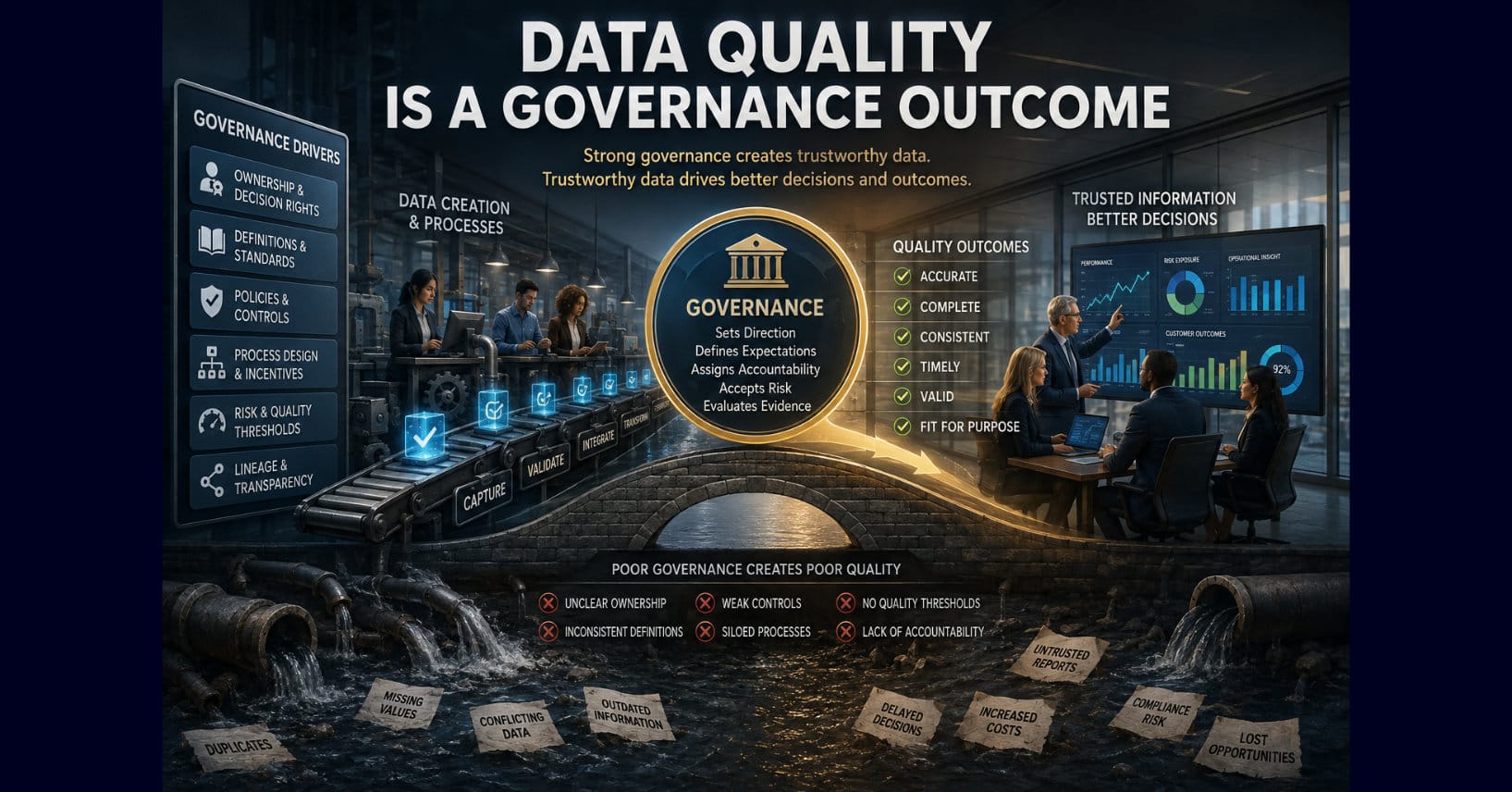
Data quality is not merely a technical characteristic of information. It is an outcome of how the enterprise governs the processes, decisions, ownership, definitions, and systems that create that information.
If those mechanisms remain weak, cleaning the data treats the symptom.
The organization simply manufactures more bad data.
Bad Data Has a Supply Chain
Data does not become inaccurate spontaneously.
Something creates the defect.
A customer enters incomplete information.
An employee misunderstands a field.
A system permits an invalid value.
Two departments define the same concept differently.
An integration truncates information.
A legacy application uses an obsolete code.
A business process encourages employees to bypass required fields.
A vendor supplies inconsistent records.
A spreadsheet transformation changes a value.
A duplicate customer is created because employees cannot find the original record.
An AI system generates an incorrect classification that is written back into an operational platform.
Every quality defect has a history.
That history is the data-quality supply chain.
Organizations that concentrate exclusively on the defective record often miss the process that produced it.
Correct the record and the immediate problem disappears.
Leave the source unchanged and the defect returns.
Quality therefore requires organizations to move upstream.
Cleansing Is Not Governance
Data cleansing is valuable.
It is not governance.
Suppose an organization discovers 40,000 duplicate customer records.
A data-quality initiative identifies the duplicates, merges records, corrects conflicts, and reduces the problem dramatically.
Success.
But why were duplicates created?
Perhaps customer-service employees cannot reliably search the CRM before creating a record.
Perhaps two applications independently create customers.
Perhaps integrations do not reconcile identifiers.
Perhaps employees are measured on transaction speed and creating a new record is faster than locating the existing one.
Perhaps acquisitions introduced incompatible customer identifiers.
Perhaps nobody has authority to establish the enterprise definition of a unique customer.
If the organization does not address those causes, the duplicate count will begin increasing again.
The cleansing project improved the data.
Governance determines whether the improvement survives.
Quality Begins With Meaning
Before an organization can determine whether data is good, it must know what the data means.
That sounds obvious.
In practice, it is one of the most persistent enterprise problems.
Consider the word “customer.”
Sales may define a customer as anyone with an active opportunity.
Finance may define a customer as an entity that has completed a revenue-producing transaction.
Marketing may include prospects.
Customer service may include anyone with an account.
An acquired business may use an entirely different definition.
None of those definitions is necessarily wrong.
The problem emerges when the enterprise combines data from those systems and assumes the term means the same thing everywhere.
The resulting inconsistency may be reported as a data-quality problem.
It is actually a semantic governance problem.
Someone must determine whether multiple definitions are legitimate, where each applies, and which definition governs enterprise reporting.
Quality depends upon meaning.
Meaning depends upon authority.
Quality Thresholds Are Business Decisions
Organizations frequently discuss data quality as though there were a universal standard called “accurate.”
There is not.
Quality is contextual.
A 2 percent error rate might be acceptable for one purpose and catastrophic for another.
An approximate location may be sufficient for marketing analysis.
It may be unacceptable for emergency response.
A customer birth date may be unnecessary for one transaction and legally consequential for another.
A slightly outdated product description may create inconvenience.
Outdated sanctions data may create regulatory exposure.
The relevant question is therefore not:
Is this data perfect?
It is:
Is this data sufficiently trustworthy for the decision or process it supports?
That is a governance decision.
Someone must establish the threshold.
Someone must understand the consequence of falling below it.
Someone must determine what remediation is required.
And someone must possess authority to accept the residual risk when perfection is impractical.
The data-quality team can measure the condition.
It should not automatically own the business decision about whether that condition is acceptable.
The Six Dimensions Are Not the Whole Story
Traditional data-quality programs often evaluate dimensions such as:
- accuracy;
- completeness;
- consistency;
- timeliness;
- validity; and
- uniqueness.
These remain useful.
But modern governance requires additional questions.
Is the data authoritative?
Is its provenance known?
Is its meaning understood?
Is its lineage traceable?
Is its permitted use clear?
Is it appropriate for this particular decision?
Is its quality sufficient for the consequence involved?
Has it been superseded?
Was it generated or inferred by AI?
Those questions extend quality beyond the record itself.
A value can be technically accurate and still be inappropriate for the purpose.
A document can be complete and still be obsolete.
A dataset can be consistent and still originate from an unauthorized source.
An AI-generated summary can accurately reflect most of a conversation while omitting the one qualification that matters to the decision.
Technical quality and governance quality increasingly overlap.
Incentives Create Data Quality
One of the most overlooked sources of poor data is organizational incentives.
People respond to the systems around them.
If a sales representative must complete 25 fields before creating an opportunity, but only five fields help close the sale, what behavior should the organization expect?
If employees are measured on call duration, will they spend additional time verifying customer information?
If an operational process rewards throughput but data-quality checks slow throughput, which priority wins?
If nobody is held accountable for poor source data but analysts are expected to repair it downstream, where will the organization invest its effort?
Data quality is often designed indirectly through performance measures, workflow design, user interfaces, staffing levels, training, and management expectations.
Governance therefore cannot treat poor-quality data solely as employee error.
Sometimes the organization has created a system in which producing poor data is the rational behavior.
Data Quality Has an Owner
When quality problems emerge, responsibility often migrates toward whoever discovers them.
Analytics identifies the discrepancy.
The data team investigates.
IT changes a validation rule.
Someone fixes the records.
But discovery does not equal ownership.
If a business process generates defective information, the accountable business owner must participate in remediation.
A data steward may coordinate the issue.
A data engineer may implement a technical correction.
An application team may modify validation.
But someone with business authority must answer for the quality standard and the process producing the information.
Otherwise, data teams become permanent repair shops for governance failures they cannot control.
That model does not scale.
Source Controls Matter More Than Downstream Repairs
The strongest quality control is often the one closest to creation.
Prevent an invalid value from being entered.
Validate an identifier at the point of capture.
Present users with controlled terminology.
Automatically populate information already known.
Eliminate unnecessary fields.
Make authoritative values easy to find.
Design integrations that preserve meaning.
Reject malformed records before they propagate.
Identify duplicates before creating another record.
Require context when an exception is entered.
These controls reduce the need for downstream cleansing.
They also create a useful governance principle:
The closer a quality control operates to the point where a defect can originate, the less expensive the defect is to manage.
Once poor data propagates through integrations, warehouses, dashboards, spreadsheets, reports, and AI systems, remediation becomes exponentially more difficult.
The defect is no longer a record.
It is a dependency.
Lineage Changes Quality Management
Data lineage allows organizations to understand those dependencies.
If an executive dashboard contains an incorrect metric, lineage should help trace the value backward.
Dashboard.
Semantic layer.
Warehouse table.
Transformation.
Integration.
Source application.
Business process.
Point of capture.
Without lineage, teams investigate symptoms.
With lineage, they can identify causes.
Lineage also helps answer the opposite question:
If this source is wrong, what depends upon it?
Which reports?
Which regulatory submissions?
Which analytics models?
Which customer processes?
Which AI systems?
Which executive decisions?
That transforms data quality from a technical metric into impact analysis.
A quality defect in an isolated dataset may be low priority.
The same defect feeding 14 critical processes and three AI systems may require immediate action.
Governance determines the difference.
AI Raises the Quality Threshold
Artificial intelligence changes the economics of poor data.
Historically, bad enterprise data might produce a bad report.
That was serious enough.
Now the same information may be retrieved, summarized, interpreted, recombined, and acted upon by AI systems.
A stale policy document may become an incorrect employee answer.
An inaccurate product record may become a customer recommendation.
An obsolete procedure may become operational guidance.
A mislabeled customer attribute may influence an automated decision.
An AI-generated classification may be written back into an enterprise system and subsequently become input for another model.
Poor data can now propagate through machine reasoning.
This creates a compounding problem.
Bad data does not merely produce bad output. It can produce new data that inherits the original defect.
The familiar phrase “garbage in, garbage out” may no longer be sufficient.
In AI-enabled enterprises, it can become:
Garbage in, inference out, new garbage stored, and the cycle repeats.
That is a governance problem.
Not All AI Data Needs to Be Perfect
The response should not be to demand perfect data before using AI.
That standard would halt most enterprise AI initiatives.
The appropriate response is consequence-based quality governance.
An AI assistant helping an employee brainstorm a presentation may tolerate considerable uncertainty.
An AI system recommending a financial control action should not.
An internal search assistant may be allowed to retrieve documents with moderate metadata quality if users understand the limitations.
An AI system supporting clinical, legal, financial, safety, employment, or regulatory decisions requires substantially stronger assurance.
The question is again:
Is the data sufficiently trustworthy for the consequence?
AI governance and data governance meet at that question.
Quality Exceptions Need Governance
Every mature data environment contains exceptions.
The objective is not to eliminate them all.
It is to govern them.
Suppose a critical dataset falls below its approved completeness threshold.
The organization may decide that remediation will take six months.
Business operations cannot stop for six months.
A governed exception might document:
the quality deficiency;
affected data;
business impact;
dependent systems;
affected decisions;
temporary controls;
accountable owner;
risk acceptance;
remediation plan;
target date; and
review requirements.
That transforms an unresolved defect into a managed governance decision.
Without that process, organizations often normalize poor quality through repeated tolerance.
Everyone knows the data has problems.
Nobody formally accepts the risk.
The problem simply becomes part of how the business works.
Dashboards Can Create False Confidence
Data-quality dashboards are valuable.
They can also mislead.
An executive sees:
Accuracy: 98.7 percent.
Completeness: 97.4 percent.
Validity: 99.2 percent.
Everything looks healthy.
But what does the missing 1.3 percent contain?
If the errors are randomly distributed across low-consequence records, perhaps the risk is minimal.
If the errors are concentrated in the organization’s largest customers, regulatory reporting, safety data, or AI decision inputs, the same percentage tells a very different story.
Aggregate quality metrics can conceal consequence.
Governance requires context.
Leaders should not merely ask:
What is our quality score?
They should ask:
Where are the defects, what depends upon them, and what happens if they are wrong?
That is a far more useful management question.
Measure Recurrence, Not Just Defects
Another important metric is recurrence.
Organizations often measure how many quality issues were identified and resolved.
That can reward activity without demonstrating improvement.
If the same defect repeatedly returns, resolution is not the success metric.
Prevention is.
Useful governance measures might include:
- recurring defect rate;
- defects eliminated at source;
- time from detection to accountable ownership;
- percentage of critical data with approved quality thresholds;
- percentage of material exceptions with documented risk acceptance;
- downstream systems affected by significant defects;
- quality incidents caused by semantic disagreement;
- unresolved defects exceeding tolerance periods;
- AI systems consuming data with known quality limitations; and
- percentage of critical defects traceable to their originating process.
These measures begin to reveal whether the governance system is improving.
Quality Is Produced by the Enterprise
High-quality data is not produced by the data office alone.
It is produced by business processes that capture information correctly.
Applications that enforce appropriate controls.
Definitions that are governed.
Owners who possess decision authority.
Stewards who monitor conditions.
Integrations that preserve meaning.
Employees who understand why information matters.
Incentives that support accurate capture.
Lineage that exposes dependencies.
Executives who accept risk explicitly rather than implicitly.
And governance mechanisms that correct the source rather than repeatedly repairing the symptom.
The data team plays an essential role.
But it cannot manufacture quality indefinitely after the rest of the enterprise has manufactured defects.
From Data Quality to Decision Quality
Ultimately, organizations do not need high-quality data because clean records are aesthetically pleasing.
They need it because information supports decisions.
That creates the real chain:
Governance → Process → Data Quality → Information Trust → Decision Quality → Outcomes
Weak governance can produce weak processes.
Weak processes produce unreliable data.
Unreliable data reduces trust.
Low trust creates reconciliation, delay, workarounds, and poor decisions.
Strong governance moves the chain in the opposite direction.
This is why data quality belongs in the governance conversation.
It is not merely something to measure after the data exists.
It is something the enterprise produces through the way it operates.
Boardroom Takeaway
Persistent data-quality problems should not be viewed solely as technical defects.
They often indicate deeper weaknesses in ownership, business definitions, process design, incentives, decision rights, lineage, and risk acceptance.
Executives should expect management to demonstrate not merely that data-quality problems are being corrected, but that the processes producing those defects are being addressed.
The leadership question is:
“Are we fixing bad data, or are we fixing what keeps creating bad data?”
The distinction matters.
Because data quality is not simply an input to governance.
Data quality is a governance outcome.
Coming Next
Article 6: The Cost of Data Nobody Trusts
Poor-quality data creates more than incorrect records. It creates an enterprise trust problem.
When employees no longer trust official information, they reconcile reports manually, build shadow spreadsheets, maintain private data stores, create competing metrics, and delay decisions while attempting to determine which number is correct.
The next article examines the hidden economic cost of data distrust—and why organizations may be paying for poor governance long before a major data failure occurs.