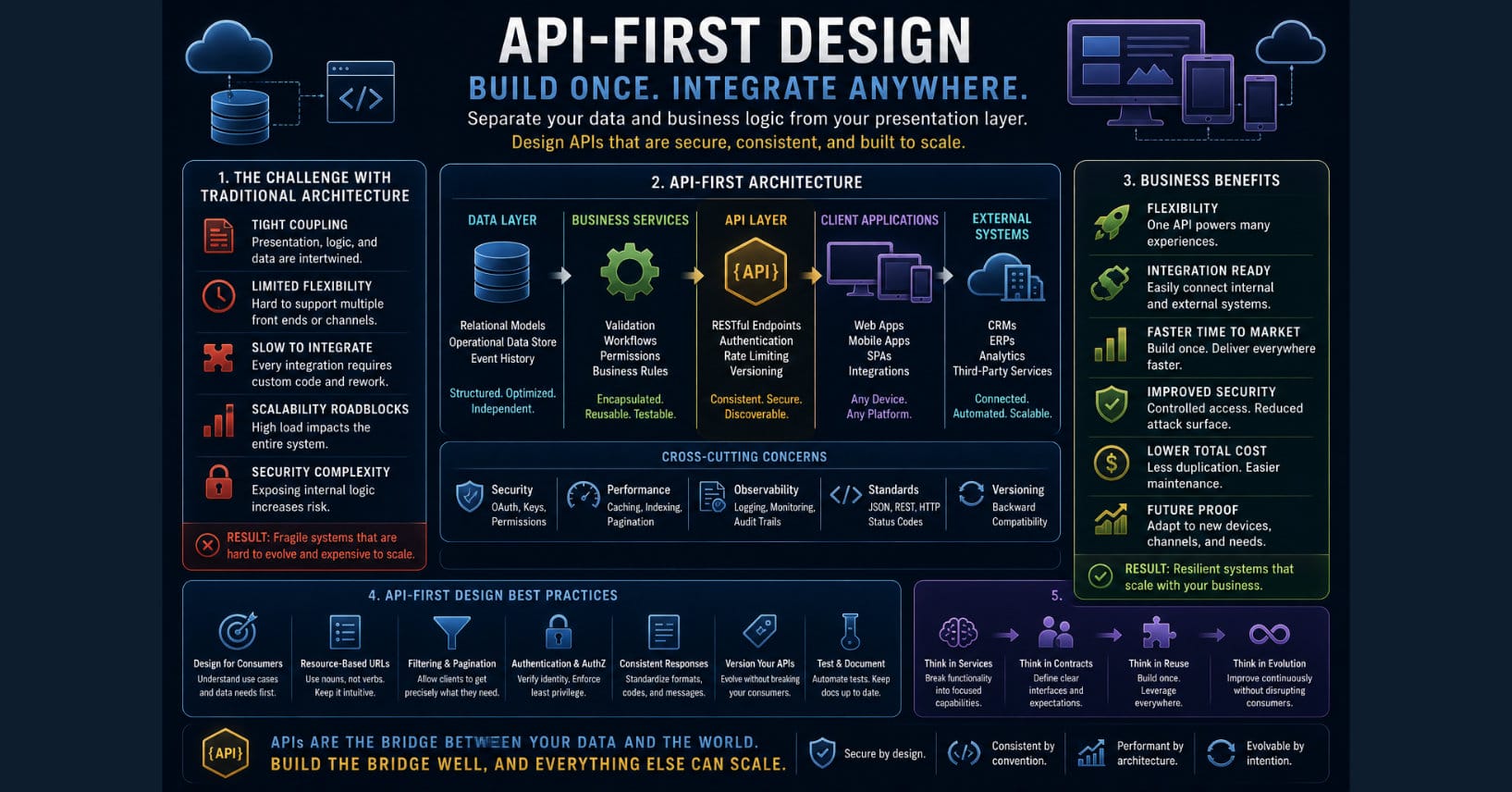
Enterprise WordPress Series—Article 6
Modern enterprise applications are no longer built around web pages—they’re built around services. This article explains why API-first design is a foundational enterprise architecture pattern and how WordPress and Formidable Forms can become the backbone of reusable business services consumed by websites, mobile applications, AI assistants, dashboards, and third-party integrations.
Traditional WordPress development usually begins with a page.
A client requests a dashboard.
A developer builds a View.
The data is assembled specifically for that screen.
Then someone asks for a mobile app.
Another API.
A customer portal.
Another API.
An executive dashboard.
Another API.
Eventually the application contains multiple versions of the same business logic, each designed for a different user interface.
Enterprise architects reverse the process.
They design the APIs first.
Pages become one of many consumers.
Executive Brief
API-first design begins by defining the business information an application exposes rather than the pages that display it.
Instead of building interfaces around database tables, enterprise architects build reusable services around business objects.
Websites, dashboards, mobile applications, reporting tools, integrations, and artificial intelligence all consume the same API contracts.
The result is greater consistency, easier maintenance, and dramatically improved scalability.
The Page-Centric Mindset
Traditional development asks:
“What should this page display?”
Every new page creates another custom query.
Another business rule.
Another transformation.
Another maintenance responsibility.
As applications grow, identical logic appears throughout the system.
The architecture slowly becomes coupled to presentation.
Thinking Like a Service
API-first development asks a different question.
“What information should this application expose?”
Instead of designing pages, developers design services.
Examples include:
- Current Assessments
- Active Risks
- Asset Inventory
- Compliance Status
- Incident Timeline
- Executive Metrics
- Vendor Portfolio
Each becomes a reusable business capability rather than a page-specific implementation.
APIs Become the Product
One of the defining characteristics of modern enterprise architecture is recognizing that the API—not the website—is the primary product.
The website is simply one client.
Tomorrow another consumer may appear:
- Mobile applications
- Customer portals
- Internal dashboards
- Reporting platforms
- AI assistants
- Workflow engines
- Third-party integrations
Every consumer receives information through the same interface.
Consistency follows naturally.
Why WordPress Fits This Model
Many developers underestimate WordPress’s REST capabilities.
Combined with custom endpoints, authentication, permissions, and structured business data, WordPress becomes an effective API platform.
Formidable Forms provides structured data collection.
Relational models organize business entities.
Database Views simplify reporting.
Operational Data Stores optimize consumption.
Event sourcing preserves business history.
REST APIs expose all of it.
Each architectural layer builds upon the previous one.
Designing Business Contracts
Enterprise APIs should expose business language rather than database structures.
Instead of returning:
Entry ID
Field 17
Meta Value
Applications should return:
Assessment
Risk Score
Department
Owner
Status
Evidence Count
The API becomes understandable without knowledge of the underlying database.
Business terminology replaces implementation details.
APIs Simplify User Interfaces
Imagine supporting:
- Executive dashboard
- Analyst workspace
- Mobile application
- Customer portal
- External integration
Without APIs, each interface assembles data independently.
With API-first architecture, each consumes identical business services.
Presentation changes.
Business logic does not.
Supporting Artificial Intelligence
One of the most important reasons to adopt API-first design has emerged only recently.
Artificial intelligence.
Large language models perform best when consuming well-defined, structured information.
An API exposing business entities provides a far stronger integration surface than HTML pages designed for human readers.
Organizations preparing for AI adoption are increasingly preparing their APIs first.
Versioning Becomes Predictable
Applications evolve.
Business requirements change.
API contracts make those changes manageable.
Versioning allows developers to introduce new capabilities without disrupting existing consumers.
Pages may be redesigned entirely while the underlying services remain stable.
This separation dramatically reduces long-term maintenance costs.
Security Improves
API-first architecture also improves security.
Rather than exposing unrestricted database access, applications publish carefully designed endpoints.
Each endpoint defines:
- Available information
- Authorization requirements
- Validation rules
- Business permissions
Consumers receive only the information necessary to perform their work.
This aligns naturally with enterprise security principles.
Formidable Forms as an API Platform
Many developers view Formidable Forms as a data collection tool.
Enterprise developers recognize it as the front end of an API ecosystem.
Every form submission becomes structured business information.
That information flows through relational models, operational data stores, event streams, and finally into reusable API endpoints consumed throughout the enterprise.
The form is simply where the journey begins.
Preparing for Headless Architecture
Once APIs become the primary interface, something interesting happens.
Pages no longer need to live inside WordPress.
Any front end capable of consuming HTTP services can become the user experience.
React.
Vue.
Angular.
Native mobile applications.
Desktop software.
Even another WordPress installation.
The API remains constant.
Only the presentation changes.
This architectural separation forms the foundation of headless WordPress.
We’ll examine that approach in the next article.
Enterprise Takeaway
Enterprise developers eventually stop asking how to build another page.
They ask how to expose another business capability.
API-first architecture transforms WordPress from a website platform into an enterprise service platform whose business logic can be consumed by any application, on any device, today and well into the future.