Enterprise WordPress Series—Article 2
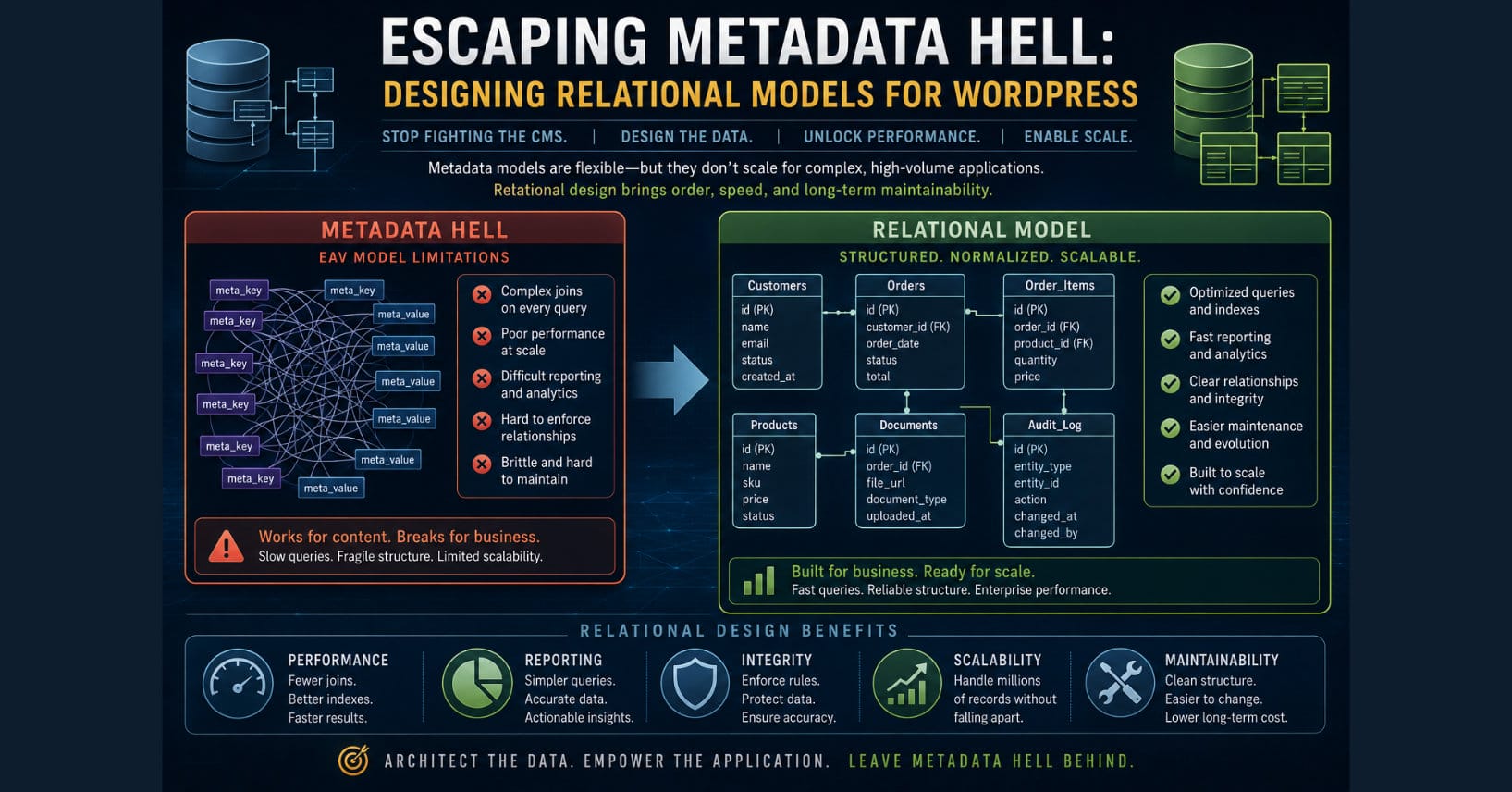
WordPress metadata provides exceptional flexibility, but enterprise applications eventually require a different architectural approach. This article explains when metadata is the right solution, when relational database models become necessary, and how hybrid architectures deliver scalable, high-performance WordPress applications.
One of WordPress’s greatest strengths is also one of its greatest architectural compromises.
Metadata.
It is extraordinarily flexible. Developers can attach virtually any piece of information to almost any object without changing the database schema. That flexibility helped WordPress become the world’s most popular content management system.
But flexibility comes with a cost.
As applications grow in complexity, metadata often becomes the bottleneck—not because WordPress is poorly designed, but because metadata solves a different class of problem than relational databases were created to solve.
Understanding that distinction is one of the defining characteristics of an enterprise WordPress developer.
Executive Brief
Metadata is an exceptional solution for managing flexible content.
It is rarely the optimal solution for highly relational business data.
Enterprise architects recognize when metadata should remain the system of record and when relational models should augment it to improve performance, reporting, scalability, and maintainability.
The goal is not to replace WordPress.
The goal is to let each technology do what it does best.
Why Metadata Exists
Imagine WordPress had to add new database columns every time a plugin introduced a custom field.
Plugin compatibility would collapse overnight.
Instead, WordPress stores custom information in metadata tables.
A typical metadata record contains:
- Parent object
- Metadata key
- Metadata value
This simple structure provides almost unlimited extensibility.
For websites, blogs, marketing pages, documentation, and many business applications, it works remarkably well.
When Metadata Begins to Break Down
Enterprise applications ask different questions.
Not:
“What is this customer’s phone number?”
Instead:
- Show every customer assigned to Project Alpha.
- Calculate open risks by department.
- List overdue assessments by region.
- Aggregate findings by business unit.
- Produce executive dashboards in real time.
- Generate audit evidence across multiple business processes.
These are relational questions.
Unfortunately, answering them often requires joining the metadata table repeatedly.
One filter becomes one join.
Five filters become five joins.
Twenty filters become twenty joins.
As datasets grow into hundreds of thousands—or millions—of records, query complexity increases dramatically.
The problem is no longer storage.
The problem is retrieval.
Metadata Is Not the Enemy
Many developers blame WordPress.
They shouldn’t.
Metadata is solving exactly the problem it was designed to solve.
Flexible storage.
The mistake occurs when developers ask metadata to behave like a normalized relational database.
That was never its purpose.
Think Like a Database Architect
Enterprise architects start with relationships.
Instead of asking:
“What fields do I need?”
They ask:
“What entities exist?”
For example, a governance application may contain:
- Organizations
- Departments
- Systems
- Assets
- Risks
- Controls
- Assessments
- Findings
- Evidence
- Users
Each represents a business entity.
Each has relationships to other entities.
Those relationships deserve first-class treatment rather than being buried inside metadata values.
Designing Relational Models
A relational model begins with identifying the core entities and defining how they relate to one another.
For example:
An organization has many departments.
A department owns many systems.
A system contains many assets.
Assets participate in assessments.
Assessments generate findings.
Findings require evidence.
Evidence supports governance decisions.
This structure reflects the business itself rather than the mechanics of WordPress storage.
Once the data model mirrors reality, reporting becomes dramatically simpler.
Let WordPress Remain WordPress
A common misconception is that adopting relational models means abandoning WordPress.
Quite the opposite.
WordPress continues providing:
- Authentication
- Authorization
- Administration
- Content management
- REST APIs
- Plugin ecosystem
- Media management
- User experience
The relational model simply becomes another data source optimized for operational workloads.
Each component performs the task it was designed to perform.
Hybrid Architecture
Most successful enterprise WordPress systems are hybrids.
Metadata remains ideal for:
- Configuration
- User preferences
- Dynamic settings
- Flexible content
- Plugin compatibility
Relational databases become ideal for:
- Reporting
- Dashboards
- Analytics
- High-volume transactions
- Operational systems
- Complex business relationships
This approach avoids unnecessary compromises while preserving compatibility with the broader WordPress ecosystem.
Formidable Forms Makes This Practical
Formidable Forms accelerates enterprise application development because it captures structured business data without requiring developers to build every interface from scratch.
However, as applications mature, developers often discover that certain reporting requirements exceed what metadata-based queries can efficiently deliver.
That realization is not a limitation of Formidable Forms.
It is a signal that the application has reached enterprise scale.
The answer is not abandoning Formidable.
The answer is introducing relational thinking.
A Real-World Example
Imagine a cybersecurity governance platform containing:
- 50 organizations
- 600 departments
- 12,000 assets
- 40,000 controls
- 250,000 assessments
- 2 million evidence records
Attempting to generate executive dashboards using increasingly complex metadata joins becomes executionally expensive.
Instead, an enterprise architecture may maintain relational reporting tables or an operational data store designed specifically for analytical workloads.
WordPress continues collecting data.
The relational model delivers insight.
Looking Ahead
Designing relational models is only the beginning.
The next challenge is deciding how WordPress should consume those models.
Should applications query the relational tables directly?
Should SQL Views provide abstraction?
Should operational data stores power dashboards?
These architectural decisions determine whether enterprise WordPress applications remain performant as they continue to grow.
We’ll explore those questions in the next article.
Enterprise Takeaway
Enterprise WordPress development is not about replacing metadata.
It is about recognizing when metadata has accomplished its purpose and allowing relational database design to solve the problems it was built to solve.
The best enterprise applications are not built by choosing one architecture over another.
They are built by combining both intelligently.