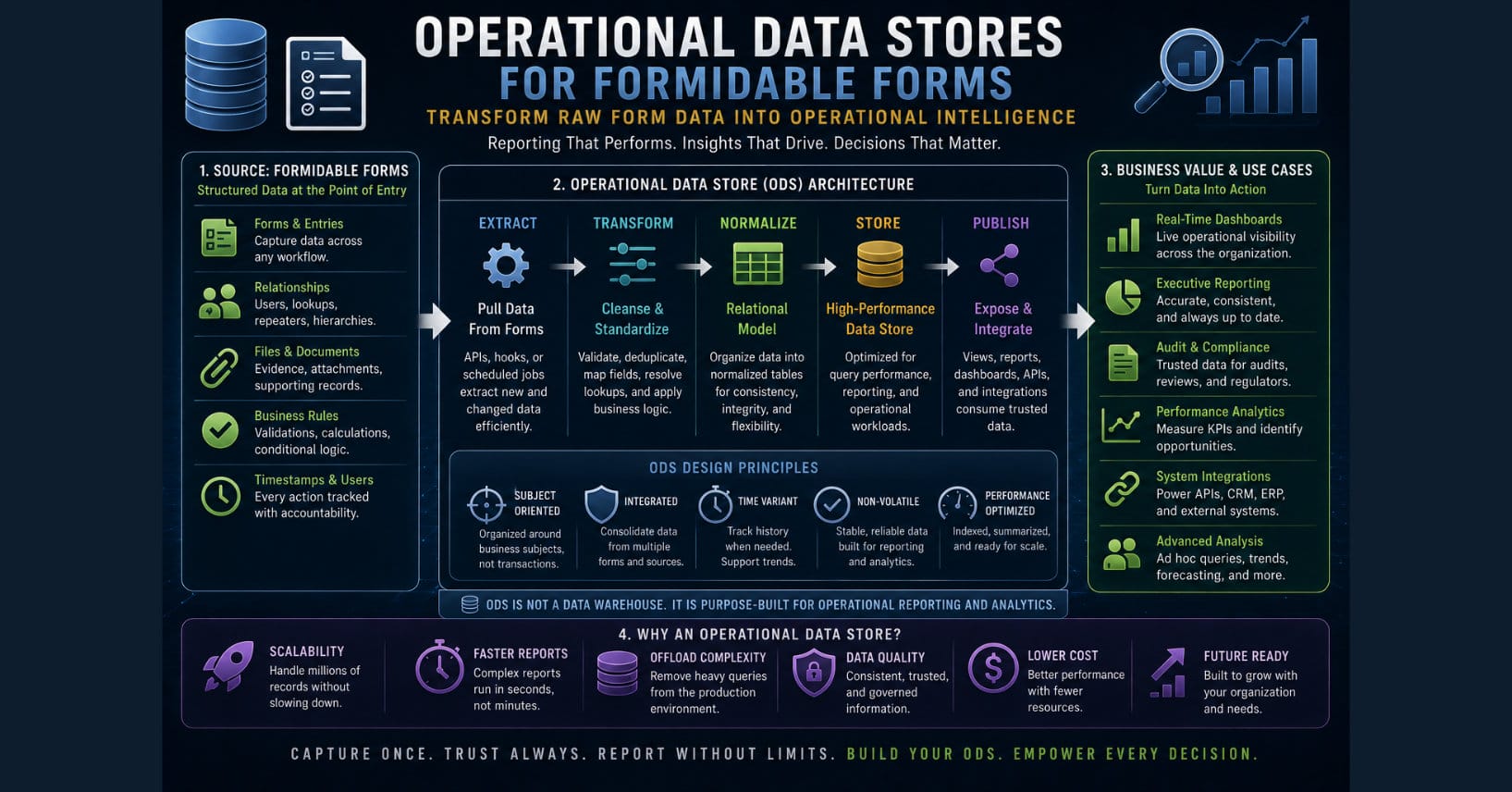
Enterprise WordPress Series—Article 4
Enterprise applications eventually separate operational processing from reporting. This article introduces the Operational Data Store (ODS), explaining how enterprise WordPress and Formidable Forms applications can improve dashboard performance, simplify APIs, and scale reporting without burdening production systems.
As enterprise WordPress applications mature, a subtle architectural shift begins to occur.
The application is no longer struggling because data collection has become difficult.
It struggles because reporting has become expensive.
Every executive dashboard.
Every operational report.
Every analytics page.
Every API endpoint.
Each one asks the operational database increasingly complex questions.
Eventually, the database spends more time answering questions than supporting the business process that created the data.
Enterprise architects solved this problem decades ago.
They called the solution an Operational Data Store.
Executive Brief
An Operational Data Store (ODS) is a reporting database optimized for operational decision-making.
Unlike a data warehouse, which stores historical analytical information, an ODS maintains current operational data in a structure optimized for dashboards, reporting, APIs, and business intelligence.
For enterprise Formidable Forms applications, an ODS allows WordPress to continue collecting data efficiently while providing a dedicated platform for consuming it.
What Is an Operational Data Store?
Think of an ODS as a second representation of your application’s data.
The operational system remains responsible for:
- Data entry
- Validation
- Workflow
- Business transactions
- User interactions
The ODS becomes responsible for:
- Executive dashboards
- Operational reporting
- Cross-functional analytics
- Search optimization
- API consumption
- Management reporting
Instead of forcing one database structure to satisfy every workload, each environment is optimized for its specific purpose.
Why Enterprise Applications Need One
Every enterprise application eventually develops two very different personalities.
The first supports operations.
Users submit forms.
Managers approve requests.
Employees update records.
Customers interact with the system.
The second supports decision-making.
Executives ask questions.
Auditors request reports.
Managers monitor trends.
Leadership measures performance.
Although both workloads rely on the same information, they have dramatically different access patterns.
An ODS recognizes this distinction.
Formidable Forms as the Operational System
Formidable Forms excels at capturing structured business information.
Applications may include:
- Incident reports
- Assessments
- Asset inventories
- Customer records
- Risk evaluations
- Compliance reviews
- Case management
- Workflow approvals
Each interaction writes operational data.
That operational system should remain responsive regardless of how many executives are viewing dashboards.
An ODS helps make that possible.
Building the ODS
The ODS does not replace WordPress.
It complements it.
Information flows from Formidable Forms into a relational reporting model designed specifically for consumption.
Depending on business requirements, synchronization may occur:
- Immediately after submission
- Through scheduled jobs
- Using background workers
- Via event-driven architecture
Each approach balances freshness with scalability.
The key principle remains the same.
Users continue interacting with WordPress.
Reporting shifts elsewhere.
Why Not Query the Operational Database?
Many organizations attempt to answer every business question directly from production tables.
Initially, this works.
As complexity grows, problems emerge.
Large reports compete with user activity.
Dashboards execute expensive joins.
Executives refresh reports every few minutes.
APIs repeatedly calculate identical metrics.
Performance begins to fluctuate.
The operational system becomes unpredictable.
An ODS isolates these workloads.
More Than Performance
Performance usually motivates the conversation.
Maintainability justifies the architecture.
An ODS allows developers to organize information according to business concepts rather than storage mechanics.
For example:
Instead of reconstructing relationships across multiple forms, the ODS may expose:
- Current Asset Inventory
- Active Risk Register
- Compliance Scorecard
- Outstanding Findings
- Vendor Status
- Executive Metrics
- Incident Summary
Each becomes a stable reporting object consumed consistently throughout the application.
Supporting Executive Dashboards
Executive dashboards rarely require every transaction.
They require summaries.
Current counts.
Trend indicators.
Calculated metrics.
Key performance indicators.
An ODS prepares this information before the dashboard requests it.
Pages load faster.
Queries become simpler.
Infrastructure scales more predictably.
APIs Become Simpler
Enterprise APIs benefit as much as dashboards.
Rather than assembling information from numerous operational tables, APIs retrieve already-organized business objects.
Consumers receive consistent responses.
Application code becomes dramatically smaller.
Versioning becomes easier.
Documentation improves because every endpoint references well-defined operational entities.
Formidable Views Become Faster
One of the overlooked advantages of an ODS is its relationship with Formidable Views.
Views perform exceptionally well when consuming datasets already optimized for presentation.
Instead of reconstructing numerous relationships through increasingly complex queries, a View simply renders information prepared by the reporting layer.
WordPress continues doing what it does best.
The ODS does the same.
Preparing for Enterprise Scale
Organizations rarely begin with millions of records.
They grow into them.
The architectural decisions made early determine whether growth becomes exciting or painful.
Building an ODS before performance becomes a crisis provides several advantages:
- Predictable reporting
- Simpler maintenance
- Faster dashboards
- Cleaner APIs
- Better scalability
- Reduced production load
- Clear separation of responsibilities
Most importantly, it allows developers to think in terms of business information instead of database mechanics.
Looking Ahead
Once information has been organized into an operational reporting layer, an interesting opportunity emerges.
Applications can begin treating business events themselves as valuable data.
Instead of asking only, “What does the database look like today?”
Enterprise architects begin asking:
“What happened?”
“When did it happen?”
“Who performed the action?”
“What changed?”
Answering those questions leads directly into one of the most powerful architectural patterns in modern enterprise software.
Event sourcing.
We’ll explore that concept in the next article.
Enterprise Takeaway
Operational Data Stores represent a shift in architectural thinking.
Rather than asking one database structure to satisfy every workload, enterprise developers separate operational processing from operational intelligence.
Formidable Forms continues capturing business transactions.
The Operational Data Store transforms those transactions into actionable information.
That distinction is one of the defining characteristics of enterprise-scale WordPress architecture.