Enterprise Software Engineering Series—Article 4
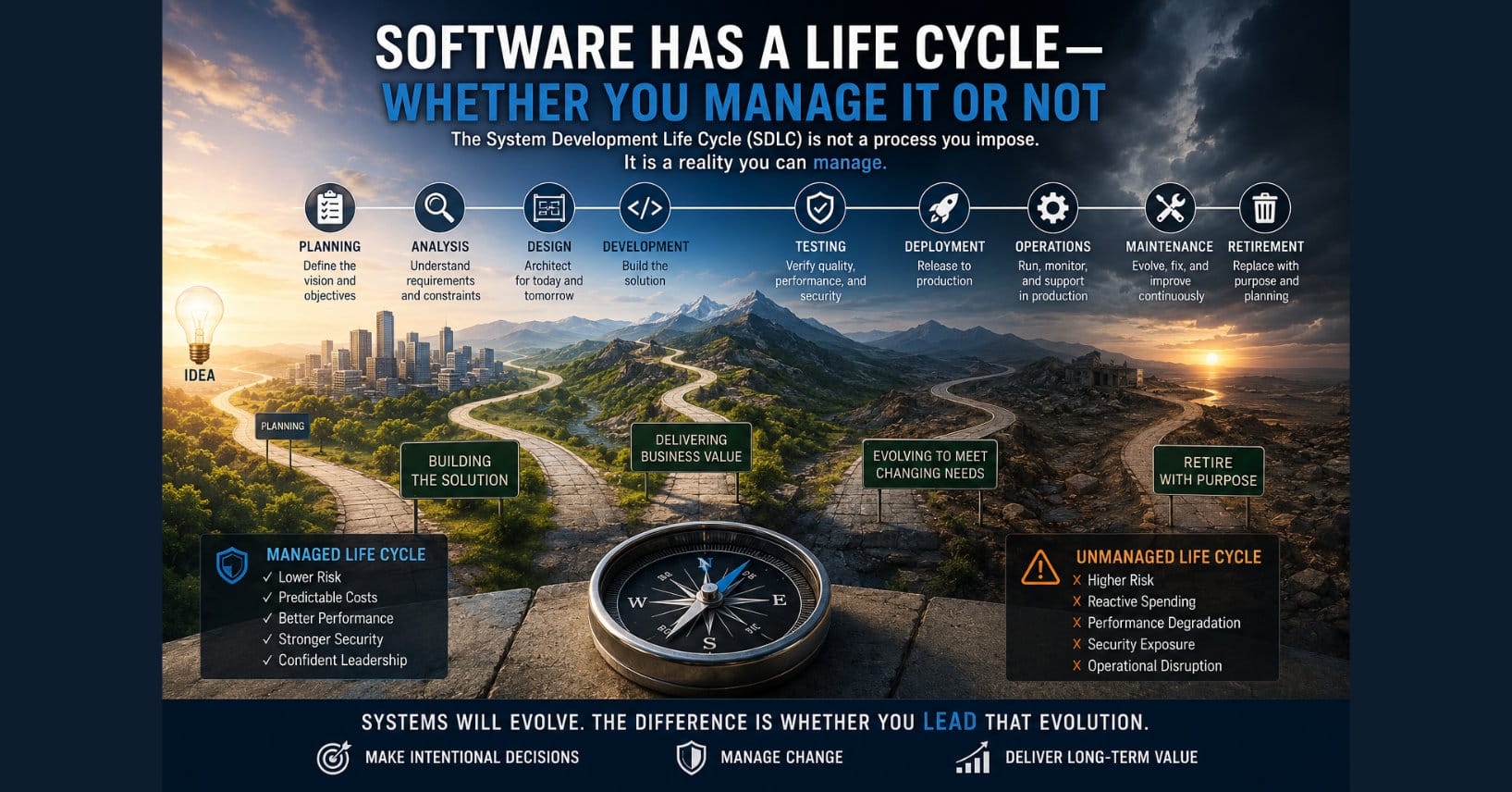
Many organizations treat the System Development Life Cycle (SDLC) as a project management methodology, but it is better understood as a framework that describes the natural evolution of every enterprise system. From planning and development through operations, maintenance, modernization, and retirement, every system progresses through predictable stages. This article explains why organizations that intentionally manage the SDLC make better engineering decisions, reduce technical risk, and extend the value of their technology investments.
Executive Perspective
Every business system follows a predictable life cycle.
It begins as an idea, grows into a solution, matures into critical infrastructure, gradually accumulates complexity, and eventually reaches the point where modernization or replacement becomes unavoidable.
Whether an organization formally adopts the System Development Life Cycle (SDLC) or not, this progression still occurs.
The difference is simple.
Organizations that actively manage the life cycle make intentional decisions.
Organizations that ignore it make reactive ones.
The SDLC is often presented as a development methodology. In reality, it is something far more important.
It is a framework for managing change throughout the life of an enterprise system.
The SDLC Describes Reality
Many people mistakenly believe the SDLC is a process invented by software engineers.
It isn’t.
The SDLC simply describes what naturally happens to every business system.
Every successful system experiences:
- Planning
- Analysis
- Design
- Development
- Testing
- Deployment
- Operations
- Maintenance
- Modernization
- Retirement
These stages occur regardless of methodology.
Agile.
Waterfall.
Hybrid.
DevOps.
Continuous Delivery.
The names may change.
The life cycle does not.
Ignoring a stage does not eliminate it.
It merely postpones its consequences.
Software Begins Aging on Day One
One of the greatest misconceptions in software development is that deployment represents completion.
From an engineering perspective, deployment represents the beginning of operational life.
The moment software enters production, it begins aging.
Business rules evolve.
Regulations change.
Security threats emerge.
Infrastructure changes.
Developers leave.
Customer expectations increase.
Every production system gradually drifts away from the assumptions made during its original design.
Engineering exists to manage that change rather than resist it.
Every Shortcut Becomes Tomorrow’s Work
Projects often operate under intense schedule pressure.
Deadlines approach.
Budgets tighten.
Stakeholders demand additional functionality.
Under these conditions, shortcuts become tempting.
Documentation can wait.
Testing can wait.
Refactoring can wait.
Architecture improvements can wait.
Sometimes those decisions are appropriate.
Often they are not.
The important lesson is this:
Nothing actually disappears.
Every shortcut becomes future work.
The SDLC simply determines whether organizations pay those costs intentionally or unexpectedly.
Maintenance Is Not Failure
Many executives assume maintenance represents a sign that something has gone wrong.
In reality, maintenance is evidence that software remains valuable.
Organizations maintain systems because they continue solving important business problems.
The objective is not to eliminate maintenance.
The objective is to reduce the cost of maintenance through thoughtful engineering.
Well-designed systems are easier to modify.
Well-documented systems are easier to understand.
Well-architected systems are easier to secure.
Good engineering does not eliminate maintenance.
It makes maintenance sustainable.
The Longest Phase Is Operations
Development projects often receive the greatest attention because they are visible.
Operations receive far less attention despite lasting far longer.
Many enterprise applications remain operational for ten, fifteen, or even twenty years.
During that time they require:
- Performance monitoring
- Security updates
- Infrastructure upgrades
- Data growth management
- Regulatory compliance
- Incident response
- User support
- Feature enhancements
The operational phase usually consumes more time and resources than the original development effort.
Enterprise engineering recognizes this reality.
Systems should be designed primarily for the years after deployment—not merely for the months before it.
Retirement Is Part of Engineering
Few organizations enjoy replacing successful systems.
Legacy applications often become deeply integrated into daily operations.
Eventually, however, every system reaches the point where replacement becomes less expensive than continued maintenance.
Unfortunately, retirement planning is rarely discussed during initial design.
As a result, organizations face difficult migrations involving:
- Undocumented business rules
- Obsolete technologies
- Data conversion challenges
- Hidden dependencies
- Operational disruption
Engineering includes planning for the end of a system’s life as carefully as planning for its beginning.
Every system should be designed with an exit strategy.
The SDLC Is About Decision Quality
Many discussions surrounding the SDLC focus on documentation, approvals, or governance processes.
Those activities have value.
They are not the purpose.
The purpose of the SDLC is improving the quality of engineering decisions.
At every stage of a project’s life, important questions should be answered deliberately.
Have business requirements been understood?
Has architectural risk been evaluated?
Can quality be demonstrated?
Can operations support the solution?
Can future engineers maintain it?
Can leadership understand its business value?
The SDLC provides opportunities to answer these questions before they become expensive problems.
Enterprise Engineering Is Continuous
Modern engineering organizations no longer think of development as a sequence of isolated projects.
They think in terms of continuous system stewardship.
Every enhancement.
Every security update.
Every performance improvement.
Every architectural refinement.
Every operational lesson.
All become part of the ongoing evolution of the system.
The project may end.
The engineering responsibility does not.
Looking Ahead
If every system naturally progresses through a life cycle, then its long-term success depends on the quality of the decisions made before development begins.
Those decisions originate with requirements.
The next article explores why requirements often fail long before developers write the first line of code—and why poorly defined requirements remain one of the most expensive risks in enterprise software engineering.
Engineering Principle
Organizations do not choose whether their systems have a life cycle. They choose whether that life cycle is managed intentionally or reactively.