Enterprise Software Engineering Series—Article 2
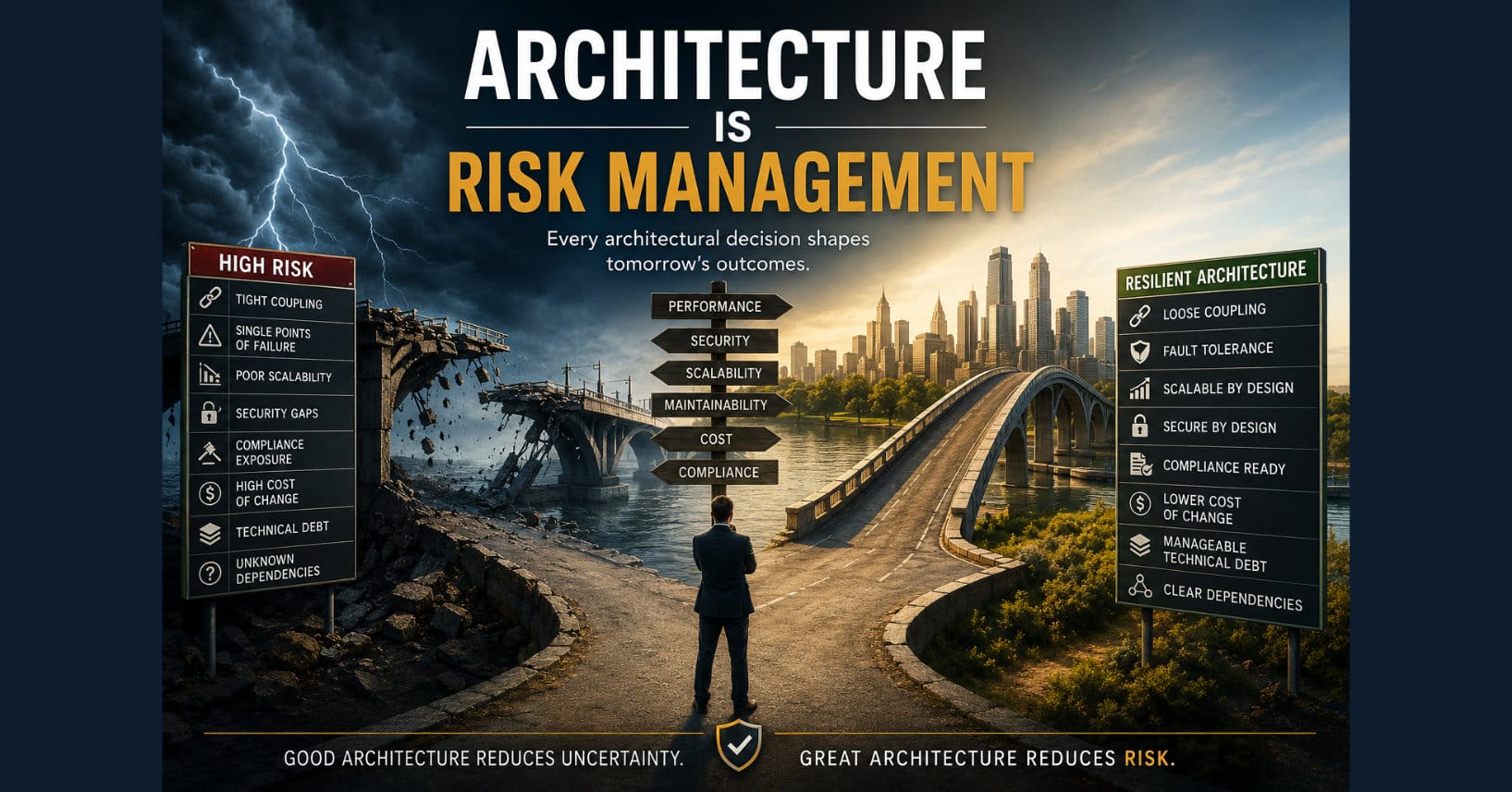
Software architecture is often viewed as a technical discipline, but its true purpose is to reduce organizational risk. Every decision—from data models and integrations to security boundaries and system design—affects an organization’s ability to adapt, recover, and grow. This article explains why architecture is fundamentally about managing operational, financial, security, compliance, and knowledge risks, and why successful architects design systems that reduce the cost of future change rather than simply solving today’s problems.
Executive Perspective
Architecture is often portrayed as a technical discipline concerned with selecting frameworks, defining system boundaries, or drawing diagrams. While those activities are certainly part of an architect’s responsibilities, they are not the primary purpose of architecture.
The true purpose of software architecture is to reduce organizational risk.
Every architectural decision influences the organization’s future ability to operate, adapt, recover, secure its information, and continue delivering value. Long after programming languages evolve and technology stacks become obsolete, the consequences of architectural decisions remain.
Organizations frequently measure architecture by the sophistication of the technologies involved. Mature organizations measure architecture by something entirely different:
How much uncertainty did it eliminate?
That question shifts architecture from an engineering exercise to a business discipline.
Every Decision Has a Future Cost
Architecture is unique because most of its value is realized in the future.
When an architect chooses a database model, integration strategy, authentication approach, or deployment pattern, very little immediate benefit may be visible. The software still functions. Users complete their tasks. Business continues as usual.
Months or years later, however, those same decisions determine whether the organization can:
- Scale without rewriting the application.
- Respond quickly to changing business requirements.
- Recover from security incidents.
- Integrate new systems.
- Demonstrate regulatory compliance.
- Support growing transaction volumes.
- Replace aging technology without disrupting operations.
Architecture delays consequences.
Good architecture postpones unnecessary risk.
Poor architecture postpones unpleasant surprises.
Risk Exists in Many Forms
When people hear the word risk, they often think only about cybersecurity.
Enterprise architects must think much more broadly.
Operational Risk
Can the business continue functioning if individual components fail?
Single points of failure, fragile integrations, and tightly coupled systems increase operational risk because one failure can cascade throughout the organization.
Resilient architecture assumes failures will occur and plans accordingly.
Financial Risk
Technology decisions carry financial consequences long after implementation.
An architecture that requires extensive manual intervention, costly infrastructure expansion, or complete redesign every few years becomes increasingly expensive to own.
Architectural sustainability is financial sustainability.
Security Risk
Security is rarely solved by adding another security product.
Most security failures originate in architectural decisions made long before vulnerabilities are discovered.
Poor trust boundaries.
Excessive privileges.
Weak data segregation.
Uncontrolled integrations.
Security should emerge naturally from sound architecture rather than being bolted on after deployment.
Compliance Risk
Organizations operating in regulated industries must demonstrate how information is collected, stored, protected, retained, and audited.
Architecture determines whether compliance becomes routine documentation or an expensive annual exercise.
Systems that preserve evidence naturally reduce compliance risk.
Knowledge Risk
Every organization eventually loses employees.
The question is whether critical knowledge disappears with them.
Architectures that depend upon undocumented assumptions or individual expertise become increasingly fragile as personnel change.
Documentation, standards, and consistent design reduce organizational dependence on individual developers.
Architecture Is About Reducing Uncertainty
One way to evaluate architecture is by asking a simple question:
What uncertainties remain after this design is implemented?
Consider several examples.
Will the application support ten times today’s users?
Will new business rules require rewriting major components?
Can another development team understand the system?
Will integrations survive future platform upgrades?
Can historical transactions be reconstructed during an investigation?
Architecture attempts to answer these questions before development begins.
The earlier uncertainty is removed, the less expensive change becomes.
The Cost of Architectural Drift
Architecture is not a one-time deliverable.
Every software system changes.
Features are added.
Deadlines compress.
Teams expand.
Business priorities evolve.
Over time, systems begin drifting away from their original architectural vision.
This phenomenon—architectural drift—is one of the primary causes of increasing maintenance costs.
Individually, each shortcut appears reasonable.
Collectively, they create systems that become:
- Difficult to understand.
- Expensive to modify.
- Challenging to secure.
- Increasingly unreliable.
Architecture should evolve intentionally.
Without intentional stewardship, every system eventually accumulates structural debt.
Designing for the Unknown
Perhaps the greatest misconception about architecture is that architects should predict the future.
They cannot.
Technology changes too quickly.
Business changes too quickly.
Markets change too quickly.
Good architects do not predict the future.
They reduce the cost of adapting to it.
Loose coupling.
Stable interfaces.
Clear module boundaries.
Documented business rules.
These characteristics do not eliminate uncertainty.
They reduce the organizational cost of responding to uncertainty.
Architecture Supports Governance
Enterprise architecture provides more than technical direction.
It creates organizational discipline.
Well-defined architecture establishes:
- Standard design patterns.
- Consistent security models.
- Approved integration approaches.
- Shared data definitions.
- Operational expectations.
- Engineering standards.
These architectural constraints allow multiple teams to build independently without creating unnecessary inconsistency.
Governance without architecture becomes policy.
Architecture without governance becomes suggestion.
Enterprise engineering requires both.
Measuring Architectural Success
Architecture should not be evaluated by the complexity of its diagrams or the novelty of its technologies.
Instead, ask questions such as:
- Can new developers become productive quickly?
- Can business requirements evolve without rewriting major systems?
- Can incidents be investigated efficiently?
- Can the organization recover from failure?
- Can systems integrate predictably?
- Can technical debt be managed intentionally?
- Can leadership make informed technology decisions?
If the answer to these questions is consistently yes, the architecture is succeeding—even if users never notice it.
That may be the greatest compliment an architecture can receive.
Successful architecture quietly enables organizational success.
Looking Ahead
If architecture exists to reduce future organizational risk, then every engineering activity should support that objective.
The next article examines one of the most important distinctions in enterprise software engineering: the difference between writing code and engineering systems.
Organizations do not succeed because they produce more code.
They succeed because they engineer systems that continue delivering value long after the original developers have moved on.
Engineering Principle
Every architectural decision either reduces future organizational risk or transfers that risk into the future with interest.