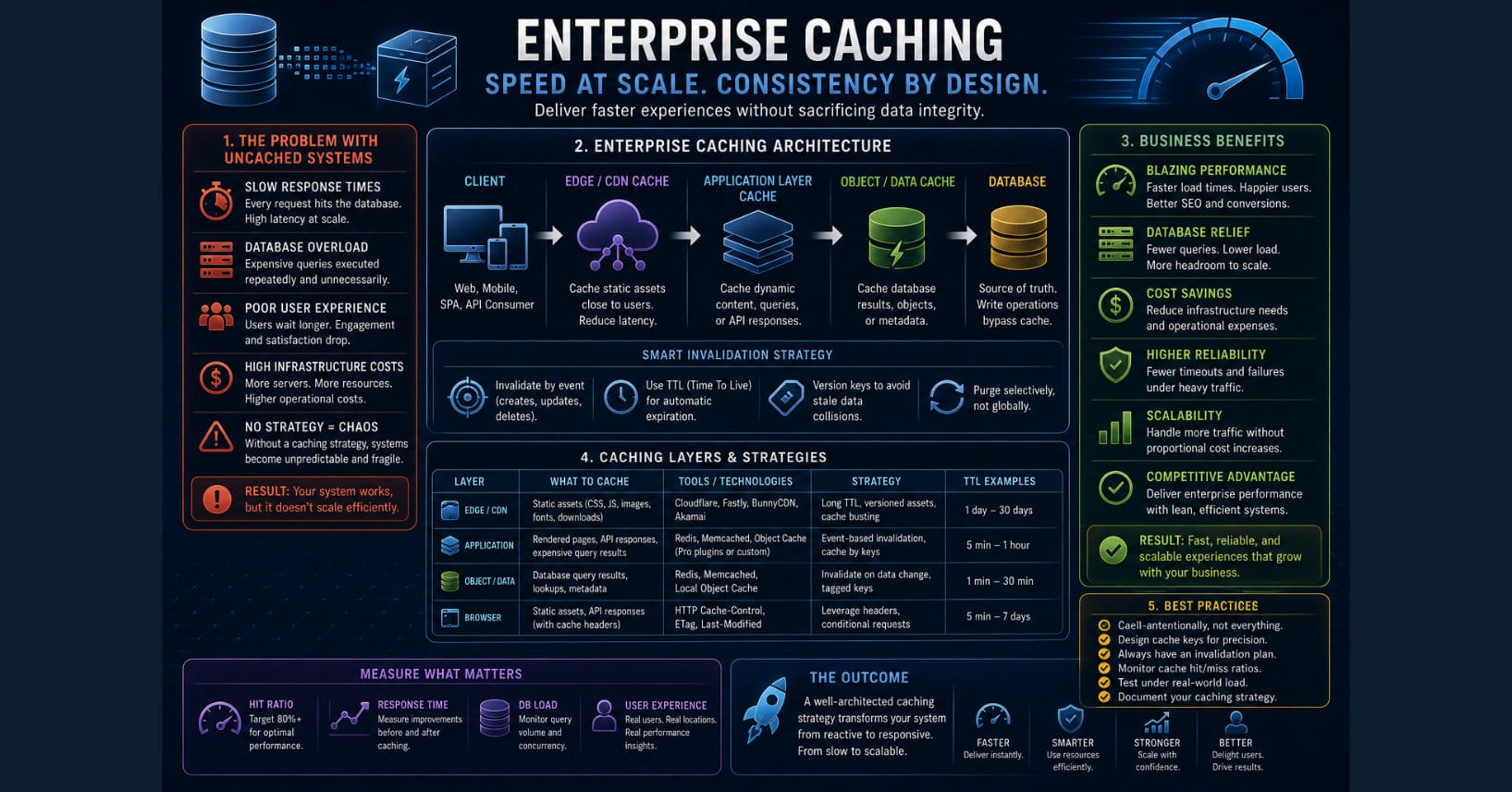
Enterprise WordPress Series—Article 8
Enterprise caching extends far beyond page cache plugins. This article explores a multi-layer caching strategy that includes browser, edge, page, object, query, and business caching to improve scalability, reduce unnecessary computation, and deliver predictable performance for enterprise WordPress applications.
Mention caching in a WordPress discussion and the conversation usually turns to plugins.
Page caching.
Browser caching.
Image optimization.
Content delivery networks.
All are valuable.
None represent the complete picture.
Enterprise applications rarely rely on a single cache.
They employ multiple caching layers, each solving a different architectural problem.
Understanding those layers is one of the defining characteristics of enterprise application design.
Executive Brief
Caching is not a feature.
It is an architectural strategy.
Enterprise WordPress applications use multiple caching techniques to reduce latency, improve scalability, isolate workloads, and deliver consistent performance across dashboards, APIs, mobile applications, and reporting systems.
The objective is not simply faster pages.
The objective is fewer unnecessary computations.
Why Applications Become Slow
Developers often assume slow applications have slow databases.
More commonly, they have repetitive work.
Consider an executive dashboard.
Every refresh may calculate:
- Open risks
- Compliance scores
- Department metrics
- Assessment counts
- Historical trends
- Vendor status
- Evidence summaries
If those calculations occur every request, performance declines as users increase.
Caching reduces repetition.
Enterprise Thinking
Instead of asking:
“How can we make this page faster?”
Enterprise architects ask:
“Why are we performing this calculation repeatedly?”
That question changes the solution.
Often the answer is:
We shouldn’t.
Layer One: Browser Caching
The first layer lives closest to the user.
Browsers cache:
- Images
- JavaScript
- CSS
- Fonts
- Static assets
These resources rarely change.
Downloading them repeatedly wastes bandwidth and increases latency.
This layer improves user experience without affecting application logic.
Layer Two: Edge Caching
Content Delivery Networks cache resources geographically.
Static content is delivered from locations close to users.
Enterprise organizations serving global audiences depend heavily upon this layer.
Application servers perform less work.
Users receive faster responses.
Layer Three: Page Caching
Traditional WordPress sites benefit greatly from page caching.
Entire HTML pages are stored and served without executing PHP.
Marketing websites often achieve exceptional performance this way.
Enterprise applications usually cannot.
Dashboards.
Personalized portals.
Authenticated users.
Real-time information.
These require dynamic responses.
The architecture must go deeper.
Layer Four: Object Caching
Object caching stores expensive application objects in memory.
Rather than rebuilding identical objects repeatedly, applications retrieve them from high-speed memory stores.
This layer dramatically reduces database activity for frequently requested information.
For enterprise applications, object caching often provides more value than page caching.
Layer Five: Query Caching
Many reports repeatedly execute identical queries.
Executive dashboards are excellent examples.
If the underlying information changes infrequently, cached query results eliminate expensive database work.
The application retrieves prepared information rather than recalculating it.
This pairs naturally with database Views and Operational Data Stores introduced earlier in this series.
Layer Six: Business Caching
Enterprise systems often cache business concepts rather than technical objects.
Examples include:
- Compliance Score
- Current Risk Register
- Executive Metrics
- Department Summary
- Vendor Health
- Operational Dashboard
These values may require hundreds of calculations to produce.
Users simply request the completed result.
This approach shifts computation away from user interactions.
APIs Benefit Even More
Modern applications increasingly communicate through APIs.
Without caching, identical API requests repeatedly execute the same business logic.
API caching allows thousands of consumers to retrieve identical information efficiently while preserving consistent business definitions.
This becomes increasingly important as:
- Mobile applications
- AI assistants
- Dashboards
- Customer portals
- Third-party integrations
begin consuming the same services.
Event-Driven Cache Invalidation
Caching introduces a challenge.
How do we know when information becomes stale?
Enterprise systems rarely depend upon arbitrary expiration times alone.
Instead, business events trigger cache invalidation.
For example:
Assessment Approved
Vendor Updated
Evidence Added
Risk Closed
These events identify precisely which cached information requires rebuilding.
The remainder stays intact.
This minimizes unnecessary work while maintaining accurate information.
The Relationship to Operational Data Stores
Earlier we introduced Operational Data Stores.
An ODS already organizes business information for efficient reporting.
Caching complements that architecture.
The ODS minimizes query complexity.
Caching minimizes repeated execution.
Together they provide remarkably responsive applications.
Headless Applications Multiply Demand
Headless architecture changes caching requirements.
Instead of serving one website, APIs now support:
- Web applications
- Mobile devices
- Executive dashboards
- AI systems
- Internal tools
- External integrations
One business service may receive thousands of requests from numerous consumers simultaneously.
Enterprise caching absorbs that demand without repeatedly executing identical logic.
Caching Is About Predictability
One of the greatest advantages of enterprise caching is consistency.
Applications respond in predictable timeframes.
Infrastructure becomes easier to scale.
Resource utilization becomes more stable.
Users experience fewer performance spikes during periods of heavy demand.
Predictability often matters more than peak speed.
When Not to Cache
Enterprise architects also recognize when not to cache.
Highly transactional information.
Financial transactions.
Real-time workflow decisions.
Security permissions.
Authentication.
Business-critical operations requiring immediate consistency.
Architecture always balances performance against correctness.
Correctness wins.
Looking Ahead
Throughout this series we’ve progressively transformed WordPress from a content management system into an enterprise application platform.
One final challenge remains.
What happens when the application grows from thousands of records to millions?
Scaling beyond one million records requires another shift in architectural thinking.
We’ll explore that in the next article.
Enterprise Takeaway
Enterprise caching is not about making WordPress faster.
It is about eliminating unnecessary work throughout the architecture.
When every layer—from browsers to APIs to business services—caches intelligently, WordPress becomes capable of supporting enterprise workloads that extend far beyond traditional websites.
The fastest computation is often the one you never perform twice.